
Louis Meneteau
CPO of Argile
186 articles published
Louis is CPO of Argile. An engineer by training, he spent four years in systems engineering, validating calculation software and designing the trials that test it, then three years in software product. He turns the installer's daily reality into product workflows: technical survey, sizing, quotes and subsidy files, with a hard requirement on the compliance of what comes out. His articles describe field gestures rather than principles, because he watches them on site before specifying them. When one entry flips a result, he says so and explains how to decide on the spot.
Subjects covered
Their articles

On a job site, choosing between a complete pathway or step-by-step works changes everything, budget, schedule, and end results. You, the tradesperson, have an interest in deciding early, based on the state of the building, how the dwelling is used and the subsidies available. With a simple method, you secure your margins and avoid unnecessary rework.
4 min read

When a heat pump or boiler feeds several zones, flow rates quickly start fighting each other. By clearly separating production from distribution, you stabilise the circulators, make balancing easier, and avoid returns that are too cold and drag down efficiency. The result: an installation that's simpler to set up, and fewer callbacks for you.
6 min read

When a heating circuit fills up with sludge and micro-bubbles, breakdowns pile up and you lose time on callbacks. A well-sized, well-installed filtration and degassing device secures circulation, protects the pump and stabilises performance. The result: you deliver a more reliable installation, and your clients feel it from the first few days.
5 min read
In renovation, the choice of heating distribution layout changes everything: balancing between emitters, commissioning time, and room-by-room comfort. On an occupied job, one solution can limit rework and bleeding, while the other makes fine-tuning and future upgrades easier. As a tradesperson, your initial diagnosis saves hours and prevents callbacks.
5 min read

On a job site, a renovation's impact also comes down to the materials you install, not just the kWh saved. With LCA (life cycle assessment), you have a simple method to compare two solutions, settle a debate with the client, and justify your choices without getting lost in spreadsheets. It's a way to steer your quotes with more clarity, and fewer pointless arguments.
5 min read

In renovation, your choice of materials can weigh heavily in a project's overall footprint, sometimes as much as the energy used while living in the home. Between insulation, joinery, systems and finishes, you have the ability to compare, arbitrate and clearly explain to your clients what really counts. With a simple method, you secure your decisions and showcase your expertise.
4 min read

An energy performance guarantee is not a turn of phrase on a quote, it is a contract with a defined content. The French order of 24 July 2020 requires a baseline built on at least three consecutive calendar years, expressed in kWh per year and adjusted for external factors, a savings target expressed as a percentage of that baseline, and a financial penalty tied to the gap actually measured. Here are those elements, and what they change about your exposure.
5 min read

After a job, your clients want simple proof that it works. By tracking a few concrete indicators — temperature, humidity, consumption — you turn the feeling of comfort into legible results, useful for settling doubts and showcasing your work. With a lightweight method and regular readings, you quickly spot a setting that needs fixing, ventilation that's too weak, or usage that's skewing the announced savings.
5 min read

When your rooms don't reach temperature or the boiler runs too much, it's often a badly set output, not a hardware problem. By starting from room-by-room heat loss, you ground your numbers in the reality of the job, then match the emitter to the need without oversizing. The result: customers who feel the difference from the very first start-up.
5 min read

Between an EPC, a quote and the reality of the job site, you're often the one who has to decide quickly, and correctly. A well-built energy simulation helps you prioritise the right measures, estimate the gains and secure your choices before opening up a wall. Here, we're talking about a tool designed to save you time, without drowning you in technical detail.
5 min read

On the ground, limescale shows up fast. Flow rates dropping, heat exchangers scaling up, clients coming back. Between the promises of magnetic devices and the reality of a well-tuned installation, what you really need is facts, clear limits and good habits for advising clients without exposing yourself.
6 min read

On a renovation project, what saves time is a clear, step-by-step pathway, with technical choices that follow one another without ambiguity. As a tradesperson, you need a simple framework to prioritise the envelope, heating, ventilation and grants, without redoing the same calculations three times over. The idea is to move from "we'll see" to a modular plan that adapts to the home and to your way of working.
5 min read

When your clients complain about a shower that's too hot then too cold, it's often the water going down the drain during adjustment that's the real cost. In renovation, you can give them comfort right away and cut wasted litres, without touching the tank. With the right installation and settings, you also secure the temperature — a real plus in family homes.
6 min read

A rendered external wall insulation system cannot be assessed from a single environmental declaration. It takes two, one for the insulation board and one for the render system, and the producer of the second says so in writing. On declarations actually registered with INIES, 120 mm of EPS weighs 5.88 kg CO₂ eq per m² over fifty years while the render system covering it weighs 32.1. Arguing about board thickness therefore misses the main item.
5 min read

When a client mentions a small wind turbine for their house, you need to sort promise from reality fast. Available height, steady winds, neighbours, local paperwork, that's often where the project is decided, well before the quote. With a few simple benchmarks, you can frame the need, avoid bad surprises, and talk profitability without selling a dream.
5 min read
Altitude is not a comfort nuance, it is a calculation input: France's 3CL-DPE 2021 method publishes its climate data by zone H1a to H3 and by altitude band, below 400 m, 400 to 800 m, above 800 m. The performance thresholds that govern grant eligibility, on the other hand, do not move by a single metre. Here is where the line falls, and what it changes on the quote and on the programme.
5 min read

In housing, cogeneration comes down to a single trade-off: overall efficiency is excellent as long as the unit runs long hours on the base load, and it collapses the moment the unit is sized on the peak. France's order of 20 July 2016 sets the only hard boundary in the subject, a micro-cogeneration unit being one with an installed electrical output of 50 kWe or less. Here are the advantages, the counterparts, and what to check before you price it.
5 min read

Your clients want to reduce their home's impact, but they don't always know where to start. As a tradesperson, you can help them take stock, category by category, then choose the work that really matters: insulation, ventilation, heating. With a simple method and clear orders of magnitude, you save time and back up your recommendations.
5 min read

On a chiller, the heat rejected isn't wasted. Properly harnessed, it can cover a useful share of domestic hot water needs, without adding electrical power, and often with a fast payback on site when usage is regular. For you, as a tradesperson, this is a concrete solution to offer wherever cooling already runs year-round.
5 min read
The diameter of a ventilation duct is not read off the connection spigot on the unit, it is calculated from the flow rate required room by room. One division gives you the cross-section, and the rest of the sizing comes down to lengths, bends and access. What is decided on the layout cannot be recovered at commissioning.
5 min read

When a client wants fast, stable comfort without swings, you have every interest in proposing an emitter that combines a quick temperature rise with sustained gentle heat. On site, it also comes down to very concrete details — controls, thermal mass, noise, and ease of installation — the ones that avoid callbacks. With the right criteria in mind, you can steer clients towards a genuinely premium solution, suited to the room and the household's routine.
6 min read

When a client asks you "how much will it really cover?", you need a simple calculation, not vague talk. By quantifying the share of energy delivered over the year and sizing the right backup, you secure hot water comfort and size the system correctly, without overcost or unrealistic promises. The result is a clearer quote and a job that runs smoothly.
5 min read

On site, you're looking for insulation that performs well, is simple to install, and uses fewer resources. Materials derived from living organisms open up a real avenue, with a manufacturing process that looks more like cultivation than a factory. It gives you a way to offer clients a different kind of insulation — credible, but still with plenty of questions to settle before it goes mainstream.
5 min read

When a client asks you whether their boiler or heat pump "really performs," the right reflex is to look at performance over a full season, not a lab peak. This figure helps you compare generators on a reliable basis, price more accurately, and avoid bad surprises on consumption. In short, a simple benchmark to secure your technical choices and your quotes.
5 min read

In renovation, well-adjusted ventilation often makes the difference between a 'clean' project and a client complaining about odours, condensation and mould. With a solution that automatically modulates flow rates according to humidity, you save time on adjustment and secure air quality without over-ventilating. The result: healthier homes and performance that lasts.
4 min read

When a client wants to cut their hot water bill without complicating their job, solar thermal remains a solid option. As a tradesperson, what you mainly need is a reliable system that's quick to install and easy to explain, with settings that avoid callbacks. Here we get straight to the practical points to help secure your installs and your margins.
6 min read
Between new ecodesign requirements and product data sheets that keep getting stricter, you need clarity to offer compliant heat generators without wasting time on back-and-forth. We sort out what actually changes on the job, from performance thresholds to labelling, to de-risk your quotes and avoid bad surprises at handover.
5 min read

On a job site, you see it right away: a glazed wall can be beautiful, but it can also let cold in during winter and cause overheating in summer. So-called "low-emissivity" treatment offers a simple answer: an almost invisible layer that sends heat back the right way, without changing the light. For you, it's a concrete lever to improve comfort and secure the performance figures you've promised the client.
5 min read

A commercial unit falls under two separate obligations, and they are not triggered by the same criterion. The French tertiary decree applies from 1,000 m² of activity floor area, with annual reporting and a 40% reduction target by 2030. The building automation decree ignores floor area and triggers on installed capacity, catching a 300 m² unit with more than 70 kW of plant.
5 min read
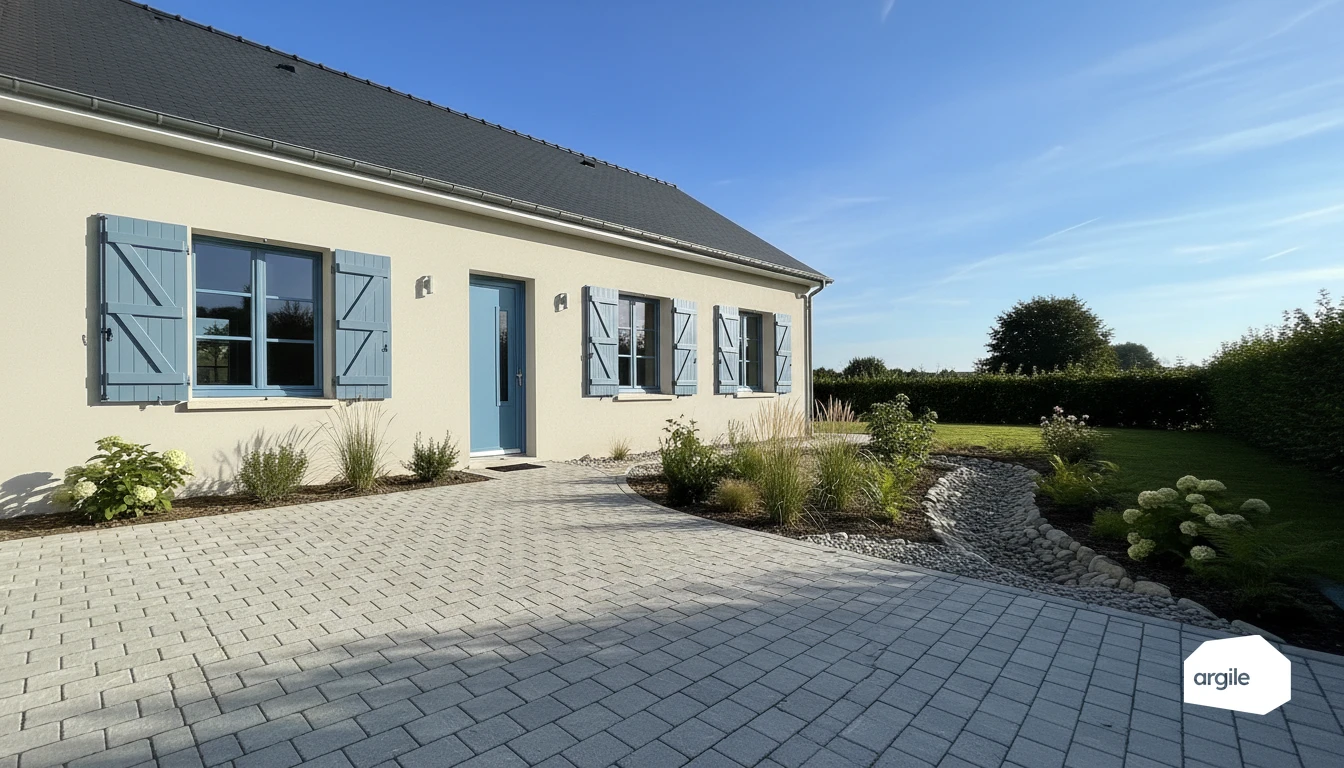
Ground sealing is not primarily a question of material, it is a question of threshold and zoning. Above one hectare of project area, stormwater discharge moves into a water-law procedure; below it, the municipal stormwater zoning takes over and can require infiltration on the plot itself. Find out which of the two applies before you price the job, not after the refusal.
5 min read
Reveal your expertise
One demo, and you see your expertise proven.
Contact us
