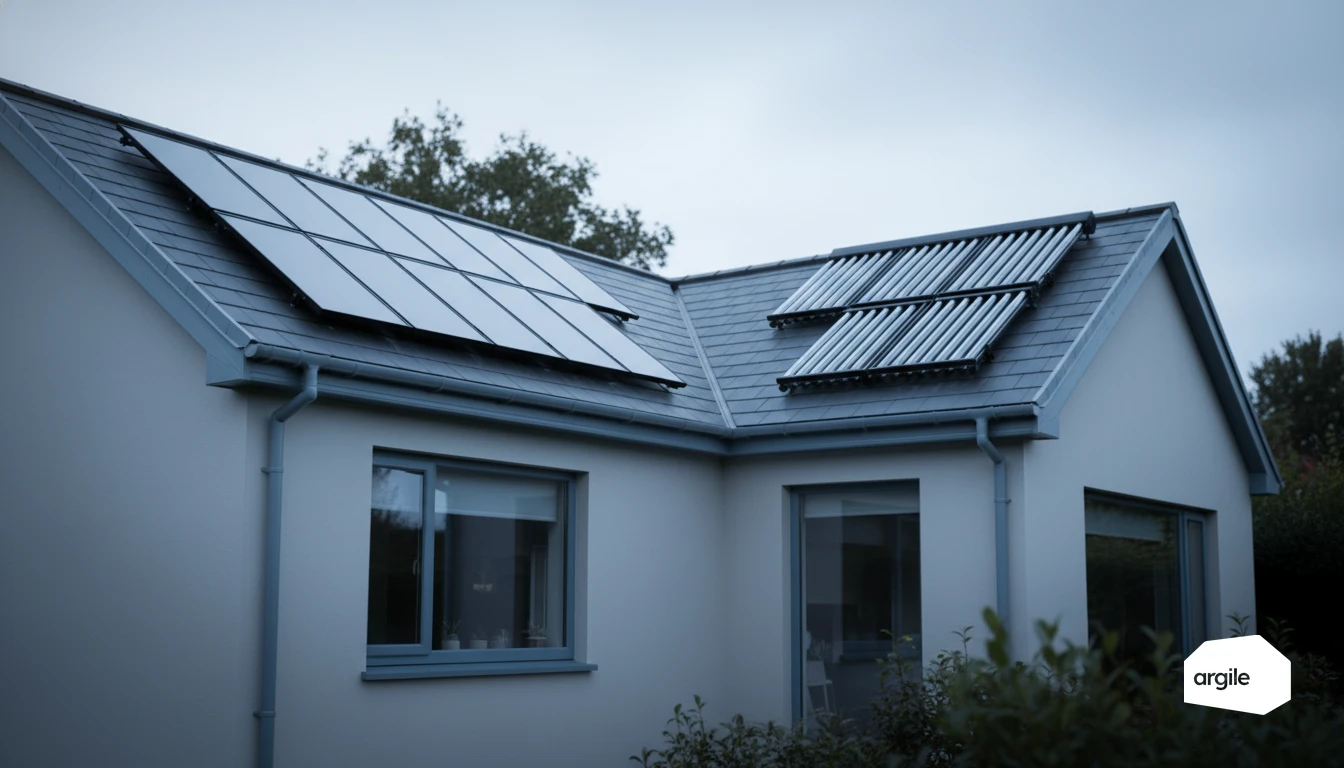
Understanding solar thermal coverage for DHW: what are we talking about on site?
Solar coverage vs substitution rate: don't mix up the indicators
For a solar thermal installation, solar coverage describes the share of DHW needs actually supplied by solar over the year. The substitution rate refers instead to energy saved compared to 100% conventional production, with its own efficiencies and losses. On site, these two values can diverge if the backup, storage or regulation are not optimized.
DHW consumption profiles: what changes everything in the calculation
The same collector array won't deliver the same coverage depending on usage. A house with morning and evening draw-offs favours storage. A small multi-unit building with spread-out draw-offs makes better use of solar. The right approach is to base the sizing on the actual profile, not on a "catalogue" average.
Real losses and efficiencies: tanks, recirculation loop, pipe lengths
Performance is also decided outside the collectors. A poorly insulated tank, a permanent recirculation loop, long pipe runs or uninsulated ducts increase losses. The result is that the backup runs more and solar coverage drops. On site, check insulation, recirculation loop settings and setpoint temperatures.
A simple coverage calculation method: data to record and assumptions to set
Quantifying DHW needs: occupants, uses, temperatures and litres/day
Record the number of occupants, uses (showers, baths, kitchen) and the tank setpoint temperature, which are used to size the solar tank. In a house, a simple baseline is 40 to 60 litres/day/person at 40°C. Also set a cold water assumption of 10 to 15°C, as it changes the power to be delivered. Keep a margin if the household often has guests.
Estimating solar thermal production: collectors, orientation, tilt, shading
Note the collector surface area, technology, orientation and tilt. Without shading and close to due south, use an average annual yield, then apply loss coefficients if azimuth, slope or shading reduce sun exposure. Solar thermal favours clear roofs, not ones with chimneys in front. Aim for a conservative estimate.
Translating production into annual and monthly coverage: a useful read for accurate selling
Convert production into usable kWh and calculate coverage. Annual coverage = usable solar energy / annual DHW need. Also do a monthly breakdown. This is where everything is decided, summer can cover a lot, winter much less. Present a realistic scenario along with the limits of use.
Sizing collectors and storage: aiming for the right coverage without overheating
Choosing a realistic coverage target based on the building (house, small multi-unit, commercial)
In a house, a target of 50 to 70% annual coverage on domestic hot water often works well. In small multi-unit buildings, aim instead for a more moderate share, as usage is more variable and the risk of a summer surplus increases. In commercial settings, you can go higher if demand is regular (showers, process water). The right target always starts from the draw-off profile, not from a "by feel" surface area.
Practical collector/tank rules and impacts on DHW in summer and winter
For solar thermal dedicated to DHW, count on roughly 1 m² of collectors per person (order of magnitude) and a tank sized consistently with the surface area, to keep margin without storing water too hot. Storage that's too small pushes temperatures up in summer. Too large, it penalizes the temperature rise in winter and increases losses.
Overheating, stagnation, glycol: points to watch and field solutions
Stagnation accelerates glycol aging and can put the expansion vessel and relief valve at risk. Field solutions: avoid oversizing, plan for heat dissipation (loop, controlled backup), choose components compatible with high temperatures, and schedule regular maintenance (pressure, pH, antifreeze). To go further, also see maintenance of the solar circuit.
Calculating and choosing the backup: electric, boiler, heat pump, district heating
Sizing the backup for the worst-case month: DHW service continuity
The backup is sized for the coldest, least sunny month, often January. The objective is simple: ensure DHW supply even if solar thermal covers little. Estimate the daily need (litres, inlet temperature, setpoint) then choose a power rating that recharges the tank within the available time. For electric, it's straightforward. For a boiler, check DHW priority and usable power. For a heat pump, validate the achievable temperature and efficiency in the cold month.
Regulation strategies: solar priority, anti-legionella, recirculation loop management
Set a solar priority on the tank. The backup only heats the upper part, only as needed. Program an anti-legionella cycle according to the manufacturer, with a periodic temperature spike and a thermostatic mixing valve at the outlet. For the recirculation loop, reduce losses, insulate the loops, put the pump on a clock or thermostat, and stop it at night if possible.
Special cases: instantaneous backup vs tank, and compatibility with existing systems
Instantaneous backup (electric, boiler, district heating) requires high power and clean hydraulics. A tank-based backup is more forgiving and smooths out peaks. For compatibility, check the heat exchanger, the regulation, the DHW/heating priorities, and integration with an existing boiler, a heat pump or a district heating network.
Pricing and financial aid in 2026: return-on-investment arguments and requirements to check
Available aid in 2026: MaPrimeRénov', CEE and RGE conditions by operation type
In 2026, pricing must factor in aid from the quote stage. For solar thermal, MaPrimeRénov' has only been available through the accompanied pathway since 1 September 2026, at a rate that depends on income and the number of energy classes gained; the standalone gesture is funded by the CEE bonus, the 5.5% VAT rate and the zero-interest eco-loan. CEE are calculated case by case, based on the standardized operation. For a heat pump, insulation or solar thermal, check the correct work description and the correct required RGE scope (not just "RGE" in general).
Indicators to present to the client: savings, coverage, DHW comfort, maintenance
Speak in simple figures. Estimate annual savings and payback time after aid, specifying the assumptions (usage, temperature, energy). Give an order of magnitude for coverage of needs (heating and/or DHW), hot water comfort (flow rate, stability, recovery time) and expected maintenance (checks, descaling, flushing, parts).
Documents and proof to secure: technical sheets, diagrams, commissioning, maintenance
For compliance, secure written proof. Technical sheets (performance, labels), hydraulic diagrams, before/after photos. For aid schemes, keep detailed quotes and invoices, CEE sworn statements, and proof of RGE qualification. Add a commissioning report, settings, and maintenance traceability.