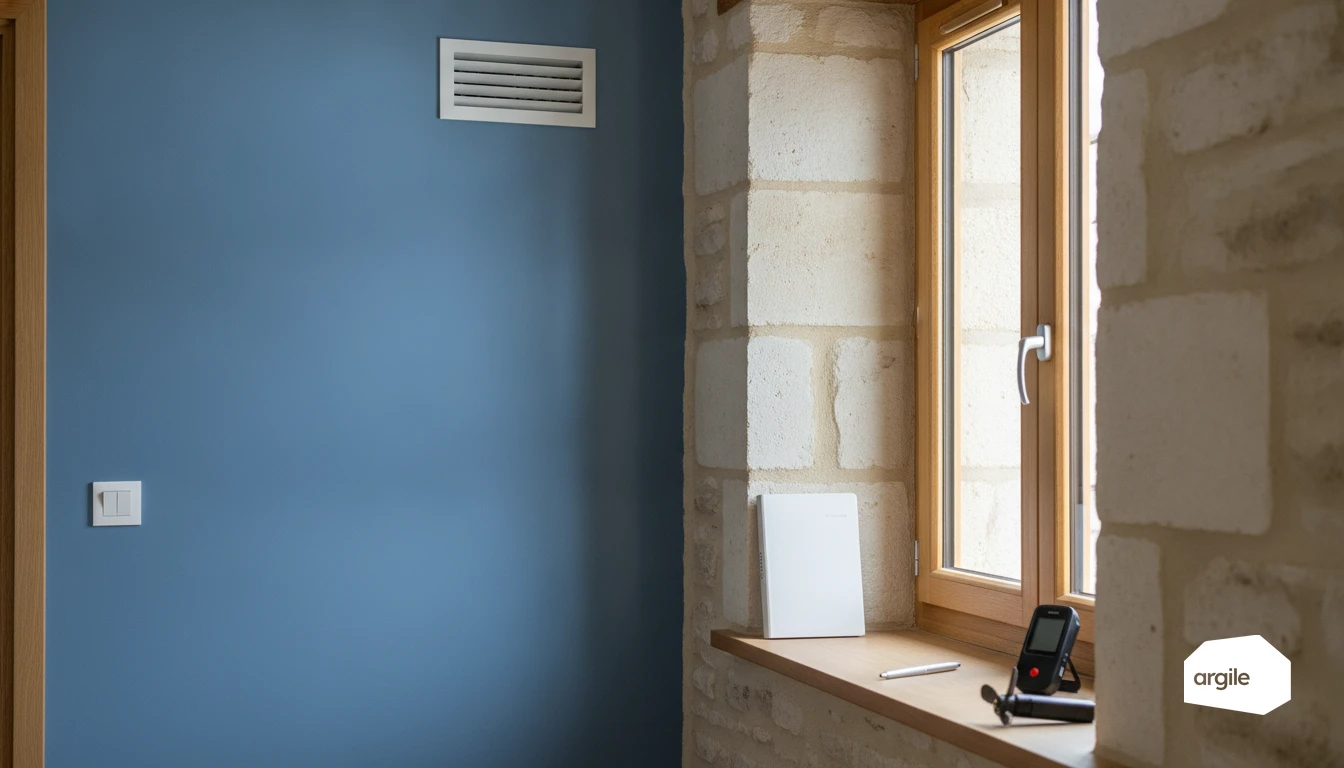
Securing your on-site diagnosis: the sequence of checks you must not miss
Identify the noise in 30 seconds: whistling, humming, vibration, rattling
First identify the noise family. Whistling means air velocity is too high or the cross-section is too tight. Humming or rushing air means the unit is running too fast or total airflow is excessive. Vibration means a fixing, hanger, anti-vibration mount, or an out-of-balance turbine. Rattling means a backdraft damper, control damper or access hatch is fluttering.
Measure airflow before doing anything: main rooms and service rooms
On a noisy MVHR system, do not touch the speeds before measuring. Measure at the terminals with a capture hood or anemometer and record the airflow before and after the intervention. To make the measurement reliable, rely on the diagnostic tools. Also map the air inlets and undercut doors.
Check the regulatory framework: do not go below the 24 March 1982 order
Reducing speed may calm the noise, but it must never leave the installation non-compliant. Lock in the regulatory airflow rates by room, record them in your report, and only then make adjustments (balancing, replacing a terminal, network correction, or unit replacement).
Quick decision tree: from symptom to cause (noisy MVHR)
On a noisy MVHR system, measure the airflow at the terminals first and then the sound level. Before touching the speed, compare your airflow readings with the regulatory minimums (regulatory ventilation airflow rates; 24 March 1982 order). Also note the available pressure at the unit and the condition of the ducts.
Whistling: air velocity too high in a section that is too small
Typical cause: reduced cross-section (crushed duct, undersized terminal, damper too closed). Check: measure the airflow, then the outlet velocity at the terminal. Action: restore cross-section, remove the restriction, recalibrate the terminal. Recheck airflow and noise.
Humming or rushing air: excessive airflow or unit speed too high
Common cause: unit set too high, lightly loaded network, extraction imbalance. Check: total airflow, electrical current draw, motor speed. Action: balance at the damper and adjust at the unit, without going below the regulatory airflow rates.
Vibration: fixing, anti-vibration mounts, turbine imbalance
Mechanical cause: fixings under stress, compressed anti-vibration mounts, fouled turbine. Check: visual inspection, listening with a jobsite stethoscope, vibration measurement if available. Action: rework the suspension, replace anti-vibration mounts, clean and check clearances.
Intermittent noise cases: rattling, flapping and speed fluctuations
| Room | Target sound level dB(A) |
|---|---|
| Main room | 35 |
| Bedroom | 30 |
| Service room | 45 |
Rattling: backdraft damper, control damper, poorly positioned terminal
For clear rattling, check the backdraft damper, the control damper and the orientation of the terminal. Measure the airflow at the terminal before any action, then again after adjustment or replacement. A damper that flaps often points to occasional backflow or too much free travel.
Intermittent noise: fouling, worn motor, condensate in the ducts
If the noisy MVHR alternates between speeding up and thumping, inspect fouling (impeller, unit, terminals), the condition of the bearings, and water in the ducts. Drain low points, restore falls, and secure the power supply. Recheck airflow and do not reduce speed below the 24 March 1982 order minimums.
Wind-related noise: air intakes, roof outlets and airtightness defects
In windy conditions, look for an intake that is too exposed, an unprotected roof outlet, or an airtightness leak in the loft space. Stabilise pressures by repositioning the terminals, adding a wind shield, and reworking the seals. Validate with a sound level meter and airflow measurement.
Adjustments and corrective actions: what to do and what to check each time
Actions on terminals and ducts: cleaning, local resizing, limiting pressure losses
On a noisy MVHR system, start as close to the terminals as possible. Remove the terminals, clean them, and check for any blockage (dust, paint, added insect mesh). Measure the airflow per terminal before acting. If whistling persists, look for a section that is too small or a crushed duct. Correct locally. Replace an overly long flexible duct with a short rigid run. Limit tight bends and reductions in diameter. The goal is to reduce air velocity at constant airflow.
Actions on the unit: speed adjustment, motor checks, tightening and part replacement
Only reduce speed after abnormal pressure losses have been eliminated. Adjust the unit with a simple logic: airflow first, noise second. Check the condition of the turbine (fouling, imbalance), bearings, anti-vibration mounts and fixings. A tightening of the hangers and replacement of flexible connectors is often enough to eliminate vibration and humming.
Mandatory final check: airflow after intervention + acceptable sound level by room
Re-measure and record the airflow rates. The adjustment must not take you below the regulatory minimums (24 March 1982 order). Then measure the noise in dB(A), with the door closed, in normal use position. To frame the adjustment choice and the possible interventions on the unit, also refer to a single-speed or two-speed MVHR unit.
| Measured zone | Target sound level dB(A) |
|---|---|
| Main room | 35 |
| Service room | 40 |
When to decide on replacement in 2026: simple criteria and a path into your ventilation offer
Replace rather than patch: noisy motor, damaged turbine, unit that is too powerful or poorly matched
On a noisy MVHR system, act quickly if the noise returns after cleaning, tightening and balancing. Replacement is recommended if the motor overheats, the turbine is bent or cracked, spare parts are no longer available, or the unit is oversized and forces high air velocity despite compliant airflow. For more on diagnosis and possible corrections, see also solutions for reducing MVHR noise.
Choose the right system: single-flow, humidity-controlled, or heat-recovery, depending on the dwelling
| Option | When it makes sense | Check point |
|---|---|---|
| Self-adjusting single-flow | Existing network is sound, priority is robustness | Regulatory airflow at the terminals |
| Humidity-controlled single-flow | Air inlets and terminals are compatible, humidity is properly managed | Measure airflow at minimum and maximum settings |
| Heat-recovery ventilation | Airtight envelope, room for duct runs, filter access | Supply/extract balancing |
Offer a complete solution: quote, maintenance, and link to your ventilation product page
In the quote, record the before-and-after measurements. Extract airflow, available pressure, and sound level. Keep in mind that reducing speed must not push airflow below the minimums of the 24 March 1982 order. Offer structured maintenance. Terminal cleaning, fouling checks, and filter replacement if needed. Then link to your ventilation product page.