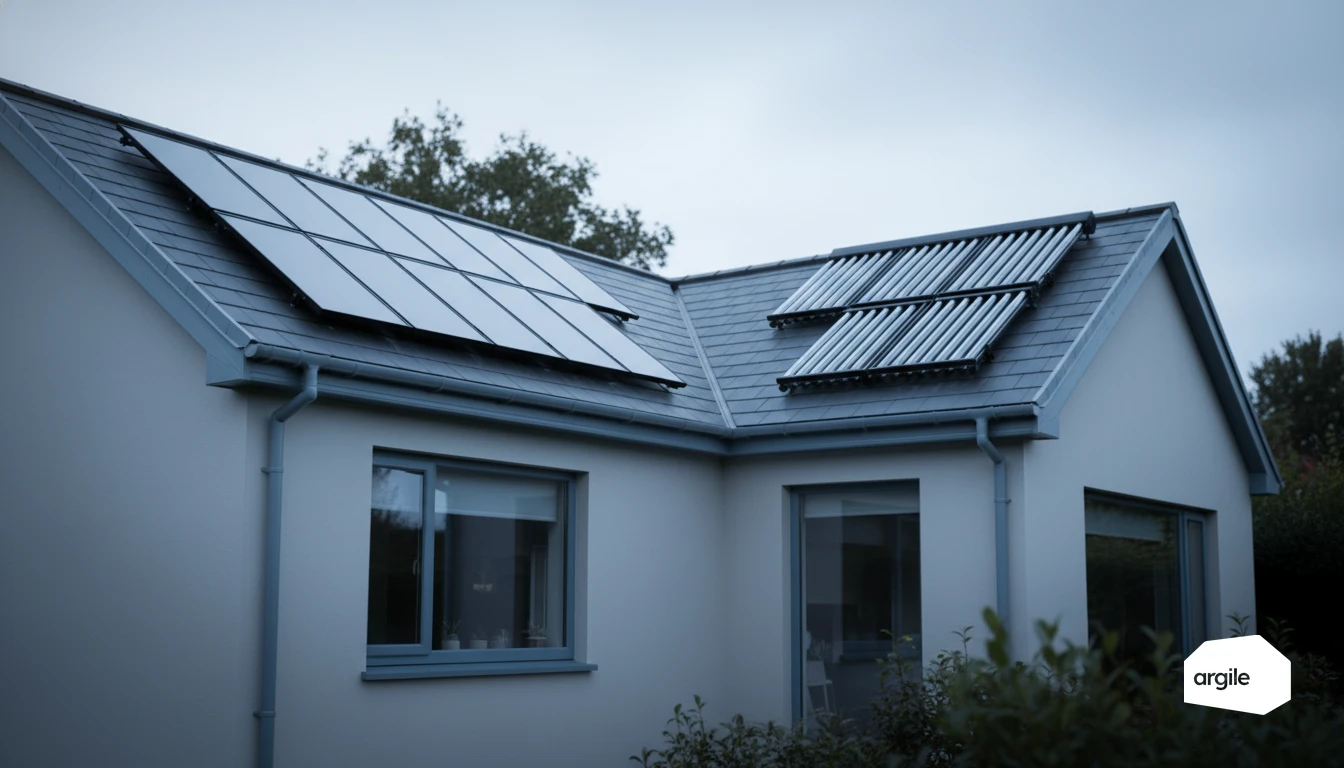
Understanding solar thermal and the role of collectors
Solar thermal: how it works and its uses (DHW, heating top-up)
Solar thermal captures heat from the sun. A fluid circulates through the collectors, then a heat exchanger heats a tank. The most common use remains domestic hot water (DHW). Depending on the emitter, it can also top up heating (underfloor heating, low-temperature radiators). Controls and a backup source (boiler, heat pump, electricity) ensure comfort year-round.
Collectors: what you need to look at (efficiency, losses, useful surface)
To compare, rely on standardised tests. Look at the optical efficiency η0 and the loss coefficients a1 and a2, all three measured to BS EN ISO 9806. Check the useful surface stated on the technical data sheet, aperture or absorber area, not just the overall footprint, since the same collector reads better on one basis than on the other. A Solar Keymark certificate carries those figures and simplifies the reading. A well-sized collector also limits summer overheating.
Site constraints: roof, terrace, façade, integration and appearance
On a roof, check orientation, tilt, shading, the condition of the covering, and how sealing is restored for in-roof or on-roof mounting. On a terrace or façade, plan for anchoring, wind, weight, maintenance access and pipe routing. Local rules (co-ownership, listed-building bodies) need to be handled early to avoid site call-backs.
Flat-plate solar collector: strengths, limits and suitable projects
When to favour a flat-plate collector (temperate climates, high DHW demand)?
The flat-plate collector is often the right choice for solar thermal in temperate climates, with a well-oriented roof and few constraints. It's particularly relevant when regular DHW demand is high, which you check by matching the tank to the household: large families, guesthouses, small collective housing. The more hot water you consume year-round, the more you make use of the output.
On-site advantages: robustness, maintenance, parts availability
On site, its simple and solid design is appreciated: a glazed casing, an absorber, insulation. Less fragile than an evacuated-tube collector, easier access for visual inspection. Maintenance is mostly limited to the hydraulic loop. Parts are also generally standardised and available.
Points to watch: winter performance, shading, summer overheating
In winter, output drops and the backup remains essential. Shading, even partial, quickly hurts performance. In summer, watch for stagnation if DHW consumption is low: the stagnation temperature is itself a tested figure carried by the Solar Keymark certificate, and it is what the fluid, the vessel and the pipe insulation have to survive. Plan careful installation and accurate sizing: controls, safety, and an anti-overheating strategy depending on the layout (draindown, dissipation, etc.).
Evacuated-tube collectors: performance and conditions for success
Why the evacuated tube performs well in cold, windy weather
In solar thermal, the evacuated tube limits heat exchange with outside air. The vacuum acts as an insulating "coat". The result: reduced losses in cold weather, and especially when wind speeds up the cooling of a standard collector. Tubes also keep good performance under diffuse sunlight, provided the circuit is well purged and the antifreeze is suitable.
Advantages on difficult roofs: orientation, tilt, available surface
When the roof isn't ideal, tubes often cope better. Their geometry and adjustable mounts let you target a useful tilt, even on a flat roof. This is useful if you're short on surface, since more energy is concentrated over a smaller area. Success depends on careful installation and the absence of cast shadows.
Limits to anticipate: fragility, cost, replacing a tube, and after-sales support
The glass remains more fragile than on a flat-plate collector. You need to anticipate the risk of impact and access for servicing. The cost is often higher, and the higher temperature reached at the collector flow is paid for on the rest of the circuit, in the insulation grade, the heat-transfer fluid and the expansion vessel. The good news: a tube can usually be replaced individually. The bad news: you need the right reference, and responsive after-sales support to avoid an installation being out of service.
Flat plate or tube: a simple method to decide for your project
Quick decision grid: need, local climate, roof space, client budget
For a solar thermal project, start from the actual need (DHW only or heating top-up), then look at climate and available space. If the roof is large, little shaded and the budget is tight, the flat-plate collector often does the job. If surface is limited or the site is cold and windy, evacuated tubes are often more suitable.
Before settling on a technology, check that the equipment and the installation clear the thresholds the job file will be judged on. They are the same for both families.
| Requirement | What to check | Where it comes from |
|---|---|---|
| Collector certification | Solar Keymark, or an equivalent scheme | Solar Heat Europe |
| Test standard behind the figures | BS EN ISO 9806, for optical efficiency η0 and loss coefficients a1 and a2 | ISO |
| Basis of the surface used in the yield calculation | aperture or absorber area from the certificate, not the overall footprint | BS EN ISO 9806 |
| Installation certification | MCS, by an MCS-registered installer | MCS |
| Temperature at a bath outlet in a new dwelling | 48 °C maximum | Approved Document G |
None of these requirements separates the flat plate from the evacuated tube: both families clear the same bar. The decision therefore sits elsewhere, on how hot the circuit runs, on the roof area available and on the client's budget.
Sizing and hydraulics: flow rate, controls, tank, antifreeze
Ensure a stable flow rate, differential control and a suitable tank with heat exchanger. In a closed circuit, plan an antifreeze mix (water and glycol), a properly sized expansion vessel and accessible bleed points to hold up over time.
Installation and safety: sealing, fixing, overheating risks and protections
Take care with the sealing of penetrations and the fixings against wind loads. Plan for overheating management in summer with protections, dissipation or a control strategy, and check the safety valve, mixing valve and temperatures to prevent burns and premature ageing.
What's changing in 2026: grants, requirements and useful sales arguments
2026 funding: how to position solar thermal
In 2026, conditions may change. To sell solar thermal without confusion, present a simple logic: the measure travels with the package the household qualifies for, and the VAT relief applies on top. Present the combination as a structured package, with clean supporting documents from the quote stage.
Quality and compliance: certification, assessments, warranties and documents to prepare
Checks are becoming stricter. Reassure with an MCS-certified installation suited to solar. Put the documents on the table: collector and cylinder technical data sheets, hydraulic diagram, maintenance manual, completion certificates, and proof of performance. On warranties, be clear about equipment and installation.
Talking to clients: hot-water savings, comfort, maintenance and lifespan
The right angle is usage: less electricity or gas for hot water, stable comfort, and a system that runs smoothly. Explain the simple maintenance: fluid check, pressure, safety, and monitoring the controls. Position lifespan as a reasonable investment, not a magic promise.