Understanding the logic of a modular renovation pathway
What a modular pathway addresses on the ground: timelines, multiple work packages, budget and grants
The modular pathway targets the day-to-day reality of job sites. Holding to short timeframes, coordinating insulation, ventilation, heating, and staying clear for the customer. The pathway clarifies the budget and secures the grants. MaPrimeRénov' and the CEE require eligible works, evidence, and RGE-certified companies. Without this rigour, financing can seize up.
Modular pathway: defining clear steps without locking down the project
The idea is simple. Break it down into simple steps that follow one another, but can be readjusted. For example: fast diagnosis, scenarios, technical visit, quote, grant setup, work package scheduling, then handover. You move forward with a compass, not a straitjacket.
Measure-by-measure renovation or whole-house renovation: when to switch, and why
A single measure is enough if the need is targeted. But as soon as you touch 2 work packages, or the heating system, the right moment to switch often arrives. A whole-house approach limits rebound effects, improves comfort, and can open more favourable grant pathways in 2026, especially with structured support (see measure-by-measure renovation or whole-house renovation).
Building a modular pathway in 2026: steps, documents and points of vigilance
Diagnosis and energy audit: what to frame from the outset in 2026
From the first contact, set the framework. Existing DPE, consumption, photos, surfaces, plans if available. For a grant-supported renovation on a guided pathway, the energy audit serves as a compass. Targeted goals, budget, technical constraints and timeline must be clarified, otherwise the project drifts quickly.
Pricing by module: insulation, ventilation, heating, controls
Price by work item. Insulation (loft, walls, floors), ventilation (mechanical ventilation), heating (heat pump, biomass), then controls and balancing. Each module must specify expected performance, supplies, labour, and overall consistency, to stay aligned with MaPrimeRénov' and the CEE fiches.
RGE, compliance and evidence: securing the file before, during and after the project
Centralise the evidence. Check your RGE certifications at the right time. Keep signed quotes, technical data sheets, instruction manuals, before/during/after photos, delivery notes, commissioning records, handover reports. For the CEE, anticipate the statement of honour and the documents requested, to avoid a rejected file.
Selling a modular renovation without losing control of the project
Presenting understandable scenarios: priorities, gains and phasing
Offer a maximum of 3 scenarios, built on the home and its goals. A "building safety" base (airtightness, priority insulation), a "comfort" tier (controls, heating), then a "performance" goal. Cost out simple gains (kWh, euros, energy classes if you have an audit). And above all, give a clear phasing. Package 1 now, package 2 next winter. With a modular pathway, you show these steps without drowning the prospect in detail.
Avoiding technical dead ends: ventilation, humidity, thermal bridges
A step-by-step renovation works if the envelope and systems stay consistent. As soon as you insulate, you check the ventilation to maintain healthy air quality. You also spot areas at risk of humidity (cold walls, ground floors) and treat thermal bridges at the junctions. A good order of works avoids callbacks and "it's been condensing since your works" complaints.
Getting quotes signed faster: readable quote, clear options, integrated grants
A quote that gets signed quickly can be read in one pass. A base price, clearly named options, and a phase schedule. Add a 2026 grant estimate (MaPrimeRénov' and CEE) and the estimated remaining cost, with the RGE conditions. You secure the decision, without vague promises. To frame both substance and form, rely on a readable quote that complies with the mandatory wording.
How Argile makes a modular pathway easier for RGE tradespeople
Energy diagnosis in under 5 minutes: framing the need from the first contact
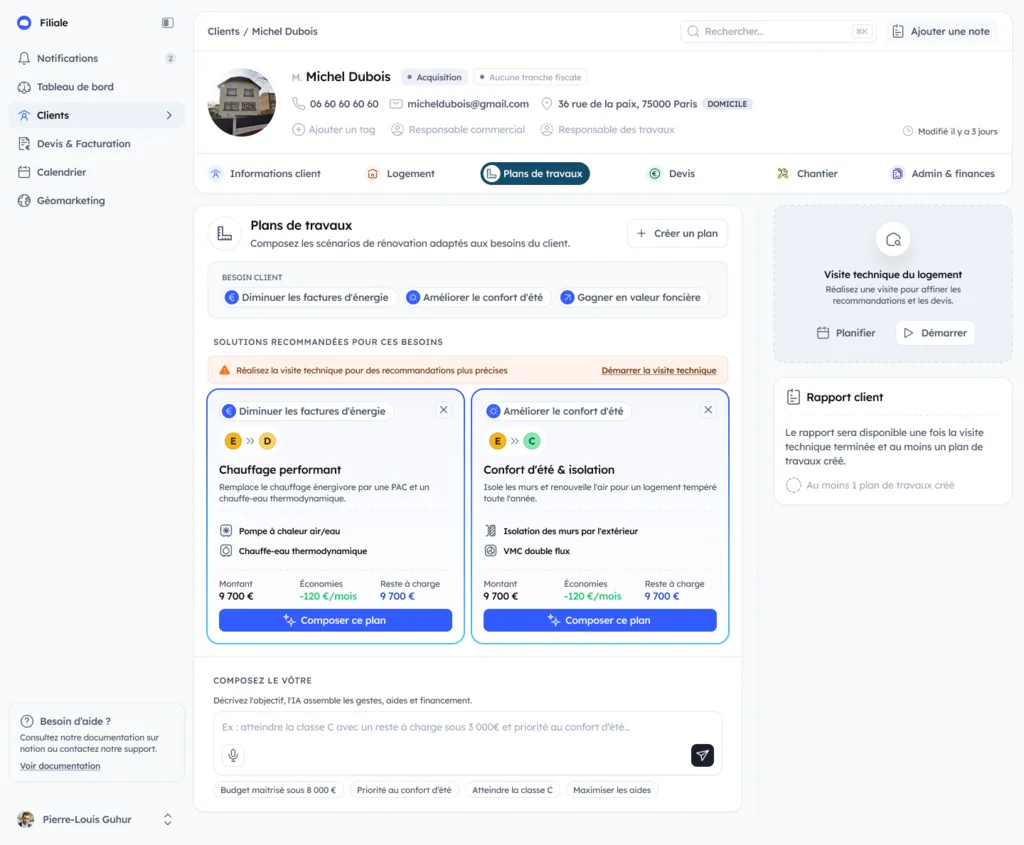
With Argile, you launch an energy diagnosis in 5 minutes. You qualify the home, spot the heat-loss items, and set a clear direction from the first exchange. The prospect understands where the works are heading, without getting lost in the details.
Feasibility analysis and constraints at the address: limiting unpleasant surprises
Before the visit, the feasibility analysis surfaces the key constraints at the address using public data and business rules. Existing heating, climate zone, surface area, points of vigilance. You arrive on site with a useful checklist, not a notebook of doubts.
From technical visit to quote: scenarios, pre-pricing and MaPrimeRénov'/CEE calculation
After the visit, your surveys become scenarios and a pre-pricing. Argile generates a quote with integrated grants, estimating MaPrimeRénov' and the CEE according to standardised operations. You announce a more accurate remaining cost, and you move forward.
Examples of modular pathways suited to single-family houses
"Immediate comfort" pathway: ventilation + airtightness + simple settings
Start by securing air quality. Check the ventilation (mechanical ventilation), track down air leaks, then make simple settings on radiators, thermostatic valves, water temperature. This way, you prioritise these low-disruption measures before touching the heating.
"Energy savings" pathway: priority insulation then heating system
To reduce bills, the most robust order remains priority insulation (loft, walls, floors) and correcting thermal bridges. Once needs are reduced, size the heating (heat pump, boiler, stove) and adjust the emitter and controls.
"Progressive whole-house renovation" pathway: planning over 12-24 months without getting it wrong
When the budget comes in several stages, set a clear plan over 12 to 24 months. Start with the audit or a technical visit, lock down the interfaces (ventilation, airtightness, networks), then move through insulation, windows, heating, and solar packages if relevant. Keep a checkpoint after each step to verify comfort and consumption. To go further on the logic of a progressive whole-house renovation, rely on a method that secures the sequencing of work packages and coordination.