Why post-renovation monitoring is becoming essential in 2026
Securing your promises: comfort, savings, indoor air quality
After the work, the result often comes down to the settings. Monitoring (temperature, humidity, CO2, consumption) lets you check that comfort is delivered, that savings follow, and that ventilation maintains indoor air quality over time.
Meeting verification requirements: clients, subsidies, and insurance
In 2026, clients want proof, not intentions. Subsidies (MaPrimeRénov', CEE) rely on inspections and can require supporting evidence. Post-job tracking provides clear traceability to demonstrate consistency between the work carried out, the settings, and usage.
Limiting disputes: recording settings and interventions after the job
Discomfort, a rising bill, persistent damp. Without a history, the discussion drags on. With monitoring, you document the commissioning (heat pump, mechanical ventilation, controls), the adjustments, and the visits. You save time, and you reduce disputes.
Which indicators to track to measure the gains after the work
Energy: kWh, the bill, actual equipment efficiency (heat pump, ventilation, hot water)
To make the gains objective, track consumption in kWh (heating, hot water, auxiliaries) via a meter, sub-metering, or the supplier's portal. Compare while correcting for weather with degree-days, otherwise a mild year can "manufacture" savings. Cross-check against the bill, but keep in mind that prices and subscription fees change. On equipment, check the actual efficiency. For a heat pump, look at the measured or estimated seasonal COP. For ventilation, monitor the flow rates and consumption. For hot water, track the cycles and the setpoint temperature. Light monitoring is often enough.
Comfort: temperatures, humidity, summer overheating, and occupant feedback
Gains also show up day to day. Record temperature room by room, humidity, and CO2 over a representative period. In summer, count the hours above a chosen threshold and note heatwave episodes. Add a short occupant questionnaire. A home can consume less while being less comfortable if the controls are poorly set.
Building fabric and usage: airtightness, ventilation, habits, and events that skew the readings
Check the building fabric. An airtightness test and a ventilation adjustment often explain the discrepancies. Document usage. Number of occupants, remote work, a backup stove, new appliances, higher setpoints, a long absence. Also note the maintenance, filters, defrosting, balancing. Without this log, you sometimes end up comparing two different dwellings.
Setting up a simple verification process, from handover to 12 months
At handover: a verification checklist, photos, setting points, a clear report
On the day, lock down the basics with a short checklist. Take dated photos of the equipment, the labels, the insulation before it's closed up, and the settings. Note the points to validate: mechanical ventilation flow rates, the heat pump's weather compensation curve, radiator balance, setpoints, and schedules. Write up a clear report with reservations, documents handed over, and the date they're lifted.
At 1-3 months: stabilisation, checking the setpoints, and occupant feedback
In the early days, everything shifts a bit. Plan for a call or a visit to check the actual setpoints, the schedules, and common complaints: discomfort, noise, humidity. Simple monitoring of the meters and run times is often enough to adjust without over-tuning.
At 6-12 months: annual review, before/after comparison, and corrective actions
At one year, do a review. Compare before/after consumption while accounting for the weather, then list the actions: settings, balancing, maintenance, resealing. Make the most of this ideal tracking period to fix things quickly and leave a stable dwelling.
How Argile helps you run monitoring without weighing down your jobs
Centralising the project data: scenarios, assumptions, constraints, and job evidence
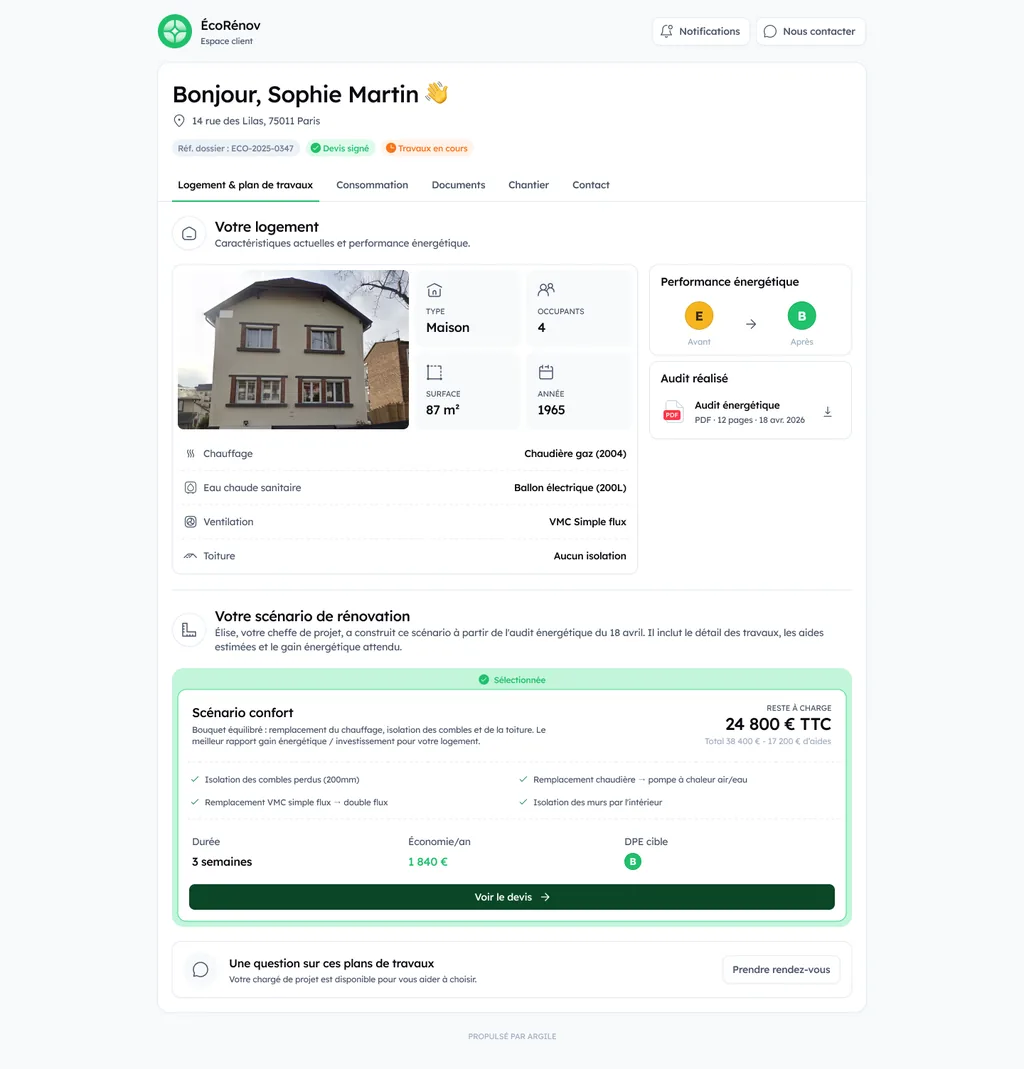
With Argile, you keep your work scenarios, your assumptions, and your technical constraints in one place. You also attach the job evidence useful for monitoring: photos, product data sheets, visit notes, decisions made with the client. Everything stays traceable, without multiplying files. Scheduling, progress, photos and snag clearing are run from the client record.
Comparing what was done against what was planned: work consistency, points to watch, and tracking discrepancies
Argile helps you compare what was planned against what was done. You check the consistency of the key line items: insulation, ventilation, heating, controls. Visible discrepancies let you prioritise points to watch before handover. You track what changes: quantity, reference, installation, and you document why.
Saving time on reporting: verification documents and better-framed client exchanges
Reporting becomes lighter. Argile prepares a ready-to-share file to give the client and to archive. You bring together the verification documents, the supporting evidence, the summaries, and the exchanges. The result: fewer back-and-forths, and smoother approval. The client, for their part, follows their home, their documents and the job from a dedicated space.
Turning monitoring into a sales lever (without overselling)
Showcasing the whole-building retrofit: proof of gains and education to help clients decide
Monitoring gives you clear data: consumption, temperatures, a heat pump's cycles, humidity levels. In 2026, your clients want to decide based on evidence. You can show the gap before and after the work, and above all explain why a whole-building retrofit holds up its promise better. Less heat loss, less overheating, more comfort. You're selling a trajectory, not a miracle.
Offering a maintenance and optimisation plan: settings, filters, balancing, weather compensation curve
After handover, offer a check-up appointment and follow-up. Monitoring quickly spots drift. A clogged filter, a hydraulic imbalance, a weather compensation curve set too high. With a few simple adjustments, you stabilise performance and avoid emergency call-outs. It's also a clean way to stay present, without pushing for further work.
Building on your field feedback: improving your pricing and technical visits with Argile
Every job produces field feedback. Note the actual causes of the gaps between theory and usage. Thermal bridges, forgotten ventilation, misunderstood setpoints. With Argile, you structure these observations into your technical visits, feed your scenarios, and refine your pricing and your subsidy applications. Monitoring becomes your improvement loop, job after job.