Refurbishing occupied premises means running three constraints an empty site does not have: continuity of use for the dwelling, control of emissions, and the duty to survey before work starts. The third is the only one that can stop the job: the Control of Asbestos Regulations require a refurbishment and demolition survey before any work liable to disturb asbestos-containing materials, and on a dwelling built before 1980 the lead risk is added on top before any paint is sanded or stripped. The first two are handled by organisation: a work zone contained under slight negative pressure, a refuge room kept warm and clean, noisy tasks grouped into short slots announced in advance. It is that organisation, written into the quotation rather than improvised, that separates a genuine occupied-premises refurbishment from an ordinary job where the residents simply stayed put.
Preparing the renovation in occupied premises: framing, reassuring and securing
Conducting a technical visit and identifying sensitive areas (noise, dust, access)
Before the renovation, carry out a technical visit with the occupants. Identify the living areas to protect, the required passageways, the noisy zones and the sources of dust. Also note access constraints (stairs, parking, hours) and possible hold points (children, remote work, pets).
That visit feeds a table the quotation then repeats line by line. It fits on one page and acts as the organisational contract with the occupant.
| Occupied-premises constraint | What triggers it | Provision to write into the quotation | Who carries it |
|---|---|---|---|
| Refurbishment and demolition asbestos survey | building work predating the 1999 ban | survey carried out and issued before any intervention | the client, under the duty to manage |
| Lead risk | dwelling built before 1980 | paint assessed before any sanding or stripping | the client |
| Airborne dust | sanding, core drilling, stripping plaster or render | on-tool extraction, class M vacuum, containment under negative pressure | the contractor |
| Noise | drilling, core drilling, demolition | slots agreed with the local authority rules, 48 hours' notice | the contractor |
| Continuity of hot water and heating | removal of the boiler or cylinder | named temporary solution, changeover within 24 hours | the contractor |
| Continuity of ventilation | removal of the ventilation unit or blocking of ducts | system kept running, or temporary extract in the wet rooms | the contractor |
| Refuge room | any intervention lasting more than a day | named room, heated, cleaned every evening | the contractor, agreed with the occupant |
The first two lines are not a matter of your organisation but of the contract: the survey falls on the client, and a job started without it puts your liability on the line from the first fibre released. Have it written into the contract that commencement is conditional on the report being issued, which is the only protection that actually holds.
Defining clear phasing and a schedule residents can understand
Announce simple phasing, room by room or by trade lot. Give a readable schedule, with the "heavy" days (demolition, drilling) and the calmer periods. Plan a single point of contact and a short ritual, for example 5 minutes every morning, to adjust without stress.
Setting up safety rules and access (circulation, protections, storage)
Set clear rules. Separate circulation where possible, floor protections, sheeting, source extraction, ventilation. Delimit storage and waste areas, lock away tools, and keep exits clear. A well-marked-out site is a house that can breathe.
Limiting day-to-day disruption: noise, dust and site cleanliness
Scheduling noisy work at the right times and giving advance notice
In renovation, noise is managed first as a scheduling matter. Group the loudest tasks (drilling, coring, removal) into short daytime windows, and announce them 48 hours ahead. A note in the letterbox and a verbal heads-up at the start of the week avoid a lot of tension. Also think about cutting unnecessary sources. A well-sharpened tool with proper settings often makes less noise than a tool pushed to its limits.
Reducing dust with containment and extraction (doors, sheeting, extractors)
Dust is the light that no longer gets through. Close off the zone with sheeting, containment doors or zip doors. Work with source extraction and a suitable vacuum cleaner (fine filtration). If possible, add an extractor to create a slight negative pressure and limit migration to the living areas. A simple airlock (entry, exit) also helps.
Keeping the zone clean: daily cleaning, waste sorting, protected walkways
Set up a routine. Wet sweeping or vacuuming at the end of the day, wiped surfaces, waste sorted as you go into labelled bins. Protect the circulation areas with films and boards, and keep a clear path for the occupants. Visible cleanliness keeps trust alive. To go further, also think about construction waste management.
Ensuring site comfort during the renovation: heat, water and continuity of use
Maintaining heating and hot water: temporary solutions and quick switchovers
For a renovation in occupied premises, the goal is simple: avoid long cut-offs. Plan a switchover within 24 hours with a temporary water heater, a temporary electric tank, or a small DHW generator at a water point. On the heating side, a properly sized electric backup and mobile radiators can keep a living room warm while the connection is being made. Keep the valves accessible and identify the circuits before removal.
Managing indoor air: ventilation, odors, humidity and drying of substrates
You limit discomfort by keeping continuous ventilation. Even during the works, avoid cutting the mechanical ventilation for long periods. Air out the space after gluing, painting, rendering. Monitor humidity with a hygrometer. A dehumidifier speeds up the drying of substrates and reduces odors, especially after insulation or joinery replacement. To go further on choosing between equipment, see air purifier vs. mechanical ventilation.
Preserving the living rooms: refuge zones, nuisances, and quick service restoration
Divide the dwelling into zones. A clean, heatable refuge room, a works zone contained by sheeting and doors. Protect floors and furniture, and schedule noisy tasks into short windows. Every evening, quick cleaning and restoring water, electricity and the kitchen improve comfort and trust.
Coordinating the parties involved: an organization that avoids delays and rework
Planning the trades: sequencing, drying times, intermediate checks
A renovation runs smoothly when each trade lot arrives at the right time. Plan a simple schedule, validated by everyone, with margins for drying times, access and checks. For example, check the substrates before insulation, the airtightness before the lining, then the tests (water fill, operation) before closing up. That schedule holds up on site when the interventions, the progress and the snags are all run from the client record.
Managing deliveries and storage without blocking the residents
In occupied premises, materials quickly block circulation. Time deliveries as close as possible to installation, identify a buffer zone, and secure the passageways. Also anticipate waste removal and floor protection to limit day-to-day nuisances.
Formalizing validation points: checklists and reservations at the end of each phase
At the end of each phase, do a written check. A site checklist avoids oversights and speeds up handover.
- Photos before closing up the walls
- Readings and settings (mechanical ventilation, heat pump, emitters)
- Compliance of insulation thicknesses and critical points
- Dated reservations, with a resolution deadline
Communicating well in 2026: informing, handling the unexpected and showcasing the renovation
Setting up simple tracking: on-site display, weekly messages, before/after photos
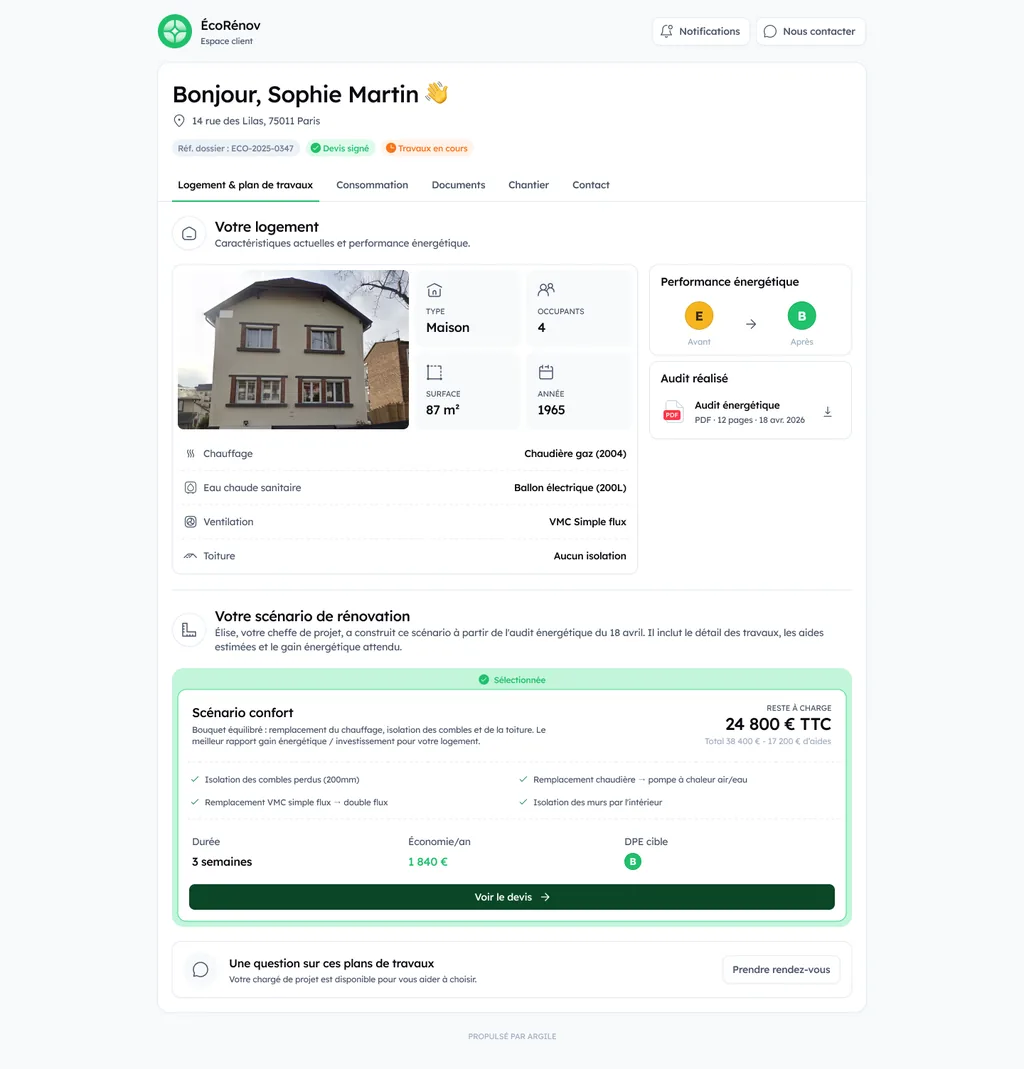
In 2026, your clients want to see where the project stands, without chasing information. A sign on site with the stages and expected date is often enough. Add a weekly message, two lines, one photo. And keep before/after shots to make the renovation tangible. That tracking removes the chasing when the client finds the progress, the photos and the documents in a space of their own.
Anticipating hazards: extra work, incidents, and fallback solutions
An unforeseen issue rarely comes as a surprise, especially if it was flagged in advance. From the quote stage, list the frequent risks: humidity, degraded substrate, difficult access. In case of a deviation, offer two costed options, a revised deadline, and a written record. Your plan B reassures and avoids tension.
Explaining the benefits: energy savings, acoustic comfort, air quality after renovation
Link every action to a result. Insulation and high-performance heating cut spending and improve comfort. Some solutions also bring quiet. And after a more airtight renovation, remind the client of the importance of suitable ventilation for good air quality.