Understanding the thermostatic mixing valve and its impact on DHW consumption
Difference between a thermostatic mixing valve, a standard mixer and a two-handle mixer: what to explain to the client
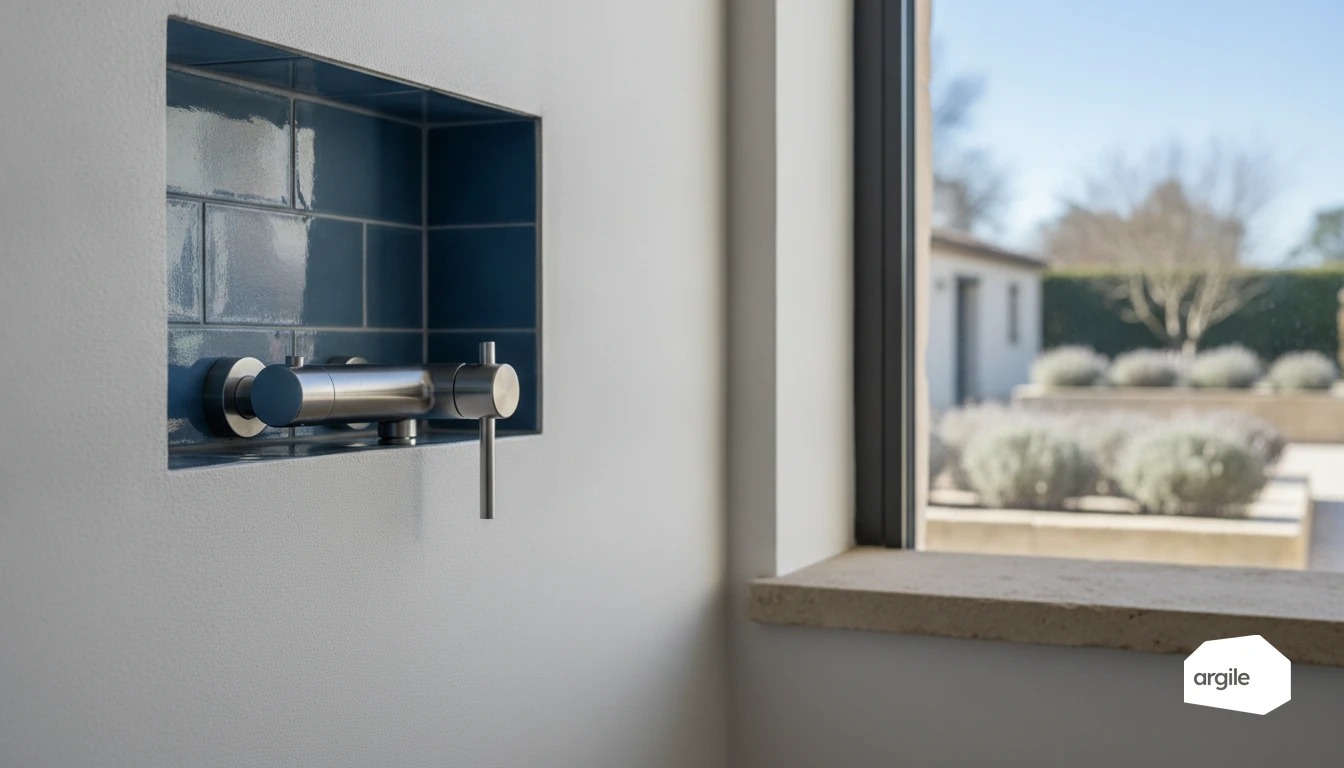
A standard mixer (single lever) sets hot and cold manually. A two-handle mixer does it with two knobs. A thermostatic mixing valve, on the other hand, targets a chosen temperature and holds it thanks to a cartridge that reacts to pressure and temperature variations. The result: fewer "by feel" adjustments at every shower.
How temperature regulation limits hot-water waste at the tap
When the temperature stabilizes quickly, you limit the time hot water runs down the drain while the client searches for the right comfort setting. This regulation also prevents overly hot spikes when someone opens another tap, which often pushes people to cool the water down more than necessary. In daily use, it's a discreet but steady saving.
Key points to check: temperature, flow rate, pressure and anti-scald safety
Set a stop limiter (often 38°C) and a suitable maximum, especially with children present. Check the available pressure and the hot/cold balance, otherwise the regulation performs poorly. Check the actual flow rate, the condition of filters and non-return valves, and recommend periodic descaling to keep a fast response.
Identifying jobs where a mixing valve delivers real savings (shower, bathtub, bathroom renovation)
Shower: reducing adjustment time and litres lost before reaching the right temperature
In the shower, a good share of the waste goes... down the drain. The mixing valve reduces the back-and-forth between hot and cold, and therefore the litres lost before reaching the right temperature. This is even more visible in renovated bathrooms with a string of short showers. To reinforce the effect, pair it with a water-saving showerhead and controlled pressure.
Homes with a hot-water source far from the tap: limiting wait time and temperature swings
When the tank or boiler is far away, the wait is mainly linked to the volume of water in the pipes. But a mixing valve, ideally a thermostatic one, avoids repeated re-adjustment once hot water finally arrives. Fewer swings, less "flushing to stabilize." Also consider insulating the pipework and checking the balance.
Special cases: families, rentals, second homes and intermittent use
For families, temperature stability limits repeated adjustments and scald risk. In rentals, a robust mixing valve reduces service calls linked to cartridges and seals. In second homes, intermittent use makes adjustments tedious, so losses climb quickly. Here, the gain comes from a simple, quick, repeatable action, added as one line to your plumbing quote.
Choosing the right mixing valve in 2026: technical criteria and DHW compatibility
Compatibility with a tank, heat-pump water heater, boiler and heat pump: what to anticipate
Before fitting a mixing valve, check the DHW temperature actually available and its stability. With a tank or boiler, hot water is often more consistent. With a heat-pump water heater or heat pump, the temperature can be lower or vary with the cycles, which can make a thermostatic valve more demanding. Also look at the available pressure and flow rates at the points of use, especially in a house with several simultaneous draw-offs.
Thermostatic cartridge, 38°C stop, non-return valves: useful options on the ground
The thermostatic cartridge limits variations, useful with instantaneous production or in a renovation with an older network. The 38°C stop provides anti-scald safety, without preventing a temporary boost if needed. Non-return valves prevent backflow and mixing between hot and cold circuits. Easy access to filters also helps in hard-water areas.
Standards and quality benchmarks: markings, warranties, spare parts and availability in 2026
In 2026, favour CE markings and references to the EN standards for mixers. For potable water, look for the ACS certification of components in contact with water. On the ground, real comfort comes from available spare parts (cartridge, diverter, seals) and a clear warranty, with lead times stated by the manufacturer.
Installation and settings: best practices to maximize hot-water savings
Preparing the installation: flushing, supply direction, filters, flow rates and balancing
Before installation, flush the pipework to clear sand and metal filings. Check the supply direction (hot on the left, cold on the right) and fit the supplied filters or valves with strainers. A mixing valve that clogs from day one means lost flow and wasted hot water. For comfort, balance pressures and flow rates (pressure reducer if needed) to prevent the cold side from "overpowering" the hot.
Temperature setting and checks: how to avoid service calls (lukewarm water, yo-yo temperature, noise)
Fine-tune the temperature. Keep DHW production consistent with sanitary requirements, then limit it at the point of use (often 38 to 45°C depending on use). Test several draw-offs. If the temperature yo-yos, look for a pressure imbalance, a clogged filter or a scaled-up cartridge. Noise often comes with excessive flow rates or trapped air; a flush usually solves a lot.
Maintenance: descaling, filter cleaning and signs of a worn cartridge
Simple maintenance. Clean the filters once or twice a year in hard-water areas, and descale the outlets (aerator, showerhead). A worn cartridge shows up quickly: unstable temperature, a stiff handle, reduced flow, dripping. It's better to act early, your hot-water savings stay on track.
Pricing and showcasing DHW savings to your clients (without overselling)
Simple calculation method: litres saved, DHW kWh avoided and euros per year
Start from the flow rate (L/min) and time of use. Litres saved = (old flow rate - new flow rate) × minutes/day. To convert to energy, use a simple rule: 1 litre heated by 1°C uses roughly 1.16 Wh. So kWh avoided = litres saved × (DHW temperature - cold-water temperature) × 0.00116. Then euros/year = kWh × the client's actual energy price. Keep a margin. A good order of magnitude beats an overpromise.
Concrete arguments to present: comfort, safety, temperature stability and frugality
A well-adjusted mixing valve avoids sudden swings of hot and cold. Less time spent "hunting for the right temperature" means less water wasted. You also add value on safety: less risk of scalding, especially for children and seniors. And the frugality remains visible: same routine, same comfort, a lighter bill.
Grants and upsell opportunities: when to also offer a water-saving showerhead and flow reducer
Offer these accessories when you're replacing the fittings, or if the shower flow rate exceeds 10 to 12 L/min. A water-saving showerhead and a flow reducer install quickly. They lock in the result without touching the boiler or the cylinder. On funding, check case by case, some measures exist depending on the product and context, otherwise it's a simple upsell with a quick payback. To go further on leveraging the schemes, see how to make the most of the certificate schemes in your applications.