Understanding residential wind power: what you can actually install
Differences between pole-mounted micro wind turbines and roof-mounted turbines: uses and limits
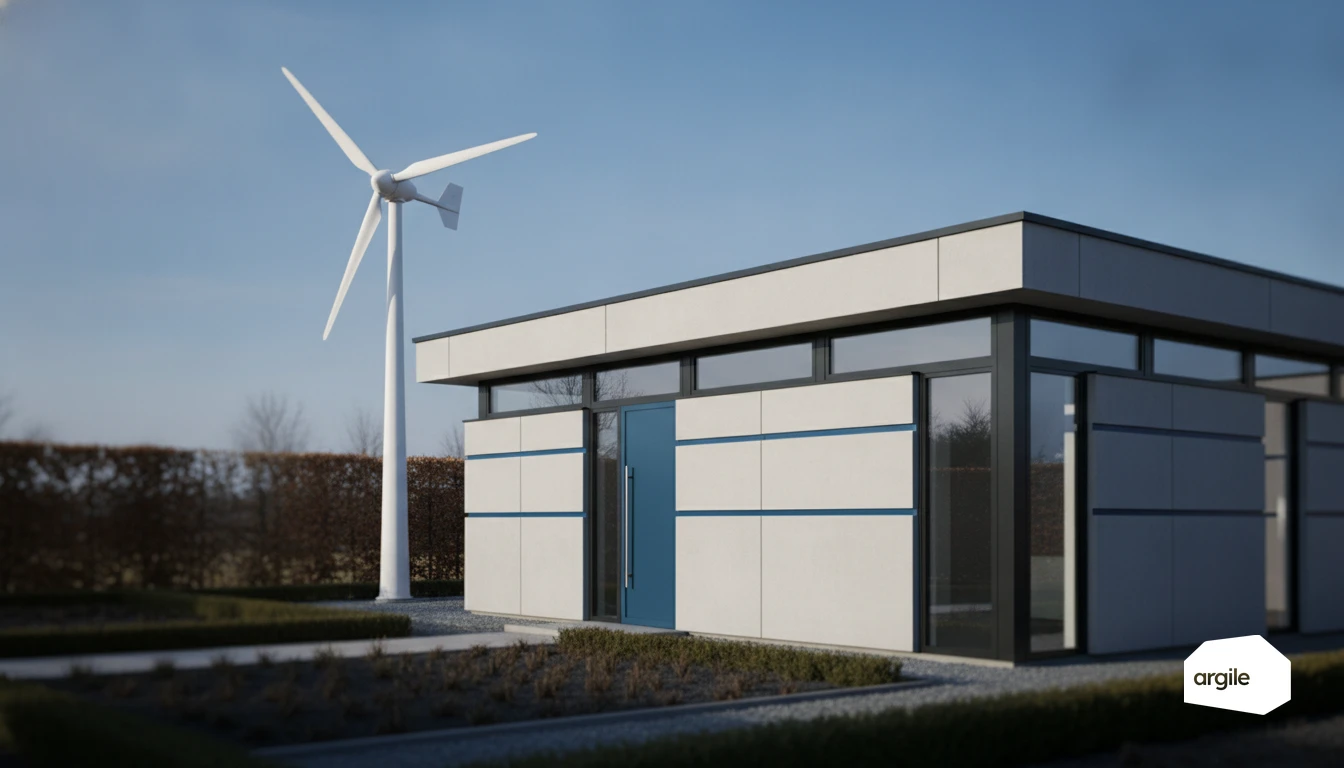
A pole-mounted micro wind turbine aims for cleaner wind capture, often above the turbulence. It needs land, foundations, and access for maintenance. A roof-mounted turbine looks simple, but the wind there is frequently broken up by the ridge and obstacles. The result is that output drops and the constraints of fixing, sealing, and vibration become critical.
Power, output and load factor: what the numbers on the datasheet actually mean
The stated power rating (kW) is measured at a given wind speed, not year-round. The real question is the kWh/year for your specific site. The load factor expresses the ratio between actual output and theoretical maximum output. A well-sited small turbine can perform decently, but a good number on a brochure doesn't replace a local wind assessment.
Site constraints: local wind, turbulence, distances and noise nuisance
Before signing, check the usable wind on your plot and any nearby obstacles. The more turbulent it is, the more wear and noise increase. Also plan ahead for distances to neighbours, planning rules, and an acceptable noise level. A site assessment, or even measurement over several weeks, avoids disappointing installations.
Common myths about wind power: what wastes time on site
"It works everywhere": why the built environment can crash output
In built-up areas, wind power quickly runs into turbulence. Roofs, trees, and gable ends break up the airflow. The result is that a machine marketed as "powerful" produces little if the mast doesn't clear the obstacles by a wide margin. An on-site wind survey avoids weeks of adjustments for nothing.
"It pays for itself in a few years": where the maths doesn't hold up
Profitability depends mainly on actual wind, not sales sheets. With an average resource, connection, maintenance, and insurance costs stretch out the payback. Without a cautious costed scenario, your schedule slips between revised quotes and administrative waiting.
"It's simple to install": points to watch (foundations, guying, safety, maintenance)
A small wind turbine is a structure. Properly sized foundations, guying, lifting, a safety zone, lightning protection, and electrical compliance all matter. Plan for maintenance access. Otherwise, every intervention becomes a mini job site that ties up the team.
Assessing renewable feasibility: a diagnostic method before pricing
Measuring and interpreting wind: weather data, obstructions, usable height and seasonality
Before talking budget, start by establishing the actual wind resource. Cross-reference local weather data with an on-site measurement when possible. Look at the speed at the usable height of the hub, not just at 10 m. Identify obstructions (trees, silos, terrain) and roughness. Also check seasonality, since output mainly depends on the windy periods.
Choosing the placement: mast, orientation, maintenance access and site integration
Placement is decided on the ground. A mast that's too low or too close to an obstacle creates turbulence and hurts output. Aim for a clear area, aligned with prevailing winds. Plan ahead for maintenance access (winch, nacelle, crane), the cable trench, the footprint of the guy wires, and simple integration into the site, without disrupting your uses.
Administrative checks: planning, neighbours, insurance and grid connection
On the rules side, start from the local zoning plan, easements, and any protected areas. Depending on the height and the project, a preliminary declaration or a full permit may be required. Check noise and neighbour impact, then secure insurance (liability, damages). Finally, clarify the connection and metering with the grid operator before finalising the pricing.
Wind power profitability in 2026: a simple calculation to decide (or walk away)
Estimating annual output: realistic assumptions and a safety margin
Base your figures on a cautious output estimate. Take the rated power, multiply by 8,760 hours, then by a local load factor. For small wind turbines, keep a margin and deduct 10 to 20% for downtime and losses.
Comparing scenarios: self-consumption, resale, storage and load management
The calculation hinges on the kWh actually put to use. Self-consumption is worth the price of the kWh avoided. Resale depends on a contract and its terms. Storage and load management (hot water tank, heat pump) increase the useful share.
Full budget: purchase, installation, civil works, connection, maintenance and replacement
Don't look only at the machine. Add the mast, foundations, lifting, connection, study, annual maintenance, and replacement of the inverter, controller, or batteries. Then work out a simple payback period.
Wind power and other renewables in residential settings: when to propose a more relevant alternative
Pairing with solar and a heat pump: sizing logic and limits
On paper, solar plus a heat pump plus wind power can smooth out output. In practice, small wind power is highly dependent on local wind, and sizing should start from actual electrical needs and the subscribed power. Avoid overengineering. Without storage, self-consumption stays limited, and the heat pump often needs power most during the coldest spells, when output remains uncertain.
Prioritising energy retrofit: insulation, airtightness, ventilation before renewables
Before adding a renewable source, look for the lost kWh. Careful insulation, good airtightness, and suitable ventilation reduce the heating power needed, and therefore the size of the heat pump and the bill. It's also the simplest way to secure performance, regardless of sunshine or wind.
Concrete recommendations: sites favourable to wind power vs sites to avoid
Favourable. Open terrain, on a ridge or open plain, far from obstacles, with steady wind, and a height compatible with planning rules. To avoid. Dense urban area, turbulent valley, proximity to trees and neighbours, heritage-protected area. In these cases, a photovoltaic plus sufficiency duo is often more relevant. On the solar side, panel layout, estimated output and self-consumption are simulated before pricing.