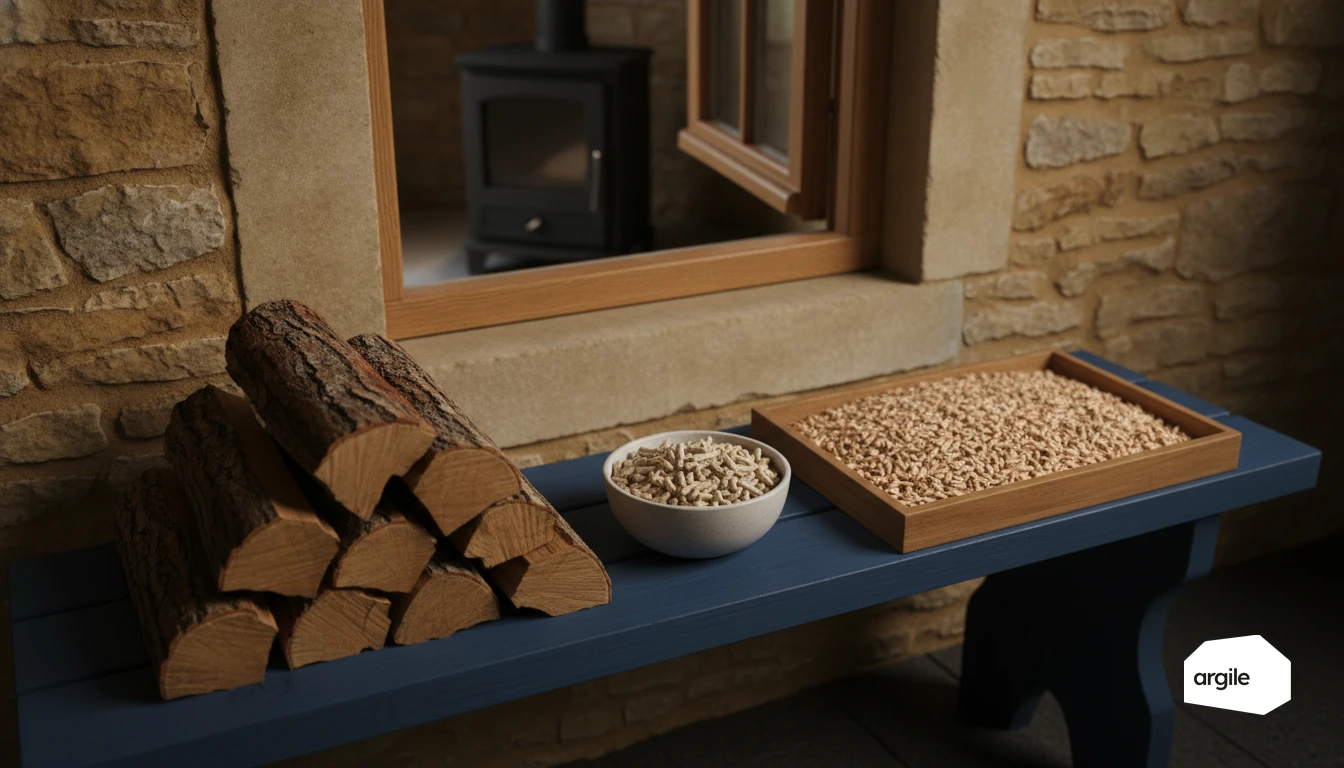
The three fuels cannot be compared by the kilo or by the stère, only by the delivered kWh of net calorific value. For the 2024-2025 season, the ADEME survey of wood fuel prices, run by CODA Stratégies across 324 retailers, puts a stère of 50 cm logs at €86 including tax delivered and a tonne of bulk pellets at €365, which works out at 4.3 and 7.9 cents per kWh using ADEME's conventional energy contents (2,000 kWh per stère, 4,600 kWh per tonne of pellets). Wood chips belong to another market and another billing unit: 3.3 cents excluding tax per kWh delivered to a district or industrial boiler house, for an energy content ranging from 2,400 to 4,200 kWh per tonne depending on the CIBE class. It is that last spread, not the headline price, that decides the real cost of a supply contract.
Defining your needs before choosing your wood
Main heating or supplementary heating: use changes everything
As a main heating source, what you are committing to is a rated output held across the season and an autonomy between two deliveries: the appliance is sized on the calculated heat losses, not on the floor area, and the fuel has to be uniform for the combustion settings to hold from one delivery to the next. As supplementary heating, the appliance does not enter the dwelling's output calculation and you are not guaranteeing that the demand is covered. The distinction is not a commercial one: it changes what you write on the quote and what you are liable for.
Appliance type: stove, insert, wood boiler or pellet boiler
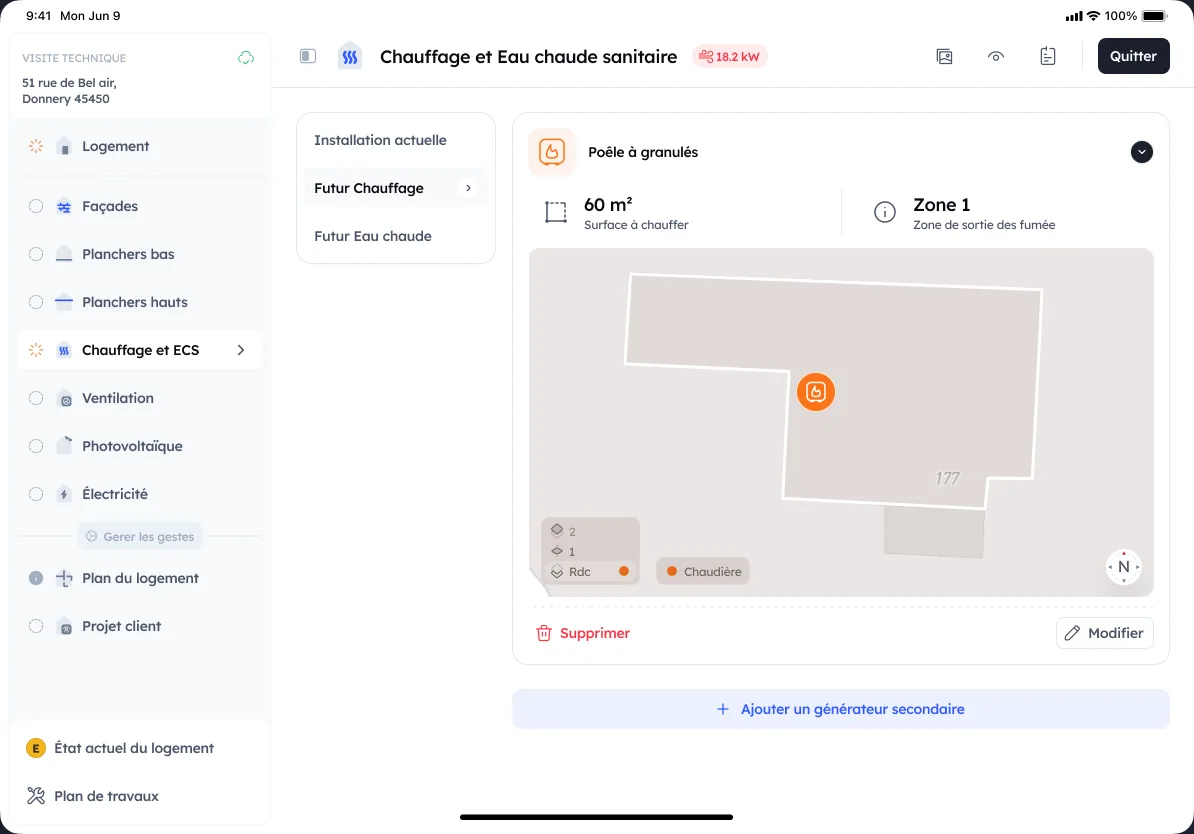
A stove or insert most often runs on logs. A wood boiler targets central heating and hot water production, with a larger volume of wood. A pellet boiler, meanwhile, relies on automation and comfort close to gas. In every case, wood quality matters. Aim for well-dried logs or certified pellets. For a pellet stove or boiler, the use, the location and the flue outlet are documented from the technical visit onwards.
Everyday comfort: storage, handling and feeding
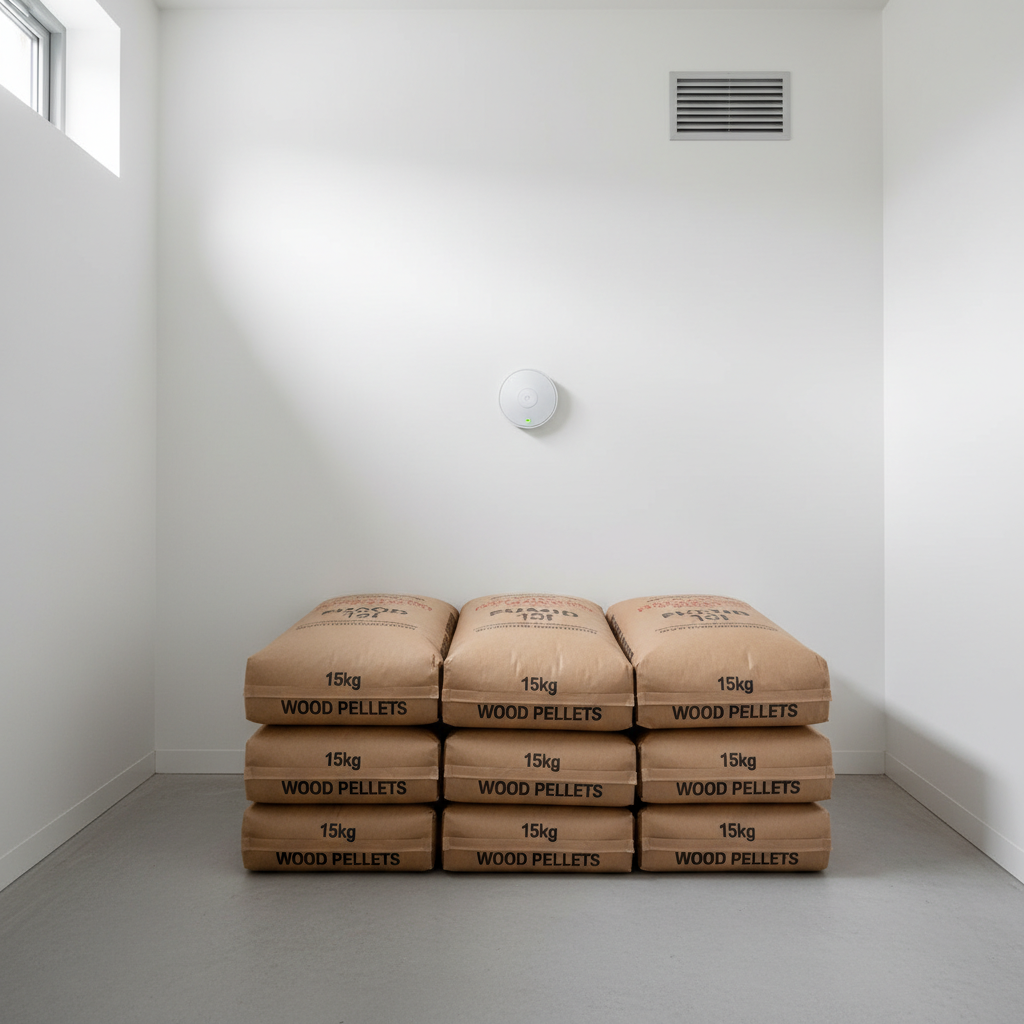
What you record on the technical visit decides more often than the stated preference. Logs call for a sheltered, ventilated volume plus an area to split them. Pellets call for a dry room the blower lorry can reach, with a hose length and a number of bends the delivery driver dictates. Wood chips call for a platform and a turning radius. Note those three constraints before proposing anything: it is the available storage volume, not the appliance, that rules out the impossible fuels.
Logs: the "traditional" wood for stoves and inserts
Species, moisture content and drying: the points that make performance
For a stove or insert, aim for dry wood. Dense hardwoods (oak, beech, hornbeam) give more heat and foul less for the same quantity. The criterion that matters is moisture. Below 20%, ignition is clean, output rises and smoke drops. Require air drying of at least 18 to 24 months, or kiln drying with proof of control. To go further, see our guide on the moisture content of firewood.
Length, diameter, cords: speaking the same language as your clients
On the ground, everything comes down to dimensions and volume. Confirm the usable length (often 25, 33 or 50 cm) and a diameter suited to limiting splitting. Clarify the notion of a stacked cord. A cord of 1 m logs doesn't have the same apparent volume as one of 50 or 33 cm logs. Always state the length and the stacking method.
Quality, origin and delivery: avoiding bad surprises on site
To avoid surprises, ask for a traceable origin, a moisture content measured at delivery, and an NF label or equivalent where possible. Check for fines and bark, the absence of mould, and plan for a dry, accessible unloading point. A detailed invoice protects you as much as your clients.
Pellets: calibrated wood for consistent output
Diameter, density, fines content: how to spot a good pellet
A good pellet is dry, uniform wood. Aim for a recognised certification, such as ENplus A1. Visually, the diameter is consistent (often 6 mm), the colour stays stable and the bag contains very little dust. Too many fines and too much moisture, and the feed auger strains, the flame becomes unstable and output drops.
Silo, bags, bulk: choosing the right packaging for the property
The silo is ideal if you heat all winter. It secures autonomy, provided you have a dry room accessible to the blower truck. Bags work as a stopgap in houses and flats alike, but require handling and a storage corner. Bulk is often the most economical option in use, if bulk delivery is possible without multiplying bends and pipe length.
Maintenance and settings: limiting fouling and breakdowns
A clean fuel helps, but maintenance makes the difference. Keep the ash pan clean, vacuum the burn pot, check the seals and air inlets. On the settings side, a pellet feed rate that's too high fouls the unit quickly. Rely on the manual and have the combustion checked during the annual service.
Wood chips: "collective" wood for large heat demand
For which projects: commercial buildings, co-owned properties, heat networks
Wood chips are suited to long, high-demand heating. Schools, gyms, care homes, co-owned apartment buildings or small heat networks. Their value shows with high throughput and steady consumption. Plan for a dedicated boiler room, operational monitoring and a solid maintenance contract.
Particle size, moisture, dust: the technical criteria to check
Fuel quality drives performance, and with wood chips it is contracted as a class, not as an adjective. The CIBE grouped the normative classes of ISO 17225 into five commercial categories, each tied to a particle size and a moisture class, and those are the categories the CEEB price surveys use as their reference.
| CIBE class | Product | Particle size | Moisture | Average energy content | Target boiler house |
|---|---|---|---|---|---|
| C1 | Fine dry graded chips | P16-P45A | M15-M30 | 3,800 kWh/t | < 200 to 300 kW |
| C2 | Graded air-dried chips | P45-P63 | M30-M40 | 3,100 kWh/t | < 800 kW, up to 1.5 MW |
| C3 | Ungraded chips and hog fuel | P63-P125 | M30-M40 | 3,100 kWh/t | 800 kW to a few MW |
| C4 | Very dry ungraded hog fuel | P100-P200 | M10-M20 | 4,200 kWh/t | > 800 kW |
| C5 | Very wet ungraded hog fuel | P100-P200 | M40-M55 | 2,400 kWh/t | > a few MW |
Between C5 and C4, the invoiced tonne carries either 2,400 or 4,200 kWh, a factor of 1.75 for a product called hog fuel in both cases. A supply contract that does not name the class therefore says nothing about the real cost of the heat, and that is the first thing to lock down in the specification. Note too that the market is not centred on dry fuel: in the CEEB figures reported by ADEME, chips above 40% moisture account for 61% of boiler house consumption, against 12% for those below 30%.
One last point drives the choice of class: the firebox technology. C1 targets the volcano firebox with auger extraction found on small boilers, while C4 and C5 target the grate firebox of large installations. Sizing the whole is covered in our article on the forestry wood chip boiler.
Logistics and storage: truck access, platform, auger and safety
On site, everything comes down to truck access and storage. Anticipate the turning radius, the unloading height and the manoeuvring space. For the silo, aim for a buffer volume, a clean platform and a reliable extraction system (auger, rake). Add fire safety, ventilation and temperature detection.
Price, subsidies and the winning choice in 2026: deciding without getting it wrong
Comparing the real cost of wood: useful energy, output and losses
To compare, bring everything back to the cost per useful kWh. The rule fits on one line: delivered price divided by the energy content, then divided by the appliance's efficiency. Here are the average delivered prices recorded by ADEME over the 2024-2025 season, converted using the survey's conventional energy contents.
| Fuel | Sales unit | Energy content used | 2024 average delivered price | Price per kWh LHV |
|---|---|---|---|---|
| 1 m logs | stère | 2,000 kWh/stère | €72 incl. tax | 3.6 c€ |
| 50 cm logs | stère | 2,000 kWh/stère | €86 incl. tax | 4.3 c€ |
| 33 cm logs | stère | 2,000 kWh/stère | €93 incl. tax | 4.7 c€ |
| 25 cm logs | stère | 2,000 kWh/stère | €97 incl. tax | 4.9 c€ |
| Bulk pellets | tonne | 4,600 kWh/t | €365 incl. tax | 7.9 c€ |
| Bagged pellets, by the pallet | tonne | 4,600 kWh/t | €383 incl. tax | 8.3 c€ |
| Compressed logs | tonne | 4,600 kWh/t | €389 incl. tax | 8.5 c€ |
| Forestry wood chips | tonne, boiler house | 2,400 to 4,200 kWh/t | CEEB price | 3.3 c€ excl. tax |
Two readings before you copy these figures into a sales pitch. First, the log rows are ranked by length, and it is the length that makes the price, not the species. Between the metre and the 25 cm, the spread per kWh is 36%, and it pays for splitting and drying that the client can do himself if he has the storage volume. Second, the 3.3 c€ for chips is a price excluding tax, recorded at district and industrial boiler houses, and it is not comparable with the tax-inclusive domestic figures on the other two rows.
Efficiency then does the rest, and the French 3CL-DPE 2021 method sets the conventional values, the ones the assessor will use after your visit. Applied to the prices above, they reverse the ranking.
| Generator, 3CL-DPE 2021 wording | Generation efficiency | Fuel used | Price per useful kWh |
|---|---|---|---|
| Log stove or insert installed before 1990 | 0.50 | 50 cm logs at 4.3 c€ | 8.6 c€ |
| Log stove or insert, Flamme Verte, from 2018 | 0.75 | 50 cm logs at 4.3 c€ | 5.7 c€ |
| Pellet stove without label, or before 2012 | 0.80 | bulk pellets at 7.9 c€ | 9.9 c€ |
| Pellet stove, Flamme Verte, from 2020 | 0.87 | bulk pellets at 7.9 c€ | 9.1 c€ |
The best pellet appliance in the table costs more per useful kWh than the worst log appliance. That is the argument nobody will let you sidestep in a meeting, and the honest answer is not to dispute the figure: pellets are bought for the automation, the fine control and the absence of handling, not for the price of the fuel. Add finally the losses the table does not carry: moisture pick-up in storage, handling, ash, sweeping.
2026 funding: the Boiler Upgrade Scheme, ECO4, VAT and certification depending on the case
Funding can cover a wood boiler where the required performance is met and the installer holds the right registration, MCS for the Boiler Upgrade Scheme, HETAS for the appliance and its installation. In a smoke control area, the appliance also has to be DEFRA-exempt. The zero VAT rate applies to energy-saving materials installed in a home.
Client pitch: making the right choice between logs, pellets and wood chips
Logs. Modest investment, but more effort and space required. Pellets. Automatic comfort, consistent quality, price more sensitive to the market. Wood chips. Relevant at high output or in collective settings, if you have storage space and local supply. The right choice is the one the client will actually use day to day.