Wood pellets emit carbon monoxide with no combustion involved, through self-heating caused by natural oxidation of the fatty acids in wood. France's ANSES documented this in VigilAnses no. 28 of April 2026: a 2025 French case where the fire service measured 700 to 1,000 ppm in a basement holding four tonnes of pellets, and a fatality in Switzerland in a store at 7,500 ppm, still at 2,000 ppm after two hours of ventilation. The agency's conclusion fits in one sentence: the store must be entirely separated from living space and have adequate ventilation. A CO alarm is a recommendation rather than a universal legal requirement, which puts the subject squarely on your duty to advise.
The mechanism, and what makes it worse
Emission without a fire
The phenomenon has nothing to do with combustion. ANSES puts it plainly: it is during storage that pellets can emit CO with no combustion, through self-heating caused by natural oxidation of the fatty acids in wood. So the CO is not a by-product of a badly set-up appliance, it is an emission from the fuel itself, in a room where nothing is running. No pellet quality certification covers this risk, which rests entirely on the store and its ventilation.
Two parameters drive the intensity, and both are within your control at design stage.
Temperature first. According to ANSES, emissions rise sharply with it: at 15 degrees the emission can already exceed several hundred ppm, and it is ten to fifteen times higher at 40 degrees. A store against a plant room wall, under an exposed roof slope, or in a thermally uninsulated space therefore sits in the wrong band for much of the year.
Species next. Again according to ANSES, some species emit more, notably pine and fir, while others emit less, such as spruce. The customer does not choose the species in practice, but this explains the variability between two deliveries and rules out reasoning on a single figure.
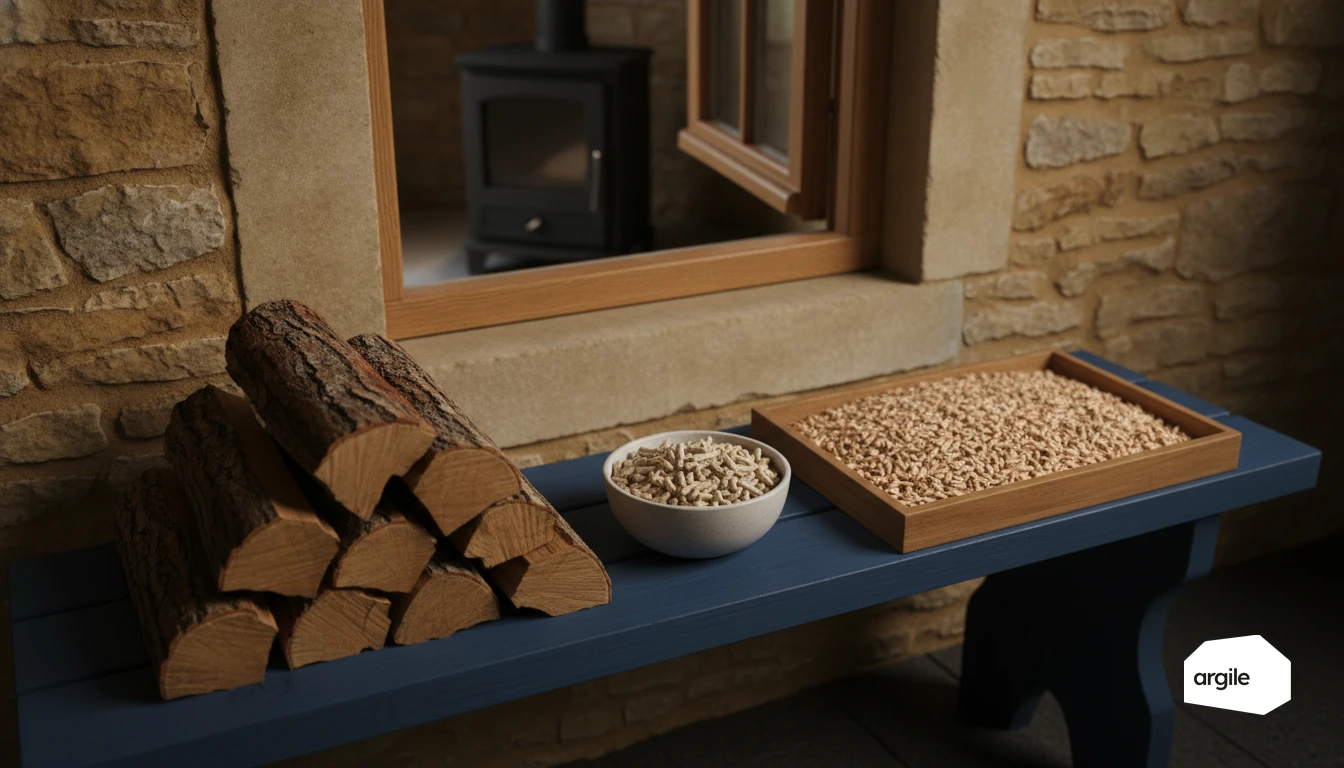
Age of the product, finally. The INRS notes an increased risk during the first six weeks after production. A bulk delivery of freshly made pellets into a closed room is therefore the least favourable configuration there is.
The toxicological reference points
| Reference point | Value | Source |
|---|---|---|
| Binding occupational exposure limit, 8 hours | 20 ppm, or 23 mg/m³ | French labour code, article R. 4412-149 |
| Binding occupational exposure limit, short term | 100 ppm, or 117 mg/m³ | French labour code, article R. 4412-149 |
| Coma, convulsions and respiratory distress | from 800 ppm | ANSES, VigilAnses no. 28 |
| Rapid death | from 1,900 ppm | ANSES, VigilAnses no. 28 |
| Fire service reading, French basement, 4 tonnes of pellets, 2025 | 700 to 1,000 ppm | ANSES, VigilAnses no. 28 |
| Storage room, Swiss fatality | 7,500 ppm, still 2,000 ppm after 2 hours of ventilation | ANSES, VigilAnses no. 28 |
The first two lines are enforceable in France: R. 4412-149 sets binding occupational exposure limits, not guidance values. Set the sixth line against them and the problem is visible: the Swiss room was at 75 times the short-term limit, and two hours of ventilation had only brought it down to 20 times that value.
What the European record shows
For the 2002 to 2011 period alone, the INRS recorded thirteen fatal CO poisoning accidents in Europe linked to pellets. Ten occurred in ships' holds, large storage rooms and silos, so in an occupational context. Three occurred from 2010 onwards in private storage rooms, which is precisely the configuration you install. The French case reported by ANSES in 2026 confirms that the shift into the residential setting is under way.
What you design, and what you refuse to design
The unventilated integrated store is the configuration to rule out
The causal chain is simple: closed room, recent pellets, rising temperature, CO accumulating, then diffusion into living space through pipe penetrations, electrical conduits and non-airtight partitions. That is exactly the description of the French case reported by ANSES, where the store was neither ventilated nor separated from the rest of the house.
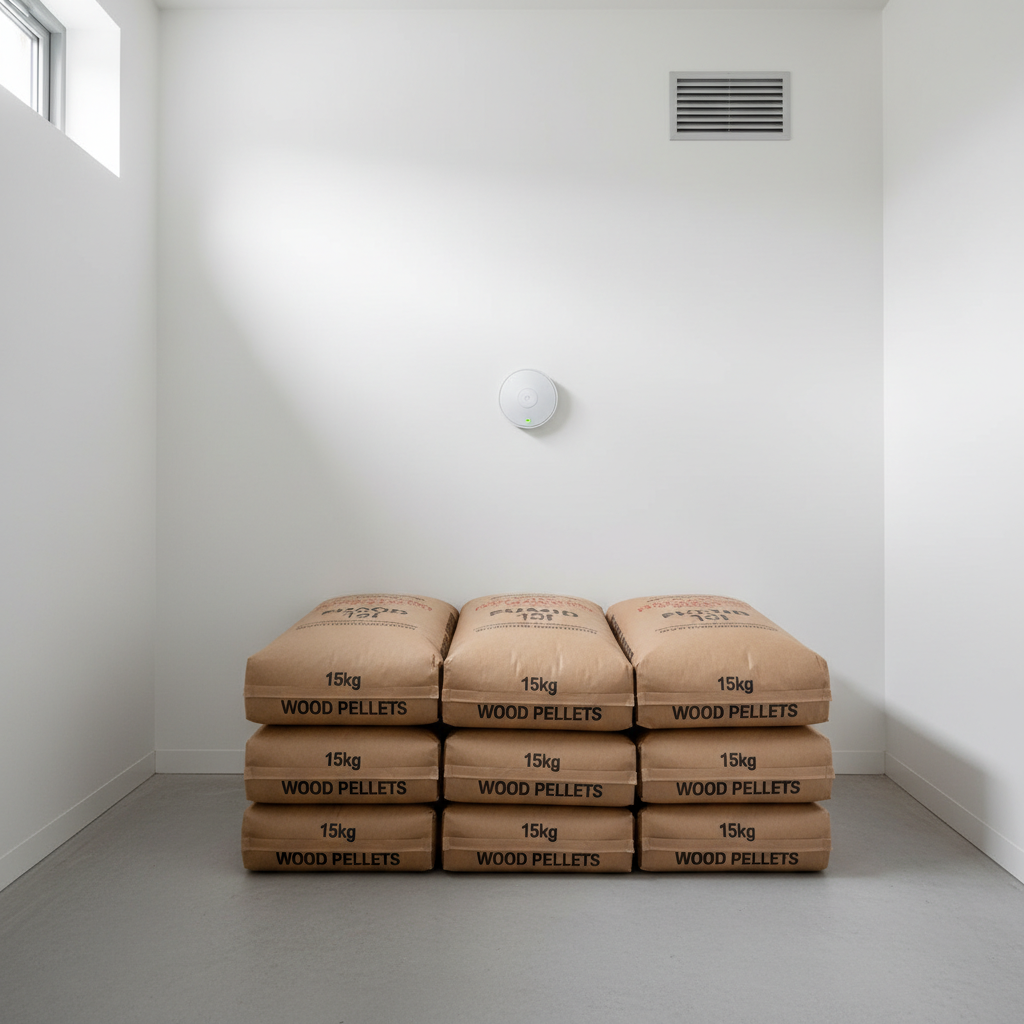
The agency's recommendation is explicit: pellets must be stored in a room entirely separated from the living accommodation and provided with adequate ventilation. Two requirements, not one. A ventilated but connected room is still dangerous, and so is a separated but sealed one.
The hierarchy of solutions
In decreasing order of safety: an external store, ventilated fabric silo, ventilated buried silo or a concrete store detached from the building; then a dedicated room inside the building, entirely separated from living space and ventilated high and low; then, only as a last resort, an integrated silo, provided separation and ventilation are genuinely designed and verified.
One design point that gets forgotten: silo sizing is not only a question of autonomy, and it comes up alongside the use, the siting and the flue route, the three steps the pellet stove workflow walks through during the survey. An oversized silo keeps stock in the risk window for longer. Two deliveries a year rather than one bulk drop reduce the quantity of recent pellets present at any moment, and smooth the customer's outlay along the way. That argument sells.
The CO alarm, worth recommending without overstating its status
ANSES notes that some French fire and rescue services recommend fitting a CO alarm near the storage area. That is a recommendation, and it should be presented as one.
Be precise with the customer about legal status, because that is where trust is won or lost.
- A smoke alarm is a requirement in dwellings across most jurisdictions, including France.
- A carbon monoxide alarm is not universally required, and in France no text imposes one in a dwelling.
- Regulatory CO prevention works through combustion air supply, flue evacuation and shutting the installation down after an incident.
- The applicable alarm standard is EN 50291-1, published on 1 September 2018, with a type A that drives an external device and a type B limited to the alarm.
A type A alarm wired to cut the silo supply is the serious answer in communal and commercial settings. In a dwelling, one alarm low down in the store and a second in the plant room is a defensible minimum, provided you tell the customer it complements ventilation rather than replacing it.
Working on a silo without putting yourself at risk
The rule that is not negotiable
Never enter a pellet silo without measuring the CO concentration first. The Swiss case reported by ANSES is unambiguous: 7,500 ppm in the room, and still 2,000 ppm after two hours of ventilation. Brief airing is not enough, and the nose detects nothing, since CO is odourless.
The defensible sequence is this: ventilate the room thoroughly before the work, measure with a portable instrument at floor level and at height, compare against the exposure limits, keep ventilating for as long as the value stays above them, and re-measure before every entry. Record the readings: it is a duty of result towards your operatives, and a piece of evidence if an accident happens.
What you hand the customer in writing
No regulatory obligation falls on pellet producers regarding CO risk labelling or a production date. The customer therefore has no simple way of knowing whether a delivery is recent, and so in its most emissive phase. That gap puts the subject on you.
The document to hand over fits on one page: never enter the silo, ventilate the room thoroughly before any technical work and wait, do not block the ventilation grilles, check the alarm once a year, and call a professional at the slightest doubt. Get it signed. That page documents your duty to advise, and it is the only thing that will distinguish you from an installer who said nothing on the day a file is investigated.
Not throwing the baby out with the bathwater
Pellets remain a relevant renewable fuel, with a competitive running cost and a level of convenience close to gas. The CO risk is real and documented, but it is manageable through simple measures: a separated and ventilated store, sensible sizing and split deliveries, an alarm as a complement, and written entry rules. An installer who masters this subject and builds it into the offer gains a commercial edge, because it addresses a point competitors still ignore. It also protects their liability, which is the real stake. The advisory logic is the same as the one set out in our guide to pellet stove selection.