The same load of wood reads 20% or 25% moisture depending on the convention used, and that is the first thing to settle before rejecting a delivery. The EN ISO 17225 series, which governs solid biofuels, expresses moisture content on a wet basis. The EN 13183 series, which governs timber as a material and the use of electrical resistance meters, expresses it on a dry basis. Then come the figures that decide real efficiency: starting from an oven-dry net calorific value in the order of 18.5 MJ/kg and a heat of vaporisation of 2.44 MJ per kilogram of water, a log at 20% on a wet basis delivers about 4.0 kWh/kg, against 3.4 kWh/kg at 30% and 2.2 kWh/kg at 50%.
The two conventions, and how to move between them
Why the same wood gives two figures
Moisture on a wet basis relates the mass of water to the total mass of the wet wood. Moisture on a dry basis relates that same mass of water to the mass of the dry wood. Both are correct, they simply do not measure the same thing, and the relationship between them is not linear. The conversion fits on one line: the dry-basis figure equals the wet-basis figure divided by one minus the wet-basis figure.
| Wet basis, solid biofuel convention | Dry basis, timber convention |
|---|---|
| 15% | 17.6% |
| 20% | 25.0% |
| 25% | 33.3% |
| 30% | 42.9% |
| 40% | 66.7% |
| 50% | 100% |
The gap becomes dramatic at the top of the table, but it is around 20% that it swings commercial decisions. A load declared compliant at 20% wet basis will read 25% on a meter calibrated on a dry basis: wrongly rejected, it costs you a delivery and a customer.
What your meter is actually showing
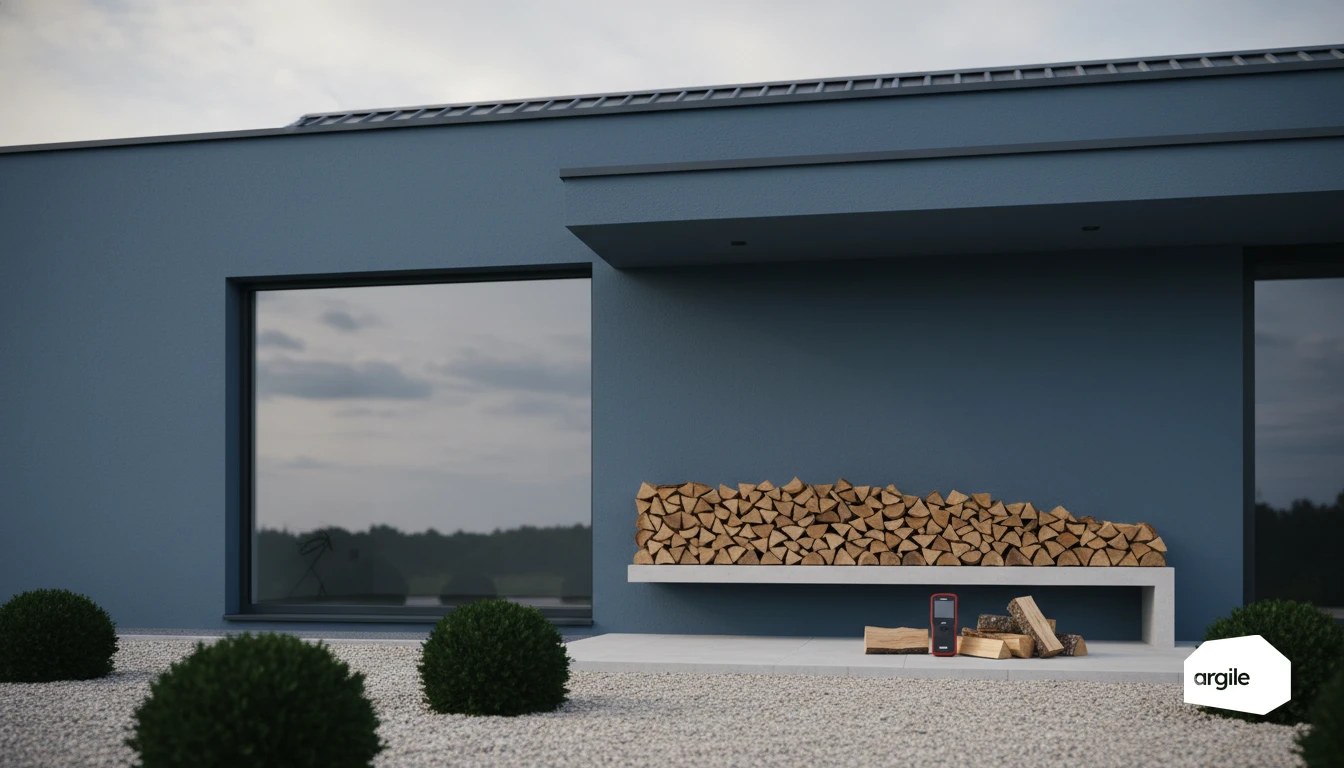
Pin meters intended for structural timber follow EN 13183-2 and work on a dry basis. Meters sold for firewood sometimes display wet basis, sometimes dry basis, and the manual does not always say so on the first page. Look for the statement in the manual, and failing that check against a sample whose value you know from weighing. Until that question is settled, no reading you take is enforceable.
Writing the convention on the record
A moisture reading with no stated convention is worthless in a dispute. Put the value, the convention, the species, the temperature of the wood and the number of readings behind the average on the document. That is the minimum for a supplier to accept a discrepancy, and it is also what protects you if the customer blames rapid fouling on your installation.
What the water really costs in energy
The calculation and its basis
The useful net calorific value starts from the oven-dry value of the wood, in the order of 18.5 MJ/kg give or take half a megajoule depending on species. Two effects reduce it. First substitution: every kilogram delivered contains a share of water that does not burn. Then vaporisation: about 2.44 MJ is spent evaporating each kilogram of water, and that energy leaves with the flue gases.
| Moisture on a wet basis | Approximate useful NCV | Difference against 20% |
|---|---|---|
| 15% | 4.3 kWh/kg | plus 7% |
| 20% | 4.0 kWh/kg | reference |
| 25% | 3.7 kWh/kg | minus 8% |
| 30% | 3.4 kWh/kg | minus 15% |
| 40% | 2.8 kWh/kg | minus 30% |
| 50% | 2.2 kWh/kg | minus 44% |
Those values count per kilogram delivered. Wood sold by volume and delivered at 40% therefore contains less combustible matter and more water to haul, which is why a wet load costs twice: once on purchase and once in the fire.
The hidden loss: appliance efficiency
The table above only measures the energy contained in the fuel. On top comes the drop in appliance efficiency, because water lowers the firebox temperature and makes combustion incomplete. That second effect is what produces black smoke, a fouled glass and tar. In other words, the real loss at the appliance outlet is greater than the calorific loss shown in the table.
What it does to the flue
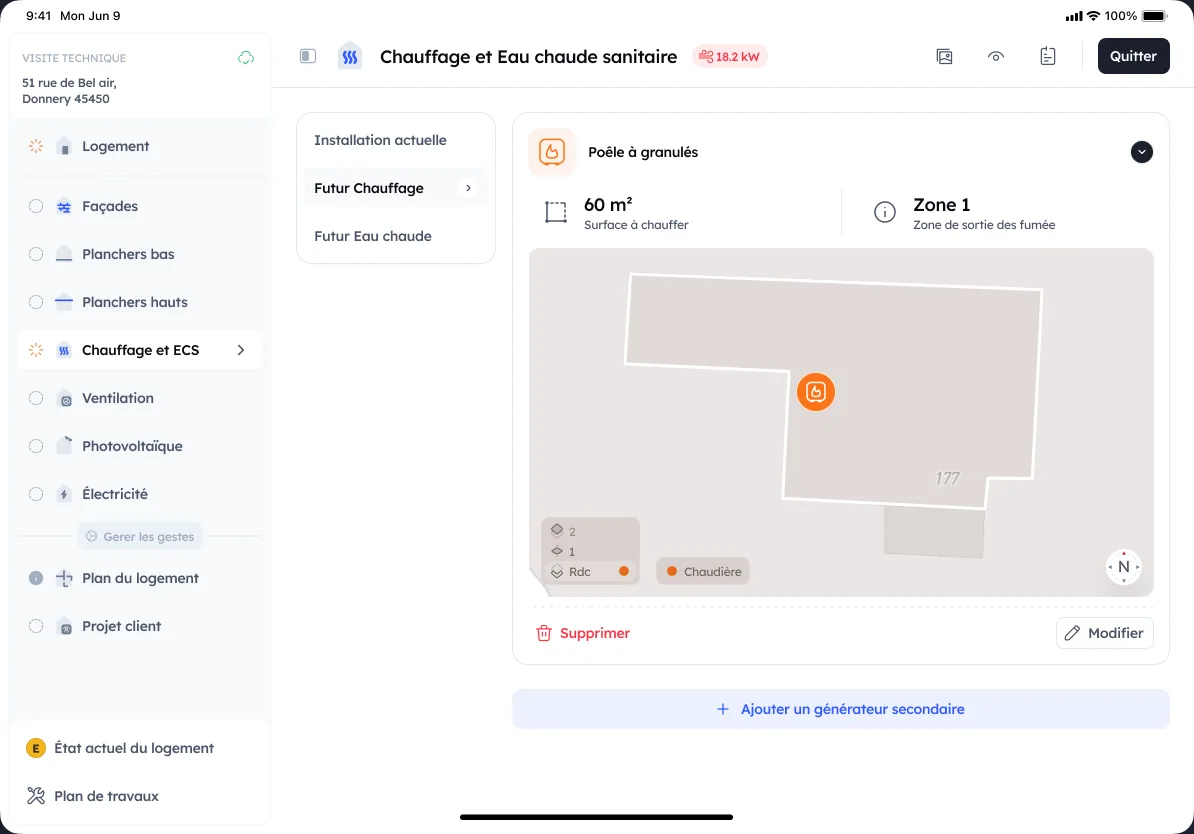
Combustion at low temperature loads the flue with condensable unburnt matter. The deposit builds up, the effective cross-section shrinks, the draught deteriorates and the risk of a flue fire rises. A customer burning wet wood sweeps more often, and after a fire an expert cannot easily separate a fuel problem from a draught problem if nothing was recorded. That is why a moisture reading at commissioning is worth taking. On a stove project, Argile checks the flue discharge rules and documents the outlet from the site visit onwards.
Measuring properly
The reference method and the site method
The reference method is oven drying to EN 13183-1: weigh a specimen, dry it to constant mass, weigh again, calculate. It is destructive and slow, but it is what carries weight and what calibrates a meter once a year. On site, estimation by electrical resistance to EN 13183-2 is enough, with a working range of roughly 7 to 30% and a species and temperature correction to apply.
Where to probe, and how many times
Re-split the log and measure on the fresh face, along the grain, a few centimetres in from the ends and at mid-thickness. The surface of a log stored outside is always drier than its core, sometimes by ten points. Five to ten readings spread across several logs from the load, then an average: a single reading has no statistical value on a mixed load.
The traps that distort a reading
Frozen or very cold wood reads low. A log left in the sun has a dry surface and a wet core. Mixed species or sizes mean re-checking the setting between logs. Treated or painted wood cannot be read at all. When in doubt, bring a log to room temperature for a few hours before measuring, and note the temperature on the record.
Thresholds by fuel
Logs
The reference target is moisture below 20%, with a minimum of eighteen months of drying after felling for wood delivered above 23%. It is a fire-management threshold as much as an efficiency one: beyond it, the evaporation phase takes up the start of every burn and the appliance never reaches its operating temperature. The storage that makes that threshold reachable, and the mistakes that rule it out, are covered in our article on storing firewood.
Pellets
Certified pellets come under EN ISO 17225-2 and carry a moisture content at or below 10% on a wet basis. That figure appears on the certificate and has to appear on the delivery note. A pellet that swells, breaks up or produces a lot of fines has picked up moisture in storage, and the feed auger reports it before the boiler does. The certification schemes and how they differ are set out in our article on wood pellet quality.
Wood chips
Chips commonly sit between 20 and 35% on a wet basis depending on the class and the storage. The relevant threshold is not an ideal but the range the installed boiler accepts, which is stated in its manual. Too wet, combustion deteriorates and shutdowns multiply. Too dry, dust increases and the settings get fussy. A check on delivery, with a dated reading, avoids both. Verifying the output the generator actually delivers is covered in our article on measuring a boiler's output.
What you hand over to the customer
Accepting a delivery
An acceptance check happens before payment, on three to five re-split logs taken from different parts of the heap. Take the readings, photograph the display and the log, note the convention and the average. A load stored on the ground, under a closed sheet or glistening at the surface is the one to check first: those are the three signs of trapped water.
Running the fire on compliant wood
Dry wood is run differently from wet wood: air open at the start, regular charges and clean flames rather than a maintained ember bed. Top-down lighting cuts the smoke from the warm-up phase and can be explained to a customer in two sentences, as set out in our article on top-down lighting.
The written record that protects you
Record the moisture reading at commissioning, the convention used and the instructions handed over. In after-sales work, those three items cut the diagnosis of a fouling problem down to minutes and stop a fuel problem from turning into a complaint about the installation.