Understanding the wood-chip boiler for large buildings
Logs vs wood chips: what changes for operation and maintenance
A log boiler requires manual loading. With wood chips, feeding becomes automatic via an auger or scraper from a hopper. Fuel quality matters. Controlled moisture limits fouling, stabilises combustion and reduces ash. On the maintenance side, you monitor the extractor, empty the ash bin, and keep up with regular chimney sweeping.
Output, efficiency and controls: the criteria that matter in a large building
In a large building, you aim for an output that covers peaks without oversizing. A modulating boiler, sometimes cascaded, handles the load with a buffer tank. Fine control (sensors, heating curve, lambda probe on some models) improves efficiency and avoids short cycling, especially in mid-season.
Footprint and layout in the boiler room: points to watch
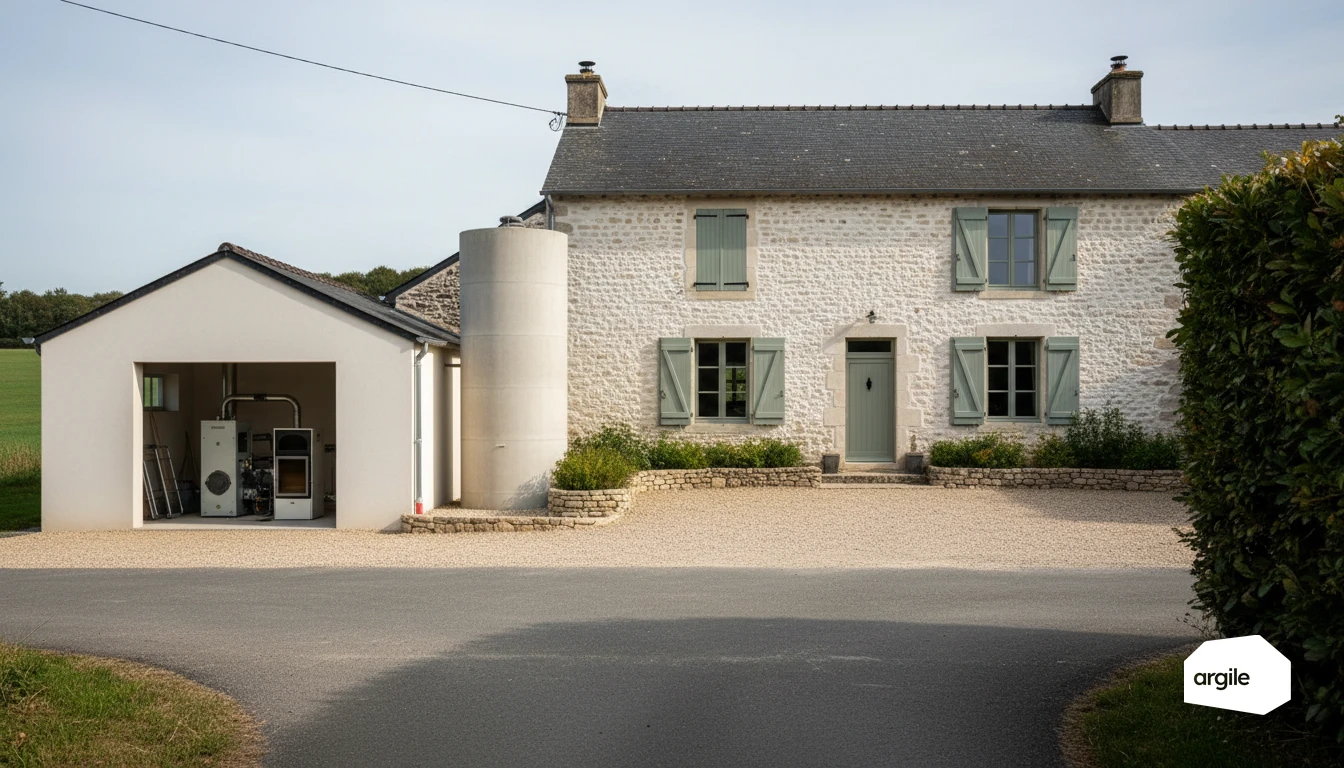
Plan space for the boiler, the hopper, the extraction system, and delivery access. Fire safety, ventilation, dust, ash removal and maintenance access are handled from the layout stage. A suitable flue and safety distances avoid unpleasant surprises.
Correctly sizing your boiler and the wood-chip feed chain
Heating and DHW needs: starting from actual consumption and occupancy profiles
To size the boiler, start from bills, heat readings and usage, retrieving actual consumption data rather than averages. Correct with degree-days and look at peaks, not just the average. The occupancy profile matters as much as the surface area. A family present all day doesn't draw the same way as a dwelling left empty during the week. For DHW, base your figures on the number of occupants and the fixtures. The goal is simple: avoid the oversizing that causes cycling, fouling and excess consumption.
Wood-chip hopper: volume, geometry, safety and delivery access
Aim for an autonomy consistent with the delivery frequency. Volume depends on annual consumption, wood-chip moisture and available space. A simple geometry, with regular slopes, limits bridging. Take care with safety. Fire brigade access, ventilation, lighting, no-occupancy rule. Also check delivery access. Turning radius, height, hose length if blown delivery is used.
Extraction, auger, blowing: choosing the right system to avoid jams
The extraction system is chosen based on the hopper's shape and its distance from the boiler. Scraper floor, auger, or suction-blowing for long runs. To reduce jams, require a consistent particle size, limit bends, provide an inspection hatch and a level sensor. A magnet or screen upstream keeps out foreign objects. An anti-jam setting is also a matter of maintenance.
Securing the wood supply and wood-chip quality
Moisture, particle size, fines rate: the parameters that drive performance
A wood boiler's performance is decided first in the hopper. Aim for homogeneous chips. Excessive moisture drives down efficiency and increases fouling. Particle size must stay consistent to avoid bridging and jams. The fines rate must be limited. Too much dust, and combustion becomes unstable, with more ash and more maintenance.
Contracts, delivery schedule and storage: limiting shortages in cold weather
During the heating season, the risk isn't a breakdown, it's a shortage. Secure a contract with fuel classes, tolerances, penalties and inspection procedures. Set a delivery schedule, with a buffer stock sized to the output and truck access. Dry, ventilated storage protects quality all the way to the feed auger.
Traceability and wood origin: requirements and expectations from contracting authorities in 2026
In 2026, contracting authorities expect clear traceability. Local origin, sustainable management, proof of compliance with quality classes. Prepare a batch record, from the forestry site to blowing, and keep the delivery notes. This is often the detail that reassures during audits and tenders.
Successfully installing and maintaining the boiler in commercial operation
Hydraulics, buffer tanks and decoupling: ensuring network stability
In commercial operation, a boiler must absorb irregular power demand. A buffer tank limits short cycling and stabilises temperature. Hydraulic decoupling (low-loss header or heat exchanger) prevents flow variations on the network side from disturbing the generator. Aim for simple, traceable balancing, with purge points and accessible isolation valves.
Ash management, chimney sweeping, flue gas checks: organising controlled maintenance
Plan ash removal and heat exchanger cleaning based on usage, not by eye. Schedule chimney sweeping and flue inspection, then log dates and results. A flue gas check (CO, draught, tightness) helps maintain efficiency and air quality. Plan a contract with rapid response during the heating season.
Fire safety and compliance: detectors, dampers, instructions and register
Reduce fire risk with suitable detectors, accessible fire extinguishers and clean storage zones. Add dampers and non-return devices on the fuel feed where needed. Post clear instructions and keep a maintenance register, useful during inspections and to secure operations.
Subsidies and procedures in 2026: building a solid case for a wood boiler in a large building
Overview of the available funding: national funds, local schemes, possible support
In 2026, the funding for a biomass boiler at this scale comes from the fund that matches the building's owner rather than from a single national scheme, and the Boiler Upgrade Scheme stops at domestic properties. Depending on the project's size, a design office is usually needed to assemble the application. Finally, consider what the local authority and the combined authority run, and regional schemes to secure the process.
Certification and job-site requirements: documents, evidence and good practices to avoid rejections
To limit rework, prepare a simple, complete file of supporting documents. Keep the signed quote, the itemised invoice, the technical data sheet (efficiency, standard), before-and-after photos, the commissioning report and the declarations signed within the deadline. On the company side, check for certification suited to biomass at this output, MCS below its threshold, and the relevant competence scheme above it.
Costing and return on investment: comparing with gas and electricity at 2026 prices
In a large building, the real comparison is made on total cost. Take your 2026 gas and electricity prices (kWh, subscription, taxes), then add delivery, storage, maintenance and operation for wood. Cost it over 10 to 15 years, with a cautious scenario on price rises, and you'll have a solid basis for deciding.