Understanding the functional economy applied to home comfort
Moving from product to use: what "paying for comfort" concretely means
With the functional economy, the client doesn't "pay for a boiler" or "for insulation." They pay for an expected level of comfort. A simple example: a stable temperature, less humidity, a lower bill. Equipment still matters, but it becomes a means, not the end. The contract is mainly about usage, with ongoing monitoring.
Benefits for the client: controlled budget, peace of mind, measurable results
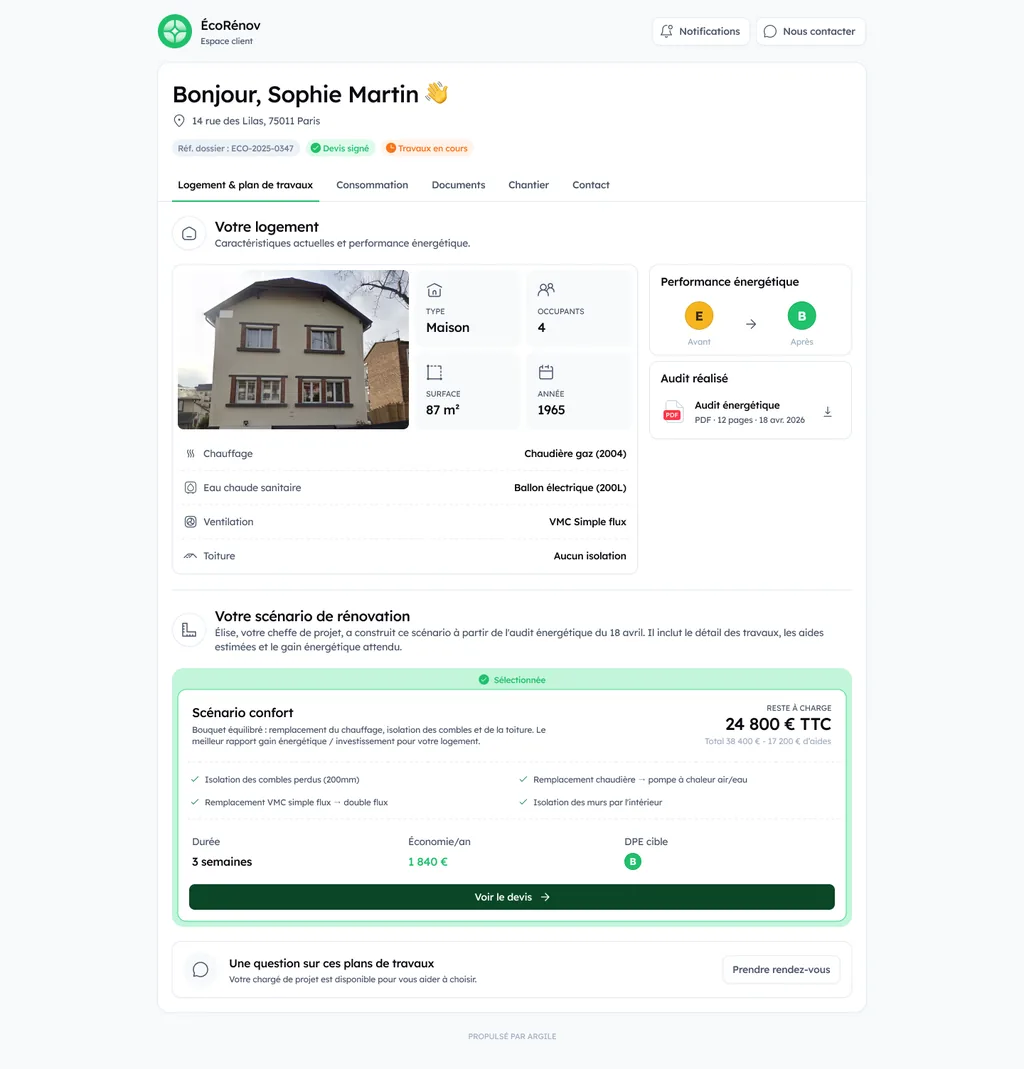
For the household, it's a predictable budget. Surprises go down. Maintenance, adjustments and small fixes are included. Results are measurable: consumption before and after, perceived comfort, air quality. The client gains peace of mind, because they know who to call and what you're committing to. Those results stay visible when the client follows their consumption and the savings from the installation in a dedicated portal.
What this changes for you: a long-term relationship and service quality
For you, it's a longer, more stable relationship. You're selling a lasting service, not just a job. This pushes you to size, adjust and explain things better, and to build tools for follow-up. That's often where quality shows: over the following winter, not on handover day.
Choosing a viable business model to sell comfort rather than a job
Subscription, results-based fee, or performance contract: which model fits your projects?
For recurring interventions, the functional economy lends itself well to a subscription. You sell monitoring, adjustment and maintenance (heat pump, mechanical ventilation, controls). For a bigger renovation, a results-based fee works if you define a simple indicator, winter comfort, humidity, or post-work kWh, for example. A performance contract becomes viable once before/after measurement and monitoring are under control.
Defining the "comfort service": scope, limits, responsibilities and guarantees
Set a clear scope. What's included (tuning, visits, optimization, support). What isn't (occupant behaviour, weather, work outside the package). Spell out responsibilities, insurance, response times, and the proper-operation guarantee. With a results commitment, frame the conditions for success and the evidence required.
Pricing without mistakes: real costs, margin, risks and revision clauses
Start from real costs. Job time, service calls, travel, measurement equipment, monitoring tools, subcontracting. Add a margin and a contingency provision. Protect yourself with revision clauses (construction cost index, equipment price increases) and an exit clause if the initial condition makes the target impossible.
Rolling out field-level innovation: packaged offers and day-to-day organization
Building a simple offer: insulation + heating + control + maintenance
To sell more easily, assemble a packaged offer with 4 clear building blocks. Insulation to cut losses, suitable heating, controls for fine-tuning, and maintenance to make it last. The idea is close to the functional economy. You're not just selling equipment, you're selling a level of comfort and controlled consumption, with a single point of contact.
Standardizing your steps: technical visit, energy audit, commissioning, follow-up
- Technical visit. Surveys, photos, constraints, and preliminary agreement on the scenario.
- Energy audit. Prioritize the work and lock in the logical order.
- Commissioning. Adjustments, explanations for the client, and a startup report.
- Follow-up. A call at day 30, then a check during the first winter if needed.
Training your teams and partners: service calls, maintenance, and coordination
Give everyone a method. Service-call diagnosis, parts, lead times, and safety instructions. On maintenance, offer a contract with simple checkpoints. And secure the coordination between certified trades. Who does what, what evidence, what signatures, to keep clean job traceability in case of an inspection.
Measuring and proving comfort: indicators, data and results commitment
Which indicators to track: temperature, humidity, consumption, air quality
To move beyond gut feeling, track 4 markers. Room-by-room temperature, aiming for stability around 19-20°C during the day. Relative humidity, generally more comfortable between 40 and 60%. Consumption (kWh, monthly readings) normalized to floor area and weather. And air quality, tracking CO2 and airing peaks.
Tools available in 2026: sensors, thermostats, readings and client reports
In 2026, a wireless temperature-humidity-CO2 sensor and a programmable thermostat are enough to objectify results. On consumption, rely on the smart meter, bills and a before/after table. In a functional-economy approach, your simple proof consists of graphs, screenshots and a clear, dated, signed client report. On the data side, actual consumption is pulled from the energy distributors with the client's consent.
Managing deviations: adjustments, continuous improvement and action plan
If the data drifts, you don't just accept it. Revisit the settings (heating curve, balancing, mechanical-ventilation flow rates), check for air leaks and usage patterns. Offer a tuning visit at day 30 and a short action plan. You show the way forward and stay in control of the result.
Financing and the 2026 framework: combining the functional economy, grants and compliance
Compatibility with the funding schemes: what works, what blocks, how to stay safe
Under the functional economy, the schemes mainly fund eligible work, not a subscription. What works: a quote that separates supply, installation and options. A registered company, with performance aligned with the measure specification. What blocks: an "all-inclusive" price with no breakdown, a vague rental offer, or a file put together after the work has started. To stay safe: get eligibility validated upfront, keep the evidence, and frame the combination of schemes.
Contracts and insurance: maintenance, liability, and intervention conditions
If you're selling a service, the contract needs to be airtight. Define maintenance levels, response times and risk allocation. Check your ten-year structural warranty (décennale) and professional liability insurance, and how subcontracting is managed. Specify site access, parts, and the conditions for bringing things back into compliance if a non-conformity is found.
Use cases by property type: single-family home, co-owned building, small commercial
Single-family home. Heat pump, insulation, then a clear maintenance contract. Co-owned building. Collective work, vote, coordination with the property manager, and harmonized supporting documents. Small commercial. Targeted actions (heating, controls, insulation) with savings tracking, keeping a "works" invoice separate from the service.