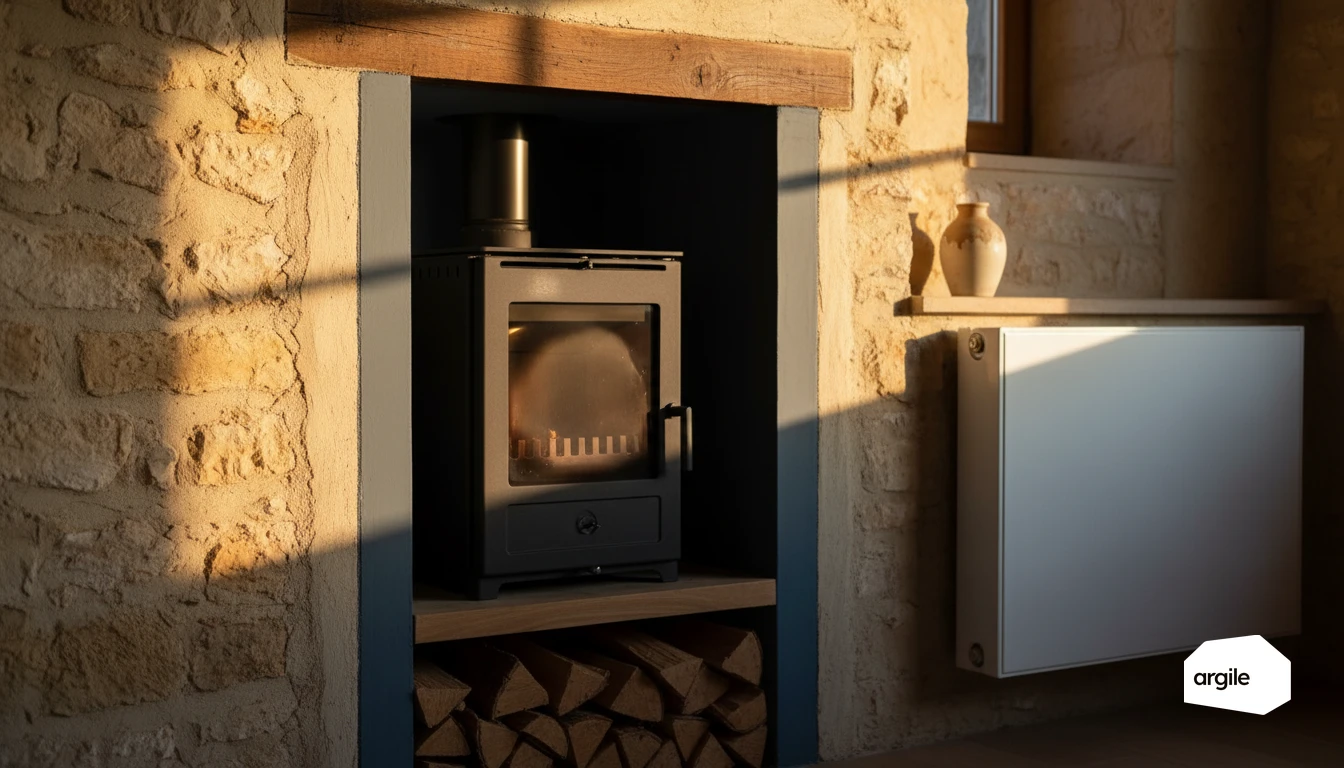
A back-boiler wood stove heats the room it stands in and, through a heat exchanger built into the firebox, the water of a central heating circuit. Once connected to that wet loop, is not assessed as an independent room heater: it falls under the solid fuel boiler regime, so BS EN 303-5 class and seasonal space heating efficiency are what the paperwork turns on. In practice a manually fed appliance needs a buffer vessel, because a log burn delivers its output when the fire decides and not when the dwelling asks for it, and a thermal discharge valve so a power cut cannot boil the appliance dry. The Ecodesign regulation for solid fuel boilers sets the seasonal efficiency and emission floors that a compliant appliance has to declare.
Back-boiler stoves: the hydraulic principle and possible uses in renovation
Difference between a standard wood stove and a back-boiler stove (water + heating)
A standard wood stove mainly heats the room it's installed in, through radiation and convection. A back-boiler stove recovers part of the heat via a heat exchanger to heat water in the circuit. You keep the "wood fire" atmosphere while also supplying emitters in the rest of the house, such as radiators.
Operating diagram: heat exchanger, buffer tank, radiators and/or underfloor heating
Inside the stove, the heat exchanger transfers heat to the water. A buffer tank stores and smooths production, then a circulator sends the water to radiators and/or underfloor heating, often with a mixing valve to hold the right temperature. Hydraulic safety devices are also included, notably an expansion vessel and a thermal relief valve.
For which jobs: existing homes, boiler replacement, combined with solar or a heat pump
In renovation, it suits homes already on central heating, particularly when replacing an oil or gas boiler. The stove can also work as a backup to a heat pump, or combine with solar thermal via the buffer tank. Sizing is done case by case, depending on insulation, emitters and the flue.
Adding a back boiler to an existing wood stove: feasibility and risks
On most wood stoves, the answer is no. An appliance that was not designed and tested with a heat exchanger cannot take one without losing its certification. The only clean route is the back-boiler kit the manufacturer provides for that exact model, described in its manual.
Manufacturer's back-boiler kit or universal kit: what changes
Some manufacturers offer the same model as an air version or with an optional heat exchanger. The kit then appears in the manual, the output to water and the efficiency are given with the kit fitted, and the appliance stays covered by its declaration of performance. The universal kit sold "for all stoves" is another story. The exchanger cools the firebox walls, combustion deteriorates (carbon monoxide, unburnt gases, creosote) and the declared performance no longer matches what is installed. The Flamme Verte label can no longer be relied on, the CEE incentive is lost, and after a claim the assessor will trace it back to the modification, and so to the installer. The same reasoning applies to inserts, covered in our article on the back-boiler insert.
Heat recovery on the flue: a false good idea
A coil or exchanger fitted on the connecting flue promises to recover lost heat without touching the stove. In practice, it pulls the flue-gas temperature below the point where it condenses. Draught weakens, creosote builds up and the risk of a chimney fire rises. The set-up also falls outside the appliance manual and the flue installation rules. Turn it down in writing if the customer insists.
When to replace rather than retrofit
Three situations point towards a new, certified back-boiler stove rather than tinkering with the existing one:
- the customer wants to heat several rooms beyond the room where it stands, which an air stove will never do;
- a radiator network in good condition already exists, fed by an oil or gas boiler to be replaced or kept as backup;
- the flue needs lining or rework anyway, and the chimney work is already on the quote.
Sizing a back-boiler stove correctly to avoid overheating and lack of comfort
Firebox output vs. output to water: understanding the right proportions
On a back-boiler stove, the stated output is split between heat blown into the room and heat sent to the network. If the "air" share is too high, the living room quickly reaches 24-26°C while the bedrooms stay lukewarm. In renovation, generally aim for a majority of output going to water, around 60 to 80%, to keep the living room comfortable.
Example: reading the water and air split in a manual
Take a log stove whose manual states 16 kW nominal, of which 12 kW to water and 4 kW released into the room. The values are illustrative: every model has its own, and the manual for the model installed is what counts.
| Figure read in the manual | Value (example) | Compare with |
|---|---|---|
| Nominal output | 16 kW | the CEE sheet ceiling (70 kW) |
| Output to water | 12 kW | heat loss of the rooms served by the loop |
| Output released into the room | 4 kW | heat loss of the room where it stands |
| Share to water | 75% | the balance you want between living room and bedrooms |
If the room where it stands loses 1.5 kW at the design temperature, 4 kW on the air side will overheat it with every burn: look for a model whose air share stays close to that room's heat loss. Conversely, a standard 8 kW wood stove will never heat five radiators, even fitted with an exchanger. That is not a setting, it is output that does not exist on the water side.
Quick calculation based on surface area, insulation and emitters (cast-iron, steel, low-temperature radiators)
As an order of magnitude, start from 30 W/m² in a very well-insulated home, 50 W/m² for average insulation, 80 W/m² for an energy sieve. Multiply by the heated surface, then check that your emitters can keep up. For the figure that goes in the file, Argile builds the NF EN 12831-1 heat-loss report from the survey data. Cast-iron radiators handle cycling well, steel reacts faster. In low temperature (LT), you need more flow and a well-set heating curve.
Choosing the buffer tank: volume, stratification, DHW priority and backup
The buffer tank avoids start-stop cycling and absorbs peaks. Generally budget 20 to 50 L per kW of output to water, depending on the fuel and your use case. Take care with stratification (flows out at the top, returns at the bottom). If DHW takes priority, plan for a suitable heat exchanger and a backup for when the stove isn't loaded.
Back-boiler stove and central heating: the connection diagram
A back-boiler stove can be connected to an existing radiator or underfloor heating network on two conditions: a buffer tank between the stove and the emitters, and the safety devices specific to solid fuel, which a gas boiler never needed. A log fire cannot be switched off on demand, and the whole installation is designed around that constraint.
The schematic, from the stove outlet to the emitters
- The stove flow goes to the top of the buffer tank through the primary circuit.
- The return leaves the bottom of the tank towards the stove through a loading unit: circulator and anti-condensation valve, which sends water back to the stove until the return reaches the set point in the manual.
- As close to the stove as possible, the safety relief valve, the air vent and the thermal discharge valve, fed with cold mains water and draining to the sewer.
- The expansion vessel, with no operable isolation valve between it and the stove.
- On the secondary side, the flow from the top of the tank feeds a three-way mixing valve, driven by a heating curve.
- The heating circulator then distributes the water to the radiators or underfloor heating.
- The return from the emitters enters the bottom of the tank, which preserves stratification.
The primary circulator starts on the stove water temperature, not on a timer, and the sensor driving the backup sits in the upper third of the tank. The two circuits stay decoupled: the stove loads the tank at its own pace, the emitters draw from it at theirs.
Keeping the existing boiler as backup
The oil or gas boiler can stay in place for days without a fire. Connect it to the top of the tank so that it only heats the volume needed for the heating flow, never the whole store: otherwise it heats, at great cost, the water the wood should have supplied. Anti-thermosiphon check valves stop an idle heat source from draining heat out of the other. The same tank can also take a low-temperature heat pump as backup, a set-up covered in our article on the buffer tank.
Connection and safety: the key points of a reliable hydraulic installation
Closed or open circuit: expansion vessel, thermal relief valve and anti-condensation
On a hydraulic stove, choose the right layout from the start. In a closed circuit, plan for a properly sized expansion vessel, a safety relief valve and an efficient bleed valve. For wood, a thermal relief valve draining to the sewer limits overheating in the event of a power cut. An anti-condensation loop or a mixing valve protects the appliance from returns that are too cold.
| Safety device | Role | Usual setting |
|---|---|---|
| Safety relief valve | limits circuit pressure | set at 3 bar, unless the manual says otherwise |
| Thermal discharge valve | removes the heat of a fire that cannot be put out, using cold mains water | opens around 95°C |
| Expansion vessel | absorbs expansion of the water in the circuit and the tank | pre-charge set to the static head |
| Anti-condensation unit | keeps the return hot to avoid creosote and corrosion | manual set point, often 55 to 60°C |
The buffer tank multiplies the water volume of the circuit: the boiler's original vessel is almost always too small. The calculation method is set out in our article on sizing the expansion vessel.
Controls and hydraulics: circulators, 3-way valve, managing cold returns
The circulator must be suited to the pressure loss and positioned to avoid cavitation. A controlled 3-way valve helps stabilise the flow temperature and keep the return above the anti-condensation threshold. Also think about balancing, anti-thermosiphon check valves, and controls that shut off the stove if the exhaust loop isn't available.
Flues, draught and air supply: what to check before installing the stove
Before installation, check the condition of the flue, its continuity, its tightness, and compliance with safety clearances. Check the actual draught, the compatibility of the lining, and a sufficient air supply to avoid backdraught and fouling. To go further, see our article on flue lining. A well-fed appliance means cleaner combustion and a smoother installation.
Wood, performance and maintenance: guaranteeing efficiency day to day
Which wood to use: moisture content, species, storage and impact on fouling
To aim for good efficiency, start with dry wood (around 20% moisture or less), checking which basis your meter expresses that figure on, a point developed in our article on firewood moisture content. Beech, oak and hornbeam give a stable ember bed. Softwoods also work if the stove is designed for them, but they foul faster when the wood is damp. Store split, ventilated, sheltered from rain, never tarped at ground level. Wood that's too damp cools the flue gases. The result: deposits, a blackened glass, and a flue that fouls up.
Actual on-site efficiency: settings, cycles, combustion quality and network losses
On site, the stated efficiency mostly drops because of a poorly set air control and smothered cycles. It's better to have brisk, clean burns, a clean air intake, and a properly sized appliance. On the hydraulic network, insulate the pipes, balance the flow rates, and monitor the return temperature. Otherwise, you're heating the boiler room more than the home.
Upkeep and maintenance: chimney sweeping, heat exchanger, hydraulic sludge, component checks
Plan for chimney sweeping according to local regulations, often 1 to 2 times a year for wood. Clean the heat exchanger and baffles, empty the ashes without smothering the air inlets. On the water side, watch for sludge: filter, dirt separator, bleeding, checking the circulator, the relief valve and the expansion vessel. An annual check avoids breakdowns at the worst time. To frame the requirements, see the obligations and regulatory frequency.
Cost of an installed back-boiler wood stove: the quote line items
For a log back-boiler stove connected to an existing radiator network, buffer tank and safety devices included, allow roughly €8,000 to €18,000 excluding VAT. The spread comes mostly from the flue and the distance between stove and tank. The ranges below are market orders of magnitude, before grants, to be adjusted to your supplier prices.
| Quote line | Order of magnitude (€ excl. VAT) | What makes it vary |
|---|---|---|
| Log back-boiler stove | 3,000 to 7,000 | output to water, finish, brand |
| Insulated buffer tank, 500 to 1,000 L | 1,000 to 2,500 | volume, built-in DHW or solar coil |
| Loading unit, circulators, mixing valve | 800 to 1,800 | pre-assembled unit or built on site |
| Expansion vessel, relief valves, thermal discharge | 300 to 700 | vessel volume, discharge pipe length |
| Flue lining or flue | 1,000 to 3,000 | condition of the existing flue, height, new build |
| Hydraulic labour and commissioning | 1,500 to 3,500 | stove-to-tank distance, network rework |
Faced with a cheaper competing quote, look first at what is missing: the buffer tank, the thermal discharge and the anti-condensation unit are the three lines removed to save €2,000. They are also the three the CEE sheet or the manual require, and the ones that decide how long the exchanger lasts. Itemise them line by line rather than as a lump "hydraulics" sum.
Grants and framework in 2026: what you can (or can't) claim with a back-boiler stove
MaPrimeRénov' in 2026: no more per-measure flat rate for wood heating
Biomass boilers left the per-measure pathway on 1st January 2026 (decree no. 2025-956), and stoves and inserts followed for applications filed from 1st September 2026 (decree no. 2026-822). A back-boiler stove sold on its own therefore no longer opens a MaPrimeRénov' flat rate, whether it is read as a boiler or as a stove. The Anah only funds it in the guided pathway, as part of a whole-house renovation package followed by an Accompagnateur Rénov'. The breakdown by income profile is in our article on MaPrimeRénov' and biomass boilers. Give the customer two prices, the single measure with the CEE incentive and the full package, rather than a flat rate that no longer exists.
CEE and Coup de pouce schemes: how to secure eligibility depending on the equipment and installation
On the CEE side, secure the operation by choosing the right technical sheet, standalone wood appliance or biomass boiler depending on the water connection. The equipment must meet the efficiency and emissions requirements, and the installation must be traceable: order date, honour declaration, commissioning. Coup de pouce schemes don't cover every wood appliance, so validate the offer before signing. Argile carries those values into the quote and flags what is missing before it goes out.
Flamme Verte, 5.5% VAT and combining: what can still be claimed
The Flamme Verte label is not a grant, it is evidence. On a 7-star appliance, it spares you from producing the four emission values one by one in the CEE file, hence the point of checking the exact model reference on the label's list before signing (see our note on the Flamme Verte 7-star label). The 5.5% VAT rate applies to supply and fitting of an efficient wood-heating appliance in a home completed more than two years ago. Add the zero-rate eco-loan and local authority grants, which vary from one area to another. Finally, check whether a Coup de pouce bonus is in force on the date the operation is committed: these programmes change often and do not cover every appliance.
RGE: relevant qualifications and good practices to avoid rejected applications
For a back-boiler stove, the most commonly required qualification is often Qualibois Eau. Mention it on the quote, along with the output, the hydraulic diagram, the safety components, and flue compliance. A complete invoice, with the equipment reference and performance data, limits rejections during inspections. To go further on managing administrative risk, also see securing your paperwork and avoiding disputes.