R290 is propane, rated A3 for flammability. It is not a fluorinated greenhouse gas: it appears neither in Annex I nor in Section 1 of Annex II of EU Regulation 2024/573, which puts it outside the Annex VII quotas, outside the Article 5 leak checks and outside the Annex IV placing-on-the-market bans. On the French side, Article R543-75 of the environment code lists four families only, CFCs, HCFCs, HFCs excluding HFOs and PFCs, and propane is on none of them. What constrains an R290 job is therefore not the refrigerant regime: it is the charge allowed per room, which comes from the manufacturer's manual and nowhere else, and now the firm's certification, which the new certificate regime extends to hydrocarbons.
What EU Regulation 2024/573 requires, and what R290 sits outside of
The closed annex lists, the point everyone skips
Regulation (EU) 2024/573 entered into force on 11 March 2024 and repeals Regulation (EU) 517/2014. It does not apply to "every refrigerant", but to the substances listed in its Annexes I, II and III. Propane is not among them. In practice a monobloc R290 unit consumes no quota, triggers no leak check interval, and carries no placing-on-the-market cut-off date. That is a verifiable technical argument to set against sales sheets that claim "2035-proof" without citing an article.
The Annex IV timetable, worth keeping to hand when quoting
That timetable does not cover R290, but it covers everything you strip out and everything you benchmark against. Mind the wording used by the text: it says self-contained and split, not monobloc and split as the trade does.
| Equipment (Annex IV) | GWP banned | Date |
|---|---|---|
| Split systems containing less than 3 kg of an Annex I gas | ≥ 750 | 1 January 2025 |
| Self-contained heat pumps and air conditioners ≤ 12 kW | ≥ 150 (750 where safety requires) | 1 January 2027 |
| Self-contained units > 12 kW and ≤ 50 kW | ≥ 150 (750 where safety requires) | 1 January 2027 |
| Split air-to-water ≤ 12 kW | ≥ 150 | 1 January 2027 |
| Split air-to-air ≤ 12 kW | ≥ 150 | 1 January 2029 |
| Split systems > 12 kW | ≥ 750 | 1 January 2029 |
| Self-contained units ≤ 12 kW | any fluorinated gas | 1 January 2032 |
| Split systems > 12 kW | ≥ 150 | 1 January 2033 |
| Split systems ≤ 12 kW | any fluorinated gas | 1 January 2035 |
The 2035 date applies only to split systems of 12 kW and under. A split above 12 kW stops at a GWP of 150 in 2033, with no total cut-off. For a comparison of the refrigerants themselves, see refrigerants for heat pumps in 2026.
What the real squeeze on R410A and R32 means for your supply
The constraint that bites first is not a ban, it is the Annex VII quota. It drops to 42,874,410 tonnes of CO2 equivalent for 2025-2026, then 21,665,691 for 2027-2029, and 0 from 2050, against a 2015 baseline of 176,700,479 tonnes. Put plainly, fluorinated refrigerant does not become illegal, it becomes scarce and expensive. That is what pushes ranges towards R290, not a ban on recharging.
- R410A can still be topped up: the servicing ban in Article 13(4) targets a GWP of 2,500 or above, and R410A sits below it.
- Spare parts remain marketable under Article 11(1), with no increase in charge and no move to a higher GWP.
- Commissioning stays possible where the unit was placed on the market before the ban date, under Article 13(19).
The regime that applies to a machine reads off three inputs, the refrigerant, the charge and whether the circuit is hermetic. R290 exits on the first; every other fluid is settled on all three.
Obligation
Leak checks: is this job covered?
The obligation is not triggered by the kilograms of refrigerant but by tonnes of CO₂ equivalent: the charge times the fluid’s global warming potential. Hence different answers for the same charge depending on the fluid.
3.0 kg
Equivalent charge
2.0 t CO₂e
GWP 675
Leak check
Not required
Trigger threshold
5 t CO₂e
that is 7.4 kg of this fluid
Below the threshold: no periodic check
This is the usual case for a residential R32 multi-split. What still applies: the company’s certification, the tightness test and evacuation at commissioning, the intervention record and the logbook.
Regulation (EU) 2024/573, article 5. Periodic checks are one thing; the company’s certification, the tightness test at commissioning and the record keeping apply whatever the charge.
An Argile tool
What changes on 1 January 2027: certification, not the refrigerant
One point has turned around, and it comes from certification rather than from the annexes. Article 10 of Regulation (EU) 2024/573 covers activities on fluorinated gases and relevant alternatives, including natural refrigerants. Implementing Regulation (EU) 2024/2215 names them, ammonia, carbon dioxide and hydrocarbons, and the French order of 21 November 2025 repeats the wording: its category A1 covers fluorinated greenhouse gases and hydrocarbons. Fitting a propane heat pump therefore calls for a company certificate carrying the hydrocarbon endorsement, mandatory from 1 January 2027.
The R290 regime is not tightening; the scope of certification is widening. Propane stays outside quotas, outside leak checks and free of any placing-on-the-market cut-off: what changes is who may open the circuit. The timetable, the six categories and the 12 March 2029 validity cap are set out in the company certificate, categories A1 to E.
Class A3 safety: what replaces the statutory leak check
Maximum charge per room: the manual is the only quotable source
This is where online material is most often wrong. Charge limits for A3 refrigerants come from EN 378-1+A1 of October 2020, whose Annex C is normative, and from IEC 60335-2-40, whose 2022 edition was withdrawn on 11 December 2024 in favour of the 2024 edition. Both are paid standards and no figure from them is publicly quotable. The 150 g figure repeated by most pages rests on no consultable text: keep it off quotes and off calculation notes. What goes into the file, in your refrigeration engineer software or on paper, is the manual reference and the minimum room area it imposes for the model fitted.
Siting the outdoor unit: ventilation, low points, ignition sources
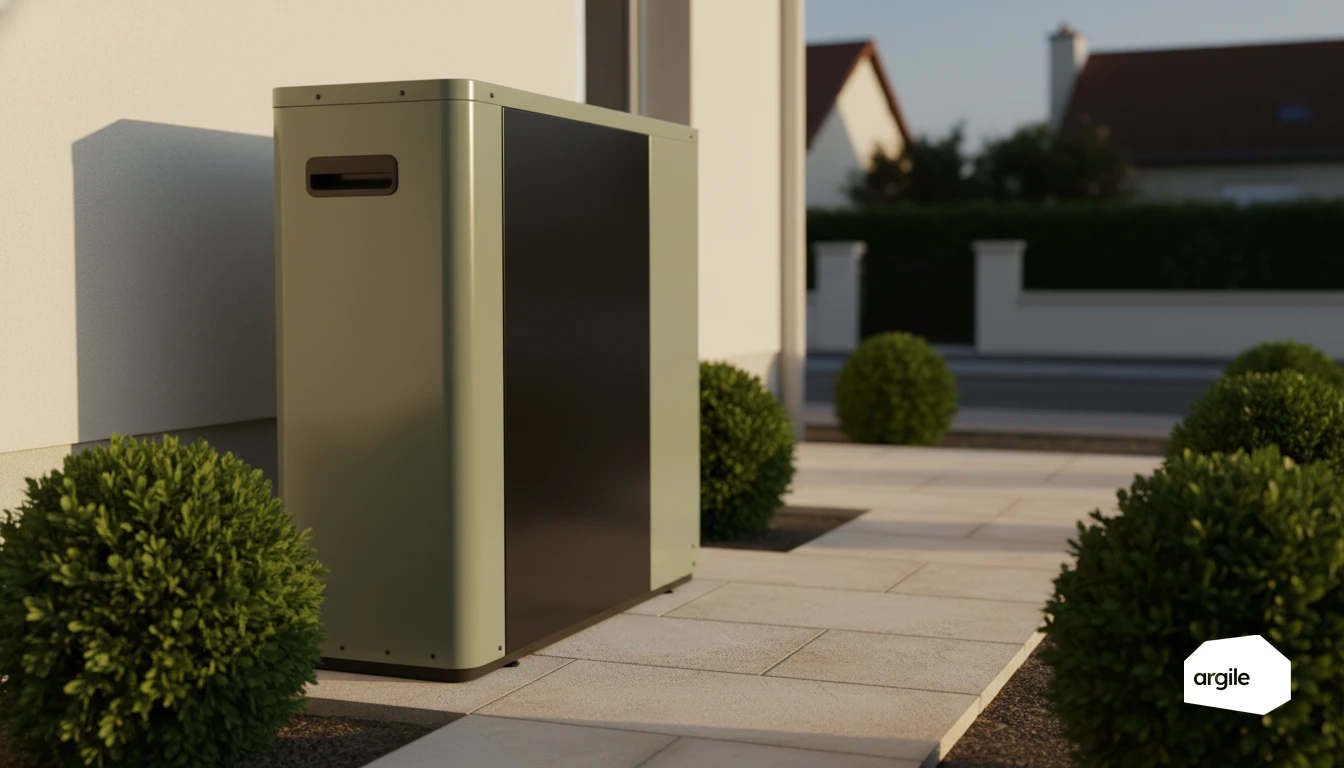
For the outdoor unit, look for open air. Avoid recesses, narrow walkways and any poorly ventilated volume. Respect the manual's distances from openings, basement windows, grilles and ignition sources. The commonest fault on a survey record: siting above a gully, a manhole or a pit, where a propane layer can settle since it is heavier than air. Photograph and date that point like the rest of the survey record, equipment positions included: it is on your liability.
Transport, storage and service calls: what gets logged
For handling and storage, keep recovery cylinders secured, upright, shaded and in a ventilated area. On service calls, use A3-compatible tools, work with doors open where possible, recover into a certified cylinder, then check tightness before returning the unit to service. The leak check is not statutory here, it is contractual: you decide to log it, and that log is what covers you in a dispute.
Sizing and commissioning an R290 heat pump
Start from heat loss, not from the advertised flow temperature
The target is the right output at the design temperature, not the machine with the highest headline flow temperature. On low water volume circuits, head off short cycling by working on usable volume and settings rather than by oversizing. The standardised figure for comparing two models is the seasonal space heating energy efficiency under Regulation (EU) 813/2013: at least 110% for medium and high temperature units and 125% for low temperature units since 26 September 2017.
Hydraulics and settings: balancing, heating curve, backup, frost protection
Clean hydraulics first. Degassing, filter, compliant flow rate, balancing valves and a properly sized circulator. Then the fine settings. Calibrate the heating curve against the emitters you recorded, cap the flow temperature, configure the backup as a last resort and secure frost protection to suit the configuration. On an outdoor monobloc, water-side frost protection is not a comfort option, it is a warranty clause.
Handover checks: what goes on the commissioning record
At commissioning, check the supply, protections, flow direction, delta T, flow rate, sound level, hot water and defrost cycles. Sound level is not cosmetic: Article R1336-7 of the French public health code caps the overall noise emergence at 5 dB(A) between 07:00 and 22:00 and 3 dB(A) between 22:00 and 07:00, with correction terms based on how long the noise runs. On attenuation methods, see heat pump noise and vibration.
What you put on the quote and in the grant file
Quote wording: what stops a file
On an R290 job the refrigerant is not an administrative argument, it is a technical characteristic to state on the quote like any other. Check eligibility for MaPrimeRénov' 2026 and the performance requirements attached to the measure, then the matching standardised operation sheet. Checks bear on consistency between the equipment fitted, its declared performance and the file: that is where refusals happen, not on the nature of the refrigerant.
Documents to supply: the minimum paper trail
- Valid installer accreditation at the signing date.
- Detailed quote and invoice: brand, reference, output, R290 refrigerant and charge in kg.
- Grant and energy-saving certificates, bank details, tax notice, site address.
- Proof of removal and commissioning record where required.
Justifying your price against a cheaper bid
An R290 job is priced on the siting constraint, not on the refrigerant. Any extra cost comes from the location the manual imposes, the hydraulic run that follows from it, and frost protection. That is what you put against a competitor who took the shortest route. On charge and its traceability, whatever the refrigerant, see refrigerant charge.