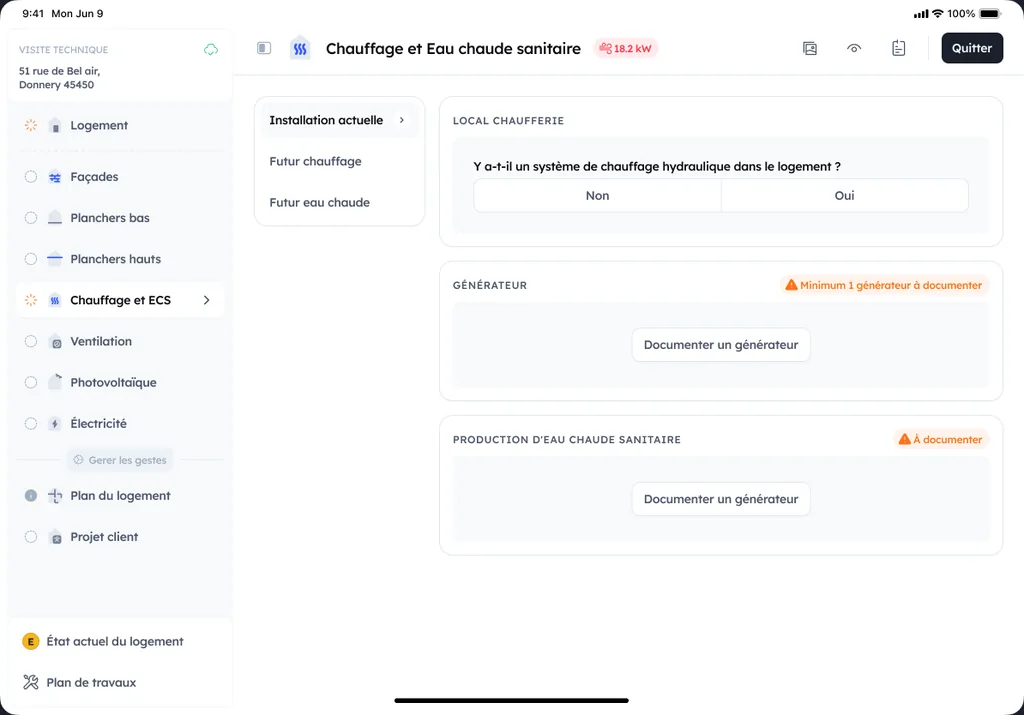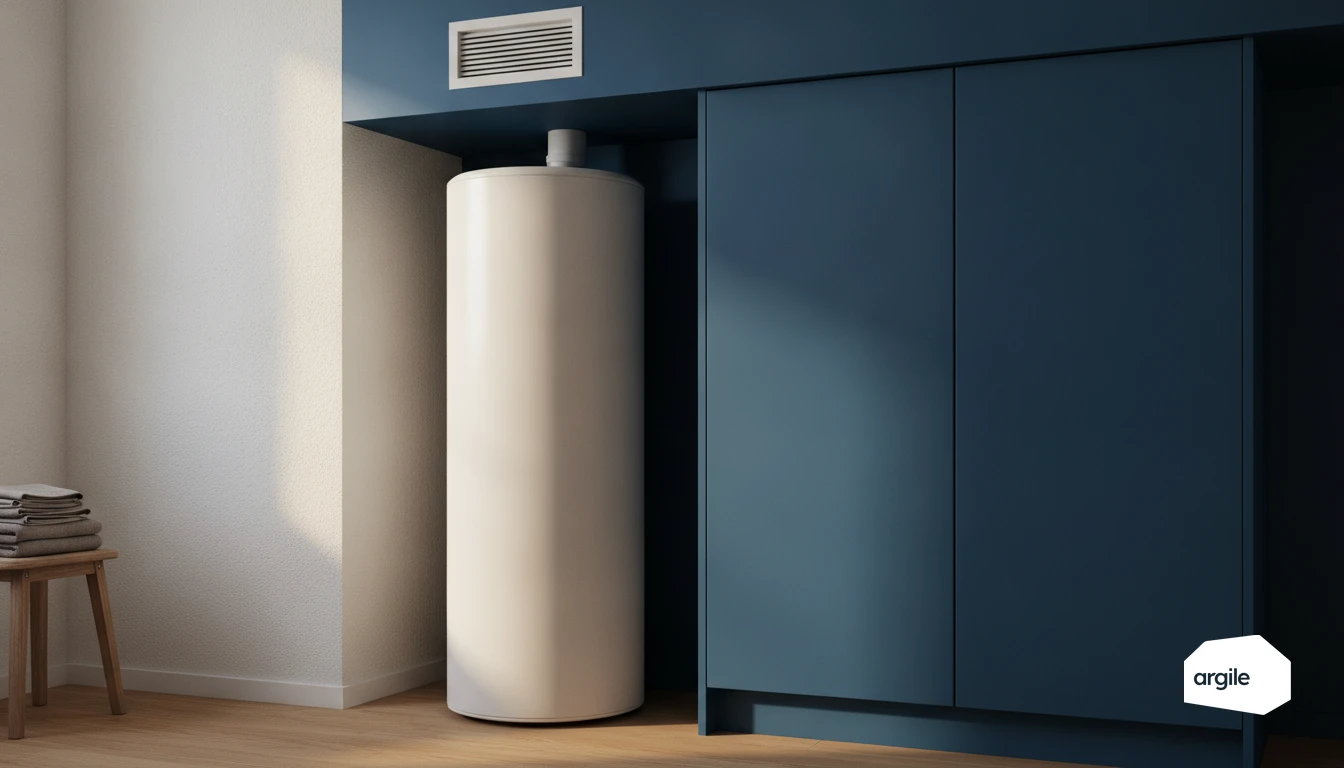
An extract-air heat pump water heater is the best credited source in the 3CL-DPE 2021 method, with a default COP of 2.8 in climate zones H1 and H2 and 2.9 in zone H3 for a unit installed from 2015, against 2.5 on outside or ambient air. That credit assumes a continuous air flow that the ventilation does not always deliver: article 4 of the French decree of 24 March 1982 allows a modulated total extract flow rate down to 90 m³/h in a home with four habitable rooms. On the incentive side, the BAR-TH-148 sheet in its A73.3 version judges neither the COP nor the air source, but the water heating energy efficiency under delegated Regulation (EU) No 814/2013, with a flat rate of 14,700 kWh cumac in a detached house.
What the machine takes, and at what price
The principle, in three components
An extract-air heat pump water heater captures heat from the air drawn out by the ventilation. The evaporator recovers the heat in that warm, humid air, the compressor raises the temperature, the condenser transfers the energy to the cylinder. The air, now cooled, goes outside. The difference from an outside-air unit lies entirely in the source: warmer, more stable in winter, but available only in quantities capped by ventilation regulation.
Extract air, ambient air, outside air: what the EPC method makes of it
| Appliance | Zones H1 and H2, from 2015 | Zone H3, from 2015 |
|---|---|---|
| Extract-air heat pump water heater | 2.8 | 2.9 |
| Outside-air or ambient-air heat pump water heater, unheated space | 2.5 | 2.8 |
| Dual-service heat pump | 2.3 | 2.6 |
These are the values kept where no exact characteristics are entered. They set the hierarchy: extract air beats ambient air, and a unit dedicated to hot water beats a dual-service machine. They also show that the step change is on the year of installation, not on the brand.
The trade-off: a flow rate that is not guaranteed
A COP of 2.8 assumes the evaporator receives air continuously. But a home's ventilation is not sized to feed a cylinder, it is sized to remove moisture and pollutants. That is the whole subject of the pairing, and it is where a specification that holds parts company with a machine that falls back on its electric element every morning.
The flow rate calculation to run on the technical visit
What the decree of 24 March 1982 allows it to drop to
| Habitable rooms | 1 | 2 | 3 | 4 | 5 | 6 | 7 |
|---|---|---|---|---|---|---|---|
| Minimum total extract flow rate, article 4 (m³/h) | 35 | 60 | 75 | 90 | 105 | 120 | 135 |
| Of which kitchen, minimum (m³/h) | 20 | 30 | 45 | 45 | 45 | 45 | 45 |
These values are floors: a compliant modulated installation is entitled to drop to them outside peak. The article 3 kitchen peak, from 75 to 135 m³/h depending on the home, must remain reachable at any time, but it is not continuous. The room-by-room detail is in our article on the flow rates of the decree of 24 March 1982.
Comparing that floor with the manufacturer's manual
The approach comes down to three readings. Count the habitable rooms to read the regulatory floor in the table above. Read in the manual the continuous flow rate the manufacturer requires at the evaporator. Then measure the flow rate actually extracted on the existing installation, after balancing, and not on boost. If the regulatory floor is below the flow rate the machine needs, the pairing will not hold without an additional provision, and that has to be said before signing.
The three ways out when the numbers do not add up
Guarantee a floor flow rate through terminal selection and settings, without short-circuiting the humidity control or degrading air quality. Provide a dedicated air intake for the evaporator, separate from the extract network, which moves the machine back towards ambient-air operation and therefore towards the 2.5 COP. Or give up on extract-air pairing and specify an outside-air unit, properly positioned. Sizing inlets and extracts is covered in our guide on ventilation ductwork.
Choosing the unit and connecting it properly
What the datasheet must carry
The binding criterion under the French CEE scheme is not the COP but the water heating energy efficiency under delegated Regulation (EU) No 814/2013, referred to the declared draw-off profile. That declared value belongs in the catalogue: Argile builds catalogues with the manufacturers, where the energy efficiency and the technical data are verified.
| Declared draw-off profile | M | L | XL |
|---|---|---|---|
| Minimum energy efficiency, BAR-TH-148 v. A73.3 | 95% | 100% | 110% |
Note that the sheet does not distinguish the air source and sets no COP threshold: it is the declared profile and the associated efficiency that drive eligibility, and that pair must appear on the proof of completion.
Discharge, condensate and penetrations
Cooled air goes outside, never into a loft, a garage or a crawl space, on pain of damp problems nobody will trace back to your work. Sealed penetration, insulated where it passes through a cold zone. Condensate drains by gravity with a primed trap and a continuous fall, or through a lifting pump where gravity is not workable, with an access point for cleaning. Every tight bend and every diameter reduction costs flow rate and adds noise.
Position, acoustics and electrical safety
Site the cylinder away from bedrooms, on a stable support, with flexible connectors where the connection is ducted, and keep access to the filter, the module and the trap. Provide a dedicated circuit with suitable protection and an accessible isolator, and respect the zones if the unit is installed in a bathroom, referring to the applicable wiring rules. On acoustics, the available treatments are the same as for ventilation and are covered in our article on ventilation noise. That siting is locked in during the technical visit, where Argile places the equipment on the plan of the home and attaches the photos to the file.
Commissioning and proving what you delivered
What you measure
Commissioning is read, not felt. Flow rate at the evaporator after balancing, flow rates at the extract terminals, absence of short-circuit between intake and discharge, air temperature in and out of the machine. Add a full heating cycle to validate the temperature rise, any defrost, and the condensate discharge. The instruments and measuring points are covered in our article on thermodynamic heat-recovery ventilation, which calls for the same kind of check.
What you record
A dated report carrying the measured flow rates, the settings retained, the temperatures read and the references of the unit. Photographs of the air connection, the external discharge, the trap and the product label. This file is not a filing formality, it is what protects you the day the client reports a shortage of hot water and the question becomes one of available flow rate.
The maintenance that keeps the pairing effective
The pairing holds as long as the air moves. Filters cleaned or replaced according to actual fouling, exchanger dusted where accessible, condensate line checked. On the cylinder, safety group, scale and anode. An annual visit with a flow rate reading lets you see the drift before the client suffers it, and it gives your original record the value of a benchmark.
Incentives and framework in 2026
MaPrimeRénov' and CEE
The MaPrimeRénov' user guide published by Anah in March 2026 kept, for the heat pump water heater measure, 2026 amounts of 1,200 euros for very low income households, 800 euros for low income and 400 euros for intermediate, with higher income households not eligible. Those amounts no longer apply: decree no. 2026-822 of 25 August 2026 removed dedicated domestic hot water heat pumps from the per-measure route for any application filed from 1 September 2026. A heat pump water heater is now funded only through the supported route. On the CEE side, BAR-TH-148 pays a flat rate of 14,700 kWh cumac in a detached house and 11,800 in a flat, with no distinction by climate zone or air source. How the two combine is covered in our article on combining grants.
The documents that make the file solid
The BAR-TH-148 sheet requires the installation to be carried out by a professional holding a recognised quality label, and the proof of completion to state the declared draw-off profile and the water heating energy efficiency. Keep the qualification valid at the invoice date, the product datasheet, the air connection drawing and the commissioning record. A reference that differs between quote and invoice is enough to bring the operation down.
What you announce to the client, and what you do not guarantee
Announce the draw-off profile and the usable volume, the flow rate you guarantee at the evaporator, and what to do if the ventilation is altered later. Do not announce a percentage saving against an electric cylinder: it depends on actual draw-off, on the setpoint temperature and on the available flow rate, and no text lets you commit to it. What you can commit to is a measured flow rate and a unit whose declared efficiency is verifiable on the datasheet.