Understanding how a reversible air-to-water heat pump works with heated/cooled underfloor heating
How the reversible air-to-water heat pump switches from heating to cooling (cycle reversal)
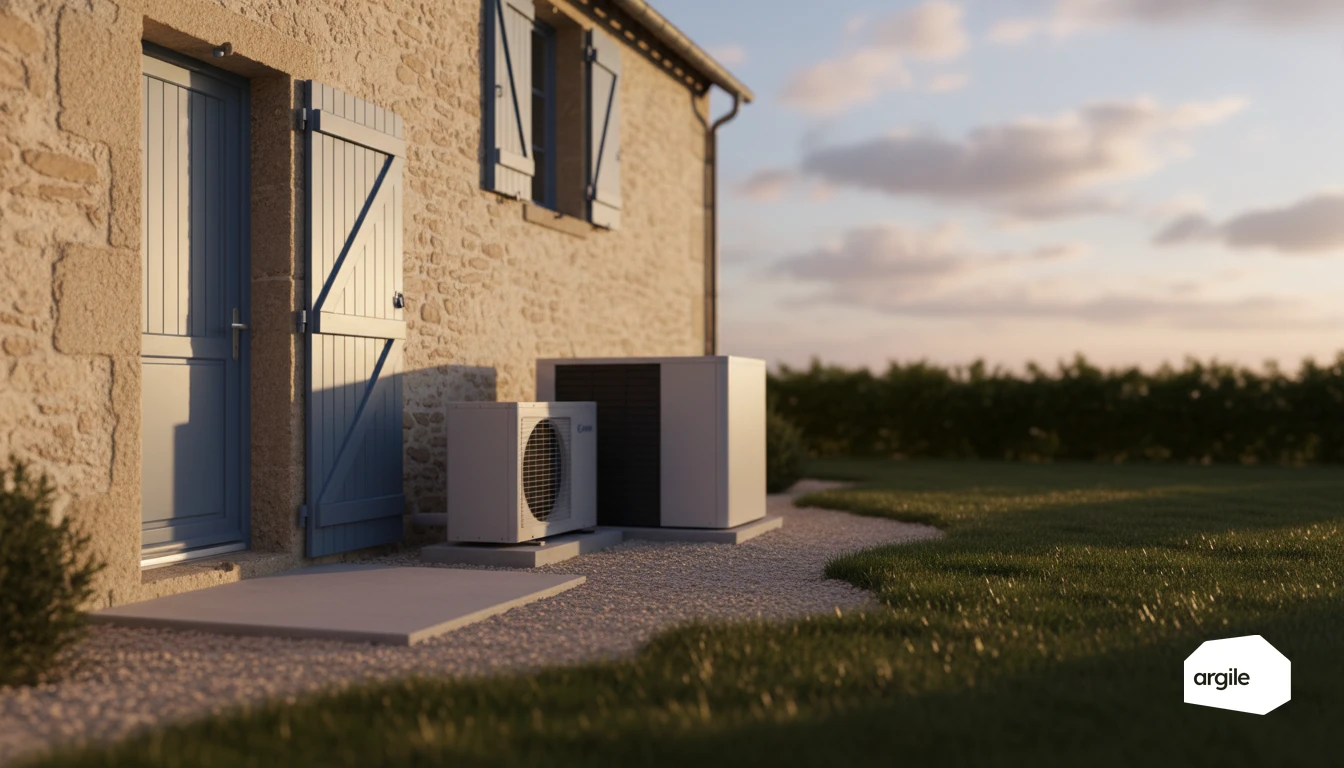
A reversible air-to-water heat pump relies on a reversing valve that changes the direction of the refrigeration cycle. In heating mode, the outdoor heat exchanger captures calories and the water-side heat exchanger transfers them to the floor system. In cooling mode, the unit rejects heat to the outdoor air and produces cooler tempered water. From a hydraulic point of view, you mainly control the water setpoints and the condensation safety function.
What cooling underfloor heating really does: lowering perceived temperature, not “air conditioning”
The floor provides gentle cooling through radiation. It does not dehumidify the air and its capacity remains limited. The critical issue is condensation. The control system must monitor temperature and humidity, calculate the dew point, then raise the water setpoint or shut off cooling if needed.
| Parameter | Typical range | Unit |
|---|---|---|
| Cooling supply temperature | 18 to 20 | °C |
| Minimum floor surface temperature (to be adjusted to dew point) | 19 to 21 | °C |
| Typical surface cooling output | 20 to 35 | W/m² |
Which homes this setup suits best (insulation, solar gains, compatible emitters)
This setup makes sense if the building envelope is high-performing and solar shading limits heat gains, and if the main emitter is a low-temperature floor system (new build or renovation with insulation below the slab and suitable loops). During the site survey, assess glazed gains, summer humidity levels, and sensor locations. If the summer load is high or humidity is poorly controlled, plan for dedicated air treatment rather than overloading the floor.
Cooling through underfloor heating: limited cooling capacity and expectations to frame properly
Why cooling capacity is lower than heating capacity (water temperatures, heat transfer, thermal mass)
In cooling mode, you quickly run into condensation limits. With a reversible air-to-water heat pump, the water temperature cannot go down like it would across an air-conditioning coil. As a result, the temperature difference with the room air is smaller, so heat transfer is smaller too. Add slab thermal mass. The system is stable, but it reacts slowly to peaks.
Typical water temperature ranges in cooling mode and their impact on comfort
| Parameter | Typical range |
|---|---|
| Supply water temperature (°C) | 16 to 20 |
| Floor surface temperature (°C) | 19 to 23 |
| Useful cooling output (W/m²) | 20 to 40 |
At these levels, you are aiming for cooling that is even and steady, not a rapid temperature drop. The control strategy must integrate a dew point based on room temperature and humidity sensors.
How to explain the result clearly to the client: summer comfort gain versus air conditioning
Present it as a measured reduction in operative temperature and a cut in overheating, subject to conditions (internal gains, solar shading, humidity). In the quotation, state clearly that this is not air conditioning. You are selling controlled summer comfort, not a heatwave-proof performance promise.
Floor condensation: the risk you must control with a reversible floor system
Where condensation comes from: humidity, dew point, and a floor surface that is too cold
In cooling mode, a reversible air-to-water heat pump lowers the water temperature sent into the floor. If the surface temperature of the finish drops below the ambient air dew point, water vapour condenses. The trigger is not “the heat pump being too powerful”, but the combination of indoor humidity and a surface that is too cold. That is why dew-point-based control matters.
Warning signs and possible damage (slippery floor, parquet, mould)
On site, the risk shows up quickly. Water film, slippery areas, darkened joints, odours. The consequences can include warped parquet and laminate flooring, swollen skirting boards, loss of adhesion for some finishes, then fungal growth along edges and under furniture. In after-sales cases, it is often “invisible” at first and then sudden after a few humid days.
The highest-risk situations: humid regions, insufficient ventilation, high moisture loads
Critical cases combine a humid climate, moisture loads (kitchen, showers, laundry drying, new units still carrying construction moisture), and undersized or poorly balanced ventilation. With cooling underfloor heating, lock down the control strategy. A humidity sensor, water temperature limitation, and a dew-point alarm make all the difference. The floor provides “gentle” cooling. It does not replace dedicated air conditioning.
Dew-point control: the key to securing cooling underfloor heating in 2026
Sensors and control: humidity probe, supply temperature, minimum water temperature limits
On a reversible air-to-water heat pump, cooling underfloor heating is controlled from the dew point calculated in the most unfavourable zone. The basics are a temperature plus humidity probe, a reliable supply temperature reading, and ideally manifold-level control. You are not looking for a “cold” setpoint. You are enforcing a low water limit, governed by the dew point.
| Parameter (unit) | Measurement / calculation | Use in control |
|---|---|---|
| Air temperature (°C) | Room sensor | Dew point input |
| Relative humidity (%) | Room sensor | Dew point input |
| Dew point (°C) | Controller calculation | Anti-condensation reference |
| Minimum supply temperature (°C) | Dew point + margin | Floor water lower limit |
Anti-condensation strategies: cooling curve, floor limitation, mixing, automatic shutdown
In cooling mode, keep a water curve, but cap it at the dew-point limit. A 3-way valve or a mixing module raises the supply temperature as soon as the air becomes more humid. Activate floor limitation and circulation shutdown on condensation alarm. Cooling remains diffuse. Do not sell it as air conditioning. Argile’s heating curve (water law), free of charge, lets you set the slope and offset and see the supply temperature track outdoor conditions.
Best commissioning practices: settings, real-condition tests, client instructions
Commissioning should be carried out in conditions close to real use. Check for any seepage at manifolds, at the base of partitions, and on uninsulated pipe runs. Record values and thresholds in your site file. Hand over short user instructions, especially to keep ventilation running and to avoid forcing cold setpoints.
Site and sales watchpoints: hydraulic pack, balancing, and a coherent sales pitch
Common hydraulic schemes: buffer tank, 3-way valve, zones, circulators
With an air-to-water heat pump, the hydraulic package is about decoupling and control. Use a buffer tank or low-loss header when the heat pump flow rates and the system flow rates do not match. Use a 3-way valve if you need to maintain an underfloor water curve while keeping some emitters hotter. One zone, one circulator, and accessible isolation valves. In cooling mode, provide anti-condensation logic and coherent sensors.
Balancing and flow rates: ensuring even cooling without discomfort or noise
Cooling through underfloor heating leaves little room for error. Set the loop flow rates one by one at the manifold, then stabilise differential pressure. Too much velocity creates noise and unstable returns. Flush, filter, treat the water, and document your settings. The key issue is maintaining the dew point through control, not chasing flow rates by eye.
“Reversible heat pump” pitch: what to state in the quotation (performance, limits, operating conditions)
In the quotation for a reversible air-to-water heat pump, state clearly the cooling mode, the calculation conditions used, and the limits. Cooling underfloor heating provides a gentle temperature drop, not air-conditioning comfort. Mention the need for humidity-based control, commissioning with balancing, and the operating conditions that determine the outcome.