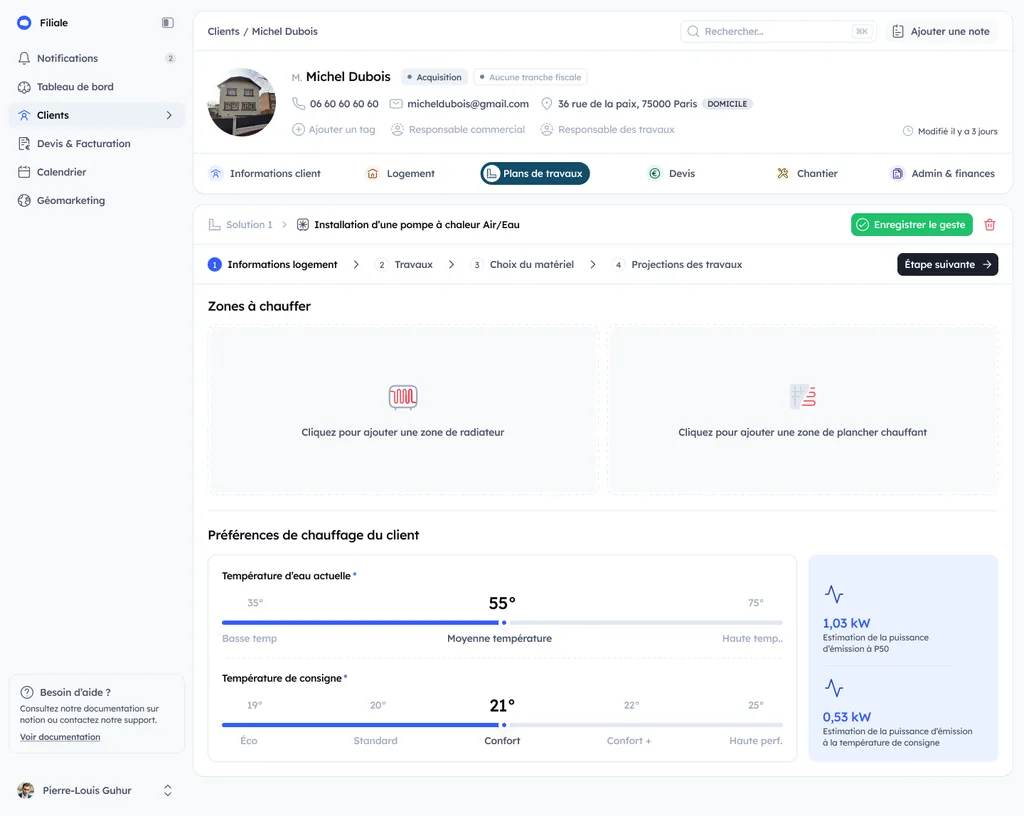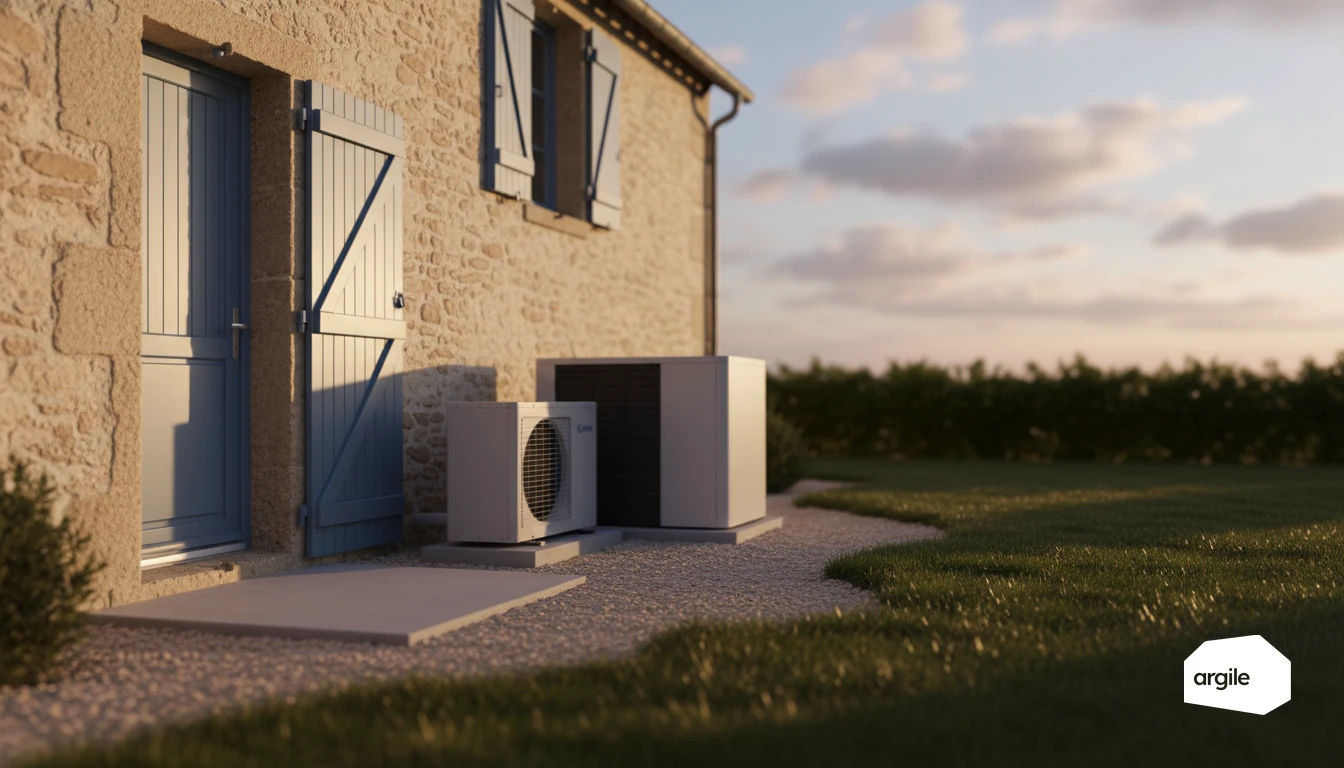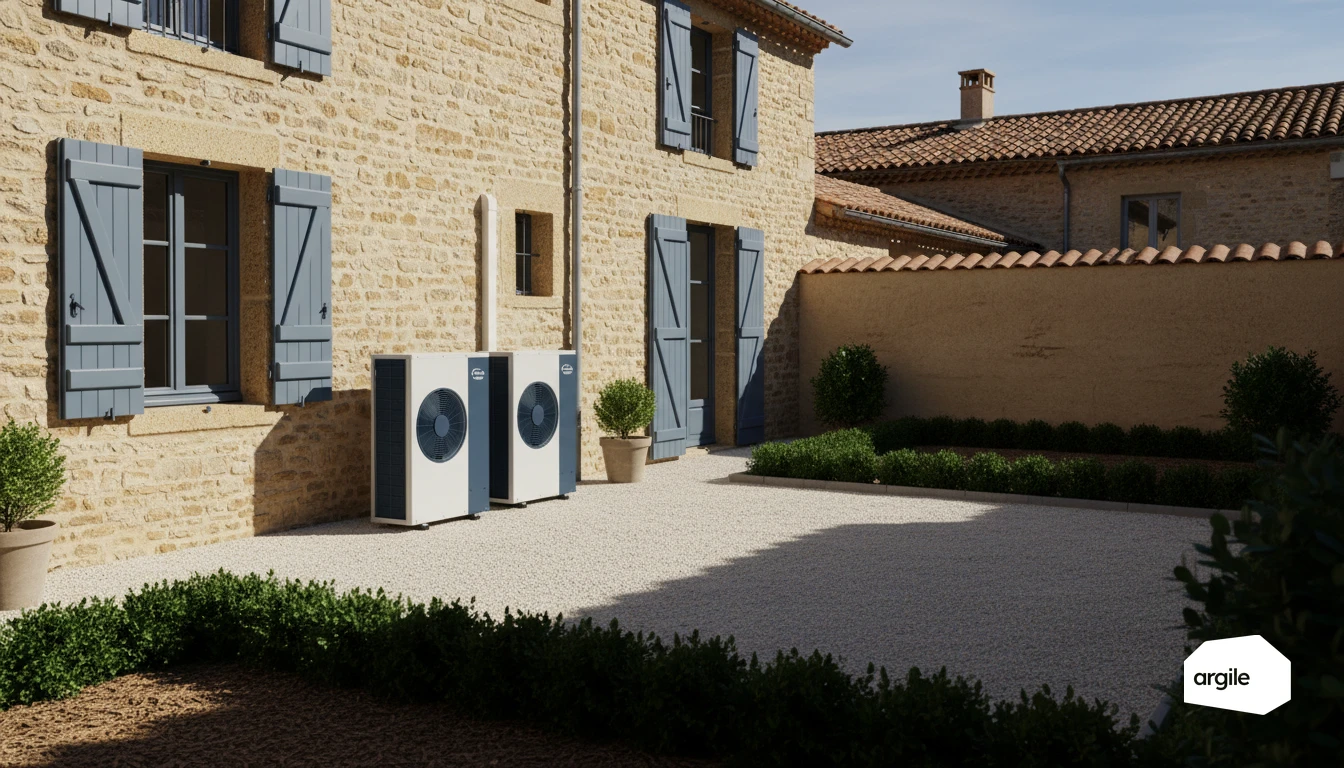
The choice between monobloc and bibloc is not decided on performance but on the scope of work. On a monobloc, the refrigerant circuit is factory-sealed: you never handle it, and the capability certificate of article R. 543-99 of the French environmental code is not required for the hydraulic and electrical installation. On a bibloc, the refrigerant lines make that certificate mandatory, issued for five years at most and per establishment, along with vacuum pull-down and a leak test. The trade-off with a monobloc is frost: the water runs outdoors, and it is you who carries the antifreeze solution on the quote.
Understanding the difference between a monobloc and a bibloc air-to-water heat pump
Monobloc: the whole refrigerant circuit outdoors, what this changes on site
On a monobloc heat pump, the refrigerant circuit is factory-sealed inside the outdoor unit. On site, you mainly install hydraulics, with two water pipes entering the home. Fewer refrigerant-related tasks, but one point of attention: the freeze risk on the outdoor lines, to be managed with antifreeze or heat tracing.
Bibloc: outdoor unit + indoor module, key points for your teams
On a bibloc, the outdoor unit exchanges heat with an indoor module via refrigerant lines. This is handy for keeping water out of the outdoor unit and improving frost protection, but it requires careful installation: line length, vacuum pull-down, leak-tightness. Plan for the right tools and refrigerant skills.
Hydraulic, refrigerant, electrical: who does what depending on the heat pump type
In both cases, hydraulics remain the heating engineer's job: heating and domestic hot water connections. The refrigerant part is almost absent on a monobloc, while on a bibloc it falls to an authorized technician. The electrical side, protections and power supply, is coordinated with your electrician and the manufacturer's manual. The table below sums up what actually changes from one case to the other.
| Criterion | Monobloc | Bibloc |
|---|---|---|
| Refrigerant circuit | factory-sealed, never opened on site | lines made up on site |
| Capability certificate R. 543-99 | not required for the hydraulic and electrical work | required for the refrigerant work |
| Periodic leak check | by charge, hermetically sealed equipment | by charge, circuit opened on site |
| Freeze risk | water outdoors, antifreeze or tracing to be costed | water indoors, risk shifted to the refrigerant |
| Length constraint | hydraulic, pressure losses and lagging | refrigerant, strict manufacturer limits |
| What it changes on the quote | an antifreeze and outdoor lagging line | a refrigeration engineer labour and testing line |
Choosing based on the home and usage: the right criteria in 2026
Renovation with radiators or underfloor heating: compatibility and flow temperatures
A heat pump is chosen first on the flow temperature your network needs, something settled between the technical survey and the sizing calculation, and that temperature has a regulatory definition. Regulation (EU) No 813/2013 calls low-temperature application a heat pump that delivers its rated heating capacity at an outlet water temperature of 35 °C, and medium-temperature application one that delivers it at 55 °C. Performance is declared at those two operating points, and it is on those same points that the certificate sheets set their requirements.
| Outlet water regime | 813/2013 qualification | Minimum ecodesign efficiency | Minimum BAR-TH-171 efficiency |
|---|---|---|---|
| 35 °C | low-temperature application | 125% | 126% |
| 55 °C | medium-temperature application | 110% | 111% |
Ecodesign requirements applicable since 26 September 2017, average climate.
The gap is clear: the higher the flow temperature, the lower the efficiency. Hence the value of aiming for low temperature after insulation work, or of increasing the emitter surface area rather than raising the heating curve.
Domestic hot water, volume, noise, footprint: deciding without getting it wrong
If the package includes hot water, the tank volume follows from the draw-offs recorded at the client's and from the power available for reheat, not from a generic order of magnitude. On the comfort side, check the sound level of the outdoor unit and its siting: article R. 1336-7 of the French public health code caps the emergence at 5 dB(A) from 7 am to 10 pm and 3 dB(A) from 10 pm to 7 am, with no corrective term once operation exceeds 8 cumulative hours. A good compromise is to keep the unit away from bedrooms and property boundaries, without unnecessarily extending the lines.
Climate, freezing and siting: monobloc and bibloc against weather constraints
In a cold zone, the freeze risk matters. A monobloc puts water outdoors, so the network needs to be secured (antifreeze, insulation, shutoff, draining depending on the case). A bibloc limits this issue, since the water stays indoors, but it requires refrigerant lines and careful installation. Also consider defrosting, wind, and ventilation clearances. If the heat pump type is not settled yet, our comparison of air-to-air versus air-to-water covers the upstream decision.
Installation: what really differs between monobloc and bibloc
Site prerequisites: location, networks, condensate drainage and anti-vibration mounting
For a heat pump, most of the comfort is decided before installation. For both monobloc and bibloc, plan for a clear location, maintenance access, a clean route for the electrical supply, and condensate drainage. Add an anti-vibration mount and think about noise, neighbors, and the freeze risk on outdoor networks.
Connections: hydraulic only on monobloc, refrigerant lines on bibloc
The monobloc connects with hydraulics only from outside. This involves pipe insulation, antifreeze management (lagging, heat tracing or glycol depending on the case) and a water leak-tightness check. On a bibloc, refrigerant lines between units are added, with length constraints, vacuum pull-down, leak tests and regulated handling of refrigerants.
Commissioning, settings and balancing: securing performance
Commissioning isn't just about "it heats." Purging, pressure, flow rate, heating curve, backup, domestic hot water and defrost cycles all need to be set to maintain performance. Balancing the emitters prevents overheated rooms and returns that are too hot. On a bibloc, refrigerant checks are a mandatory step.
Costs, timelines and maintenance: comparing to help your client decide
Equipment, accessories and labor: where the price differences come from
The price of a heat pump mainly varies by type (air-to-air, air-to-water), power, and controls. Differences also come from accessories: hydraulic module, hot water tank, buffer tank, refrigerant lines, water treatment, sludge removal. This is often where the quote shifts, and where a cheaper bid cuts corners: show these lines separately so the comparison is possible.
Installation time and coordination (plumber, refrigeration technician, electrician): avoiding extra costs
A smooth job costs less. Coordinated penetrations, network routing, reserved volumes, and same-day commissioning. When the plumber, refrigeration technician and electrician cross paths without a schedule, time is lost and the bill grows. On a bibloc, having a certified refrigeration engineer on site is a scheduling constraint to book early.
Maintenance and common failures: parts, accessibility and field feedback
Plan ahead for maintenance. Access to filters, heat exchangers, circulator, sensors, and control boards. Common failures come from a flow-rate defect, a fouled heat exchanger, or a faulty sensor. Plan for simple monitoring and available parts.
Grants and rules to know in 2026 for an air-to-water heat pump
RGE, F-gas and certificates: staying compliant whether monobloc or bibloc
To unlock the energy certificates of the BAR-TH-171 sheet, the professional must hold a quality mark within the meaning of decree no. 2014-812, which in practice means RGE QualiPAC. On a bibloc, the refrigerant capability certificate of article R. 543-99 of the French environmental code is added, its issuing rules being set by the order of 21 November 2025. It is granted for five years at most, per establishment, and assumes staff holding the individual qualification. In operation, Regulation (EU) 2024/573 triggers the periodic leak check from 5 tonnes of CO2 equivalent for Annex I gases, or 1 kg for those in section 1 of Annex II, with an exemption in residential buildings for hermetically sealed equipment under 3 kg. On a monobloc, the circuit being factory-sealed, you avoid handling refrigerant on site, but the electrical, hydraulic and commissioning rules still apply.
Obligation
Leak checks: is this job covered?
The obligation is not triggered by the kilograms of refrigerant but by tonnes of CO₂ equivalent: the charge times the fluid’s global warming potential. Hence different answers for the same charge depending on the fluid.
3.0 kg
Equivalent charge
2.0 t CO₂e
GWP 675
Leak check
Not required
Trigger threshold
5 t CO₂e
that is 7.4 kg of this fluid
Below the threshold: no periodic check
This is the usual case for a residential R32 multi-split. What still applies: the company’s certification, the tightness test and evacuation at commissioning, the intervention record and the logbook.
Regulation (EU) 2024/573, article 5. Periodic checks are one thing; the company’s certification, the tightness test at commissioning and the record keeping apply whatever the charge.
An Argile tool
MaPrimeRénov' and CEE: points to watch on heat pump applications in 2026
In 2026, check the current scales and conditions (home, income, type of replacement). On the quote and invoice, specify the model, power, the seasonal space heating efficiency at the chosen regime, controls and useful options (sludge removal if planned). It is the seasonal efficiency that is checked, not the nominal COP: a unit marketed as high-performance but declared at 55 °C will not clear the 126% threshold reserved for low temperature. On the certificate side, refer to the standardized operation sheet dedicated to air-to-water heat pumps. Watch the dates: the quote must be signed after the applicant's commitment, otherwise the file can be rejected.
Documents to hand over: commissioning report, manual, settings and usage advice
Hand over the commissioning report, the manual, the installed references and a summary of the settings (heating curve, curve slope, schedules, hot water setpoint). On a bibloc, attach the leak-test record and the reference of the company's capability certificate: that is what covers you in an audit or a dispute. Add a simple memo: best practices, maintenance, antifreeze, what to do in case of an alarm.