The decision turns on function, not on efficiency: air-to-air heats and cools by blown air without producing domestic hot water, air-to-water feeds a wet circuit and can cover hot water too. The two are not even declared on the same metric. An air-to-air unit is rated in SCOP and SEER under Commission Delegated Regulation (EU) No 626/2011, an air-to-water unit in seasonal space heating efficiency under Regulation (EU) No 813/2013, at an outlet water temperature of 35 °C for low-temperature applications and 55 °C for medium temperature. On funding, air-to-water is the route that grant schemes are written around, since they fund a generator feeding a wet distribution circuit, while air-to-air has to be argued on running cost, summer comfort and, in France, on its own energy-certificate sheet.
Understanding the basics: air-to-air and air-to-water heat pumps, what's the day-to-day difference?
Principle, uses and limits
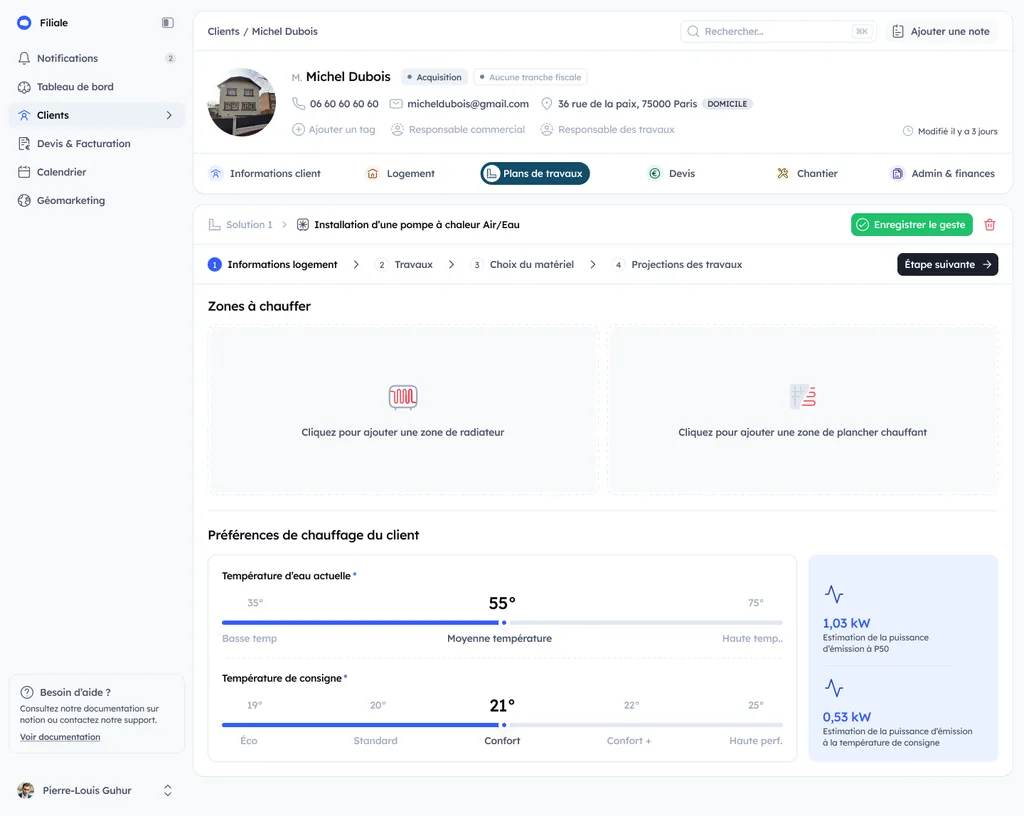
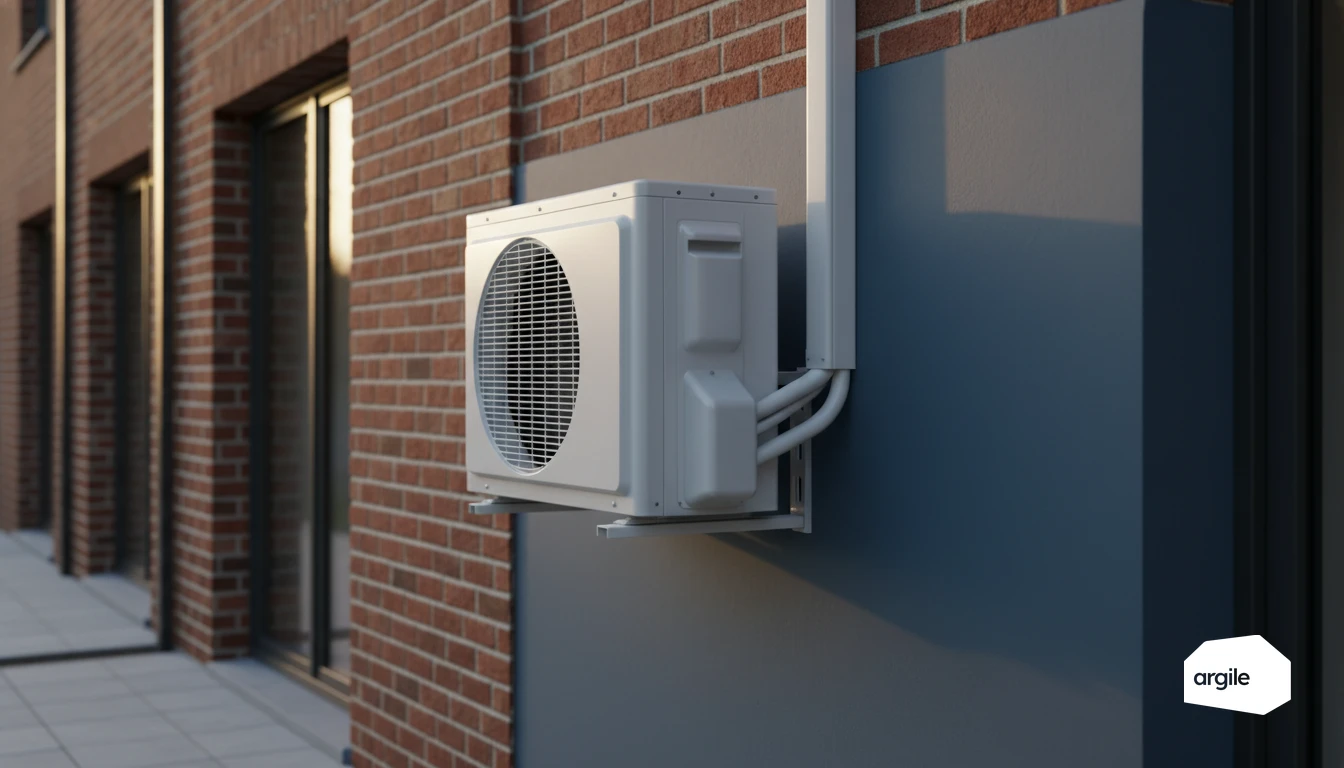
A heat pump captures calories in the outdoor air and transfers them indoors. Its efficiency is read via COP or SCOP. The higher these values, the less electricity you consume for the same amount of heat. Day to day, an air-to-air heat pump heats (and often cools) the air via indoor units. It does not produce hot water. An air-to-water heat pump feeds a hydraulic network, low-temperature radiators or underfloor heating, and can cover both heating and domestic hot water depending on the setup. As for limits, air-to-air requires diffusion by blown air and assumes well-designed ventilation. Both models can generate outdoor noise and trigger defrost cycles in humid weather. In cold periods, output drops, which is why good sizing and a well-managed backup matter. On the air-to-air side, Argile works out the load room by room and the coverage of the indoor units placed on the plan.
| What you are comparing | Air-to-air | Air-to-water |
|---|---|---|
| Declared metric | SCOP and SEER, Regulation (EU) No 626/2011 | seasonal space heating efficiency, Regulation (EU) No 813/2013 |
| Reference operating point | average heating season | 35 °C at low temperature, 55 °C at medium temperature |
| Domestic hot water | no | yes, depending on the setup |
| Cooling | yes, the unit is reversible by design | only with a reversible unit and suitable emitters |
| Minimum ecodesign requirement | classes on the A+++ to G scale | efficiency ≥ 125% at low temperature, ≥ 110% at medium temperature |
The last line is the one to remember: a SCOP and a seasonal space heating efficiency are not comparable figures. Lining the two up on a quote to show that one beats the other is a mistake that turns against you in an audit.
Comparing heating comfort for your job site
With an air-to-air heat pump, heat arrives via blown air. You get a fast temperature rise and room-by-room control via the indoor units. In exchange, you must accept the presence of the split units, a slight fan noise and sometimes draught sensations if the sizing or orientation is poorly designed.
An air-to-water heat pump heats a water circuit that feeds radiators or underfloor heating. Comfort is often more even. The thermal mass of the floor smooths out variations and avoids sudden shifts, but makes the response slower when the setpoint changes.
In partial renovation, air-to-air fits in quickly without redoing the whole network. In full renovation, air-to-water pairs better with an insulated envelope, low-temperature emitters and fine-grained control across the whole home.
Comparing costs: equipment, installation, maintenance and consumption
Installation budget
The price of a heat pump is not limited to the unit. Count the indoor and outdoor units, the network (refrigerant lines or hydraulic piping), the electrical connections, the accessories (valves, filter, circulator, expansion tank), plus condensate drainage. The hydraulic side can add up quickly when radiators need to be redone, a buffer tank added, or the balancing redone. Labour time varies mainly with accessibility, wall penetrations, the length of the lines and commissioning.
Servicing and maintenance
- Access to the units and clearance around the outdoor unit.
- Wear parts, cleaning, leak checks where applicable.
- Contracts, often on an annual or biennial basis depending on the equipment.
Actual consumption
The bill depends first on insulation. Then on the settings, especially the flow temperature and the heating curve. The higher the flow temperature, the lower the efficiency. Finally, client habits matter. A 20-21°C setpoint, time schedules, hot water, and use of backup heating make all the difference.
Choosing based on the home: insulation, existing emitters and configuration
Insulation, radiators and layout, the trio that changes everything
In a well-insulated house, the heat pump can be less powerful and run longer, with better efficiency and fewer short cycles. In an energy sieve, heat demand climbs fast. The risk is oversizing to "cope" with peaks, then losing comfort and performance the rest of the time. On the emitter side, high-temperature radiators require hotter water, which degrades efficiency. With low-temperature radiators or underfloor heating, the heat pump works at a lower temperature, so more efficiently. If the existing network cannot keep up, a hybrid solution (heat pump plus backup) or resizing certain radiators avoids bad surprises. Finally, in apartments or multi-zone setups, layout matters. Space, acoustics, access to the outdoor unit, and the length of refrigerant or hydraulic lines can limit the choice and require a precise study.
Subsidies and obligations in 2026: what weighs on the client's decision
2026 overview: the funding schemes and conditions to check before quoting
In 2026, the client mainly weighs the Boiler Upgrade Scheme against what an ECO4 package can cover. Before costing, check the property's eligibility, its tenure and the right route (single measure or whole-house retrofit). Also ask whether the household has already started an application, since an offer signed too early can block the funding. For a heat pump, check the technology, the design flow temperature and whether an old generator is being replaced, since these points change the amounts and the supporting documents expected.
Certification, retrofit assessment and documents to provide: securing your application
- MCS certification in the right scope, company registration number and valid dates consistent.
- Detailed quote, subcontracting mentions if needed, then an invoice matching the quote.
- Depending on the project, EPC or retrofit assessment, plus bank details and proof of income or benefits.
Special cases: boiler replacement, whole-house retrofit and combining funding
When replacing an oil or gas boiler, the Boiler Upgrade Scheme can tip the decision. In a whole-house retrofit, the retrofit coordinator and the assessment structure the works plan and limit back-and-forth. Combining the Boiler Upgrade Scheme, an ECO4 package and the zero VAT rate on energy-saving materials remains a lever, provided you avoid funding the same measure twice and keep all the supporting evidence. One point to settle before quoting: whether an air-to-air unit qualifies for the VAT relief, since the zero rate is written around energy-saving materials installed in a home and air-to-air sits at its boundary, which changes the comparison with air-to-water on the quote. To go further on the costing side, you can also see how to calculate the certificate value and maximise it on your projects.
A field method for choosing: from the technical visit to a clear quote
Useful readings, without forgetting anything
On site, your checklist must be thorough. Record the heat loss (surfaces, actual insulation, thermal bridges, ventilation), then the emitters (radiator type, dimensions, 70/50 regime or low temperature, possible balancing). On the electrical side, note the subscribed power, the available cable cross-section, the space in the panel and the dedicated protection. Finally, secure the outdoor location of the heat pump. Clearances, noise, condensate drainage, anti-vibration mount, distances to boundaries and maintenance access.
Sizing and settings
Base the output on heat loss at the design temperature, not on square metres. Aim for a unit that modulates well. Otherwise, you create short cycles, rising consumption and a compressor under strain. Plan the heating curve, the lowest possible flow temperature and a well-scoped backup. That calculation does not have to be redone back at the office: Argile generates the sizing note to NF EN 12831-1 from the visit readings and picks the equipment from up-to-date catalogues.
Client pitch
To help them decide quickly, show a clear comparison. Investment, estimated subsidies, projected consumption, comfort, noise. Add 3 points of attention. Minimum insulation, emitter quality, maintenance. And to go further, also consider a clear quote that helps close the deal.