News
Articles by Argile
Regulation, field practice and tools: our analysis to help renovation professionals sell and deliver energy retrofits.

A client complaining about a whooshing sound or vibrations in the ventilation system is often a job that can tip into dissatisfaction. As a tradesperson, you can quickly diagnose the cause (clogged vent, poorly fixed duct, wrong flow rate) and restore comfort without redoing everything. With a few simple actions and the right choice of equipment, you cut the noise and keep air quality on track.
8 min read

In housing, cogeneration comes down to a single trade-off: overall efficiency is excellent as long as the unit runs long hours on the base load, and it collapses the moment the unit is sized on the peak. France's order of 20 July 2016 sets the only hard boundary in the subject, a micro-cogeneration unit being one with an installed electrical output of 50 kWe or less. Here are the advantages, the counterparts, and what to check before you price it.
5 min read

Your clients want to reduce their home's impact, but they don't always know where to start. As a tradesperson, you can help them take stock, category by category, then choose the work that really matters: insulation, ventilation, heating. With a simple method and clear orders of magnitude, you save time and back up your recommendations.
5 min read

On a chiller, the heat rejected isn't wasted. Properly harnessed, it can cover a useful share of domestic hot water needs, without adding electrical power, and often with a fast payback on site when usage is regular. For you, as a tradesperson, this is a concrete solution to offer wherever cooling already runs year-round.
5 min read
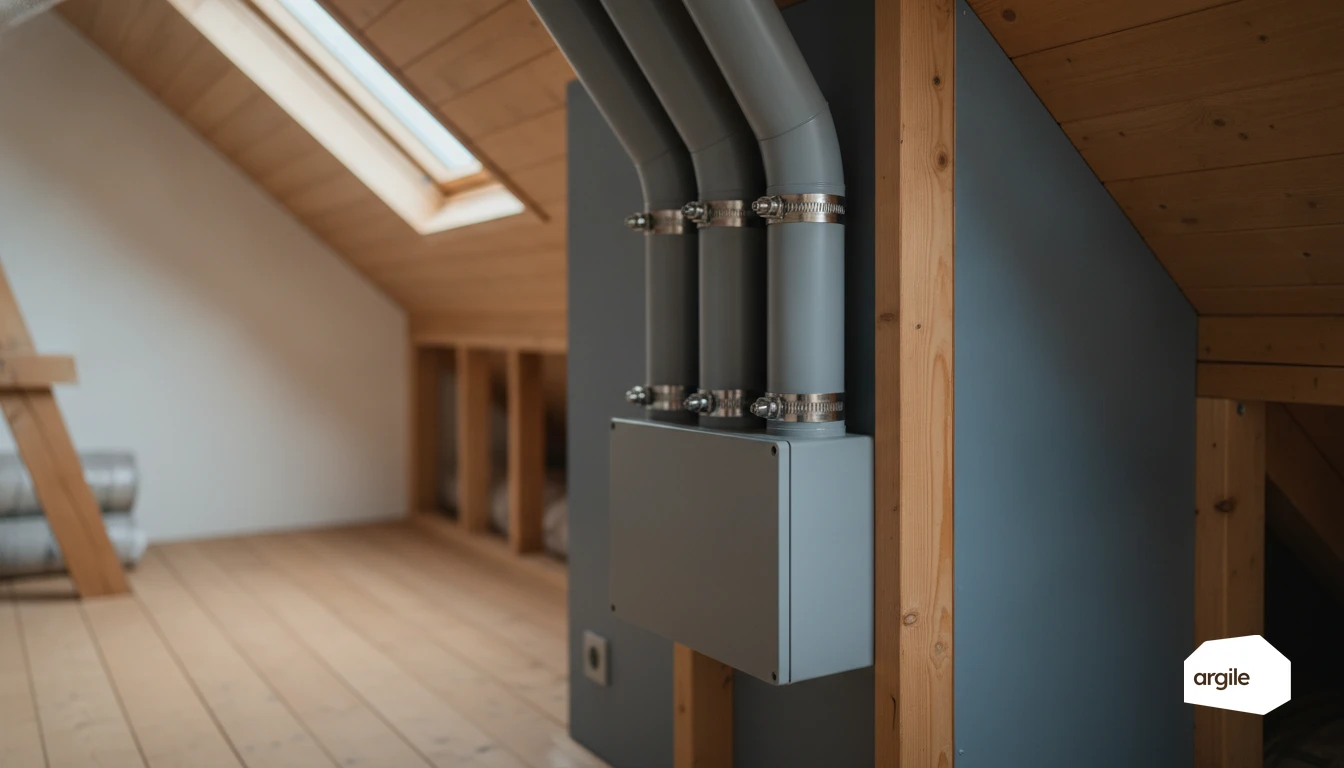
The diameter of a ventilation duct is not read off the connection spigot on the unit, it is calculated from the flow rate required room by room. One division gives you the cross-section, and the rest of the sizing comes down to lengths, bends and access. What is decided on the layout cannot be recovered at commissioning.
5 min read

On a job, an error in surface area or a "default" output figure can quickly wreck profitability and client satisfaction. You need simple benchmarks to size correctly, without over-equipping or underestimating, from the very first estimate. We sort out the practical field values from the assumptions that send a quote off track.
5 min read

When a client wants fast, stable comfort without swings, you have every interest in proposing an emitter that combines a quick temperature rise with sustained gentle heat. On site, it also comes down to very concrete details, controls, thermal mass, noise, and ease of installation, the ones that avoid callbacks. With the right criteria in mind, you can steer clients towards a genuinely premium solution, suited to the room and the household's routine.
6 min read

In a retrofit, the hot water going down the drain can still earn you kWh, especially from showers and small multi-unit buildings. As a tradesperson, this is a simple option to build in when a client wants to cut their bill without major work, provided you spot the right uses and installation points. Here, we lay out the principle and the cases where it's genuinely worth it.
5 min read

No statutory interval governs the servicing of a ventilation system in an occupied dwelling. Two cases sit outside that rule, a new dwelling at completion and any work that affects ventilation, and everywhere else the only defensible benchmark is the flow rate you measure against the Approved Document F tables.
5 min read

When a client asks you "how much will it really cover?", you need a simple calculation, not vague talk. By quantifying the share of energy delivered over the year and sizing the right backup, you secure hot water comfort and size the system correctly, without overcost or unrealistic promises. The result is a clearer quote and a job that runs smoothly.
5 min read

A water heater's energy class means nothing on its own: it only makes sense alongside the declared load profile, because the scale changes with every profile. The same 40 % efficiency earns class A in profile XS and class C in profile M. Here are the two tables from Regulation 812/2013, the floor that ecodesign has imposed since 2017, and where to check a product's declared figure.
6 min read

On site, you're looking for insulation that performs well, is simple to install, and uses fewer resources. Materials derived from living organisms open up a real avenue, with a manufacturing process that looks more like cultivation than a factory. It gives you a way to offer clients a different kind of insulation, credible, but still with plenty of questions to settle before it goes mainstream.
5 min read
Reveal your expertise
One demo, and you see your expertise proven.
Contact us
