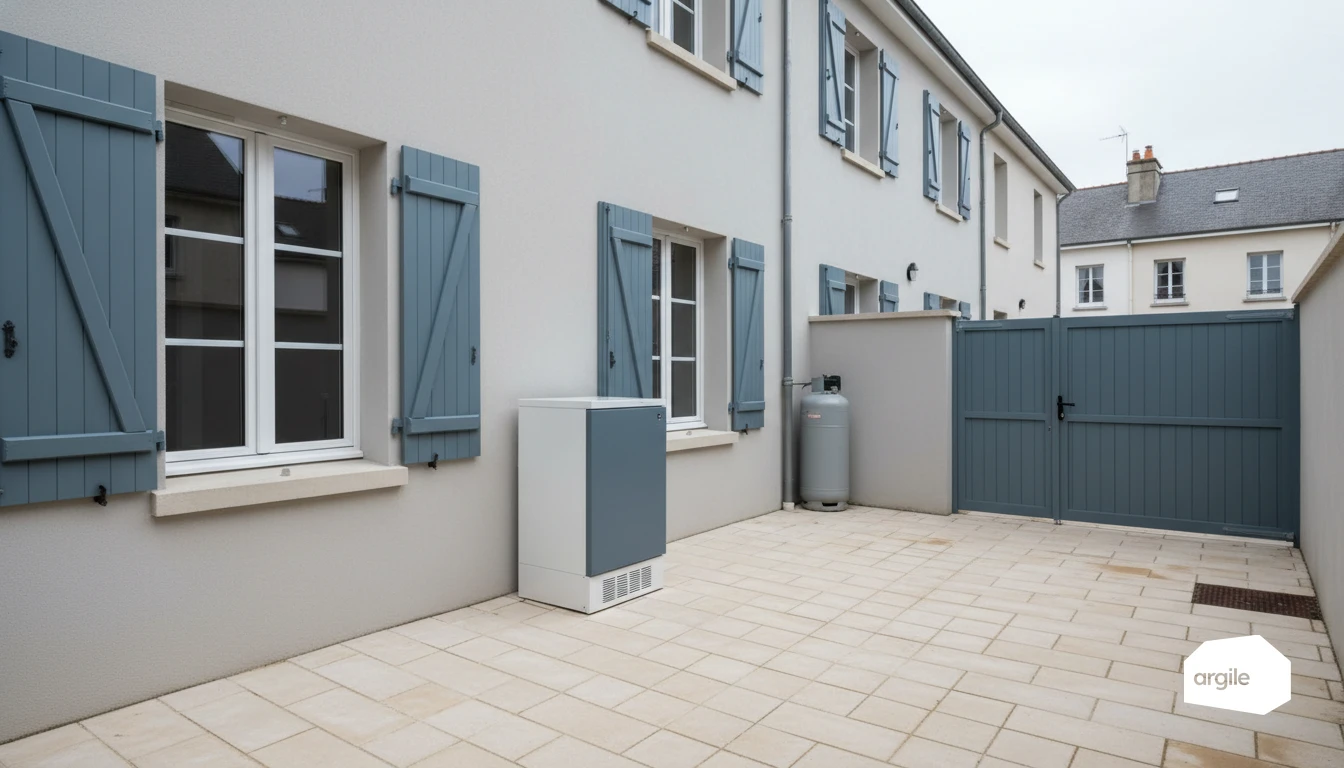
R744 is carbon dioxide. It appears neither in Annex I nor in Section 1 of Annex II of EU Regulation 2024/573, which puts it outside the Annex VII quotas, outside the Article 5 leak checks and outside the Annex IV placing-on-the-market bans. On the French side, Article R543-75 of the environment code closes its list on CFCs, HCFCs, HFCs excluding HFOs and PFCs: CO2 is not there either. What constrains an R744 job is therefore not the refrigerant regime, it is the high pressure of the transcritical cycle, compliance with the hot water temperatures in Article 36 of the order of 23 June 1978 as amended, and now the firm's certification, to which carbon dioxide has been attached.
The legal status of R744, and what it is worth on a quote
Outside the annexes, so outside quota, checks and deadlines
Regulation (EU) 2024/573 entered into force on 11 March 2024, replacing Regulation (EU) 517/2014. It covers only the substances listed in its annexes. Carbon dioxide is not among them, so an R744 machine consumes no quota, triggers no leak check interval and carries no placing-on-the-market cut-off. That argument can be demonstrated, unlike the future-compliance wording on sales sheets. For a comparison of refrigerants and their deadlines, see refrigerants for heat pumps in 2026.
What the quota trajectory makes visible
The HFC quota in Annex VII goes from 42,874,410 tonnes of CO2 equivalent for 2025-2026 to 21,665,691 for 2027-2029, then 9,132,097 for 2030-2032, and 0 from 2050, against a 2015 baseline of 176,700,479 tonnes. That is not a ban, it is organised scarcity: the price and the lead time of fluorinated refrigerant will follow that curve. It is the slope, not a ban date, that justifies studying R744 on an installation whose life exceeds fifteen years.
What remains enforceable despite the refrigerant's status
Falling outside the F-gas scope waives no other duty. The first of them changed in nature in 2025: Implementing Regulation (EU) 2024/2215 extended certification to natural refrigerants, and the French order of 21 November 2025 opens a category B specific to carbon dioxide, mandatory from 1 January 2027. Working on an R744 circuit therefore calls for a company certificate, where the reading that held while Article R543-75 alone set the scope concluded the opposite; the six categories and their timetable are set out in the company certificate, categories A1 to E. The refrigerant regime itself does not move: no quota, no leak check, no ban date. Working pressure calls for tooling, hoses and gauges rated for the transcritical range, and the high pressure safety devices belong on the annual check list. Manufacturer warranty conditions remain contractual and often tie cover to commissioning by a trained operator. On calculating and logging the charge, whatever the refrigerant, see refrigerant charge.
Hot water temperatures, where R744 is actually decided
The table of enforceable temperatures
Article 36 of the French order of 23 June 1978, as written by the order of 30 November 2005, sets two series of requirements that appear to contradict each other: raise the temperature against legionella, cap it against scalding. That pair commands the hydraulic layout, not the machine's performance.
| Subject | Requirement | Scope |
|---|---|---|
| Legionella, distribution | At least 50°C at every point of the system | Volume above 3 litres, excluding final supply tails |
| Legionella, storage | At least 55°C permanently at the generator outlet | Storage volume of 400 litres or more |
| Legionella, alternative to continuous holding | Raised to a sufficient temperature at least once every 24 hours | Per the temperature and duration pairs in Annex 1 |
| Scalding, washing rooms | 50°C maximum at the draw-off point | Showers, bathrooms, basins |
| Scalding, other rooms | 60°C maximum at the draw-off point | Excluding kitchens and laundries |
| Scalding, public building kitchens and laundries | 90°C maximum, at signed outlets | Buildings open to the public |
The temperature and duration pairs of Annex 1 are not reproduced in the article itself: open the annex before configuring a periodic temperature rise, do not reuse a value found elsewhere.
Why the transcritical cycle suits those constraints
CO2 does not condense like a subcritical refrigerant: above the critical point it releases heat as gas cooling, with a large temperature glide. That suits counterflow exchange onto a cylinder, where water enters cold and leaves hot. The practical consequence never varies: the colder the water entering the gas cooler, the better the efficiency. A hot secondary return destroys that advantage, and it is the point to check before any pricing.
The jobs where it turns into a result
Communal housing, social housing, hotels, catering, gyms and laundries share one profile: substantial, regular hot water demand, a high setpoint and storage already in place. That is where R744 compares favourably, and that is where the secondary loop, its balancing and its insulation must be surveyed before sizing. On the sizing method itself, see sizing heat pump output.
Fitting, commissioning and monitoring a transcritical machine
What gets recorded before the output is fixed
The commonest trap is taking the catalogue output without checking the real temperature pair. Record the demand at the design temperature, the manufacturer's available output at those exact conditions, the storage volume, the secondary return temperature and the modulation range. An oversized transcritical machine short cycles exactly like any other, with harsher pressure transients on top.
Those readings make sense once the heat losses are calculated room by room to EN 12831-1 and gathered into a sizing note.
Hydraulics and controls, in that order
Treat the circuit as new pipework: flushing, magnetic dirt separator, strainer, air vents, flow balancing. Then the controls: a stable setpoint, correctly placed sensors, an explicit hot water priority and a periodic temperature rise strategy compliant with Annex 1 of the order. Cylinder stratification is not a refinement on a transcritical machine, it directly sets the water temperature entering the gas cooler.
What you monitor after commissioning
Plan an annual visit with exchanger cleaning, checks on the circulators, the relief valve, the expansion vessel, water quality and the high pressure safety devices specific to R744. Fit an energy meter or read the indexes: a drift in performance shows up in the kWh long before it shows up as a service call. On reading performance indicators, see seasonal and instantaneous efficiency.
What you price and what you promise
The cost lines that explain the price
- Equipment: components rated for the transcritical pressure range.
- Installation: commissioning time and the quality demanded on hydraulics and the secondary loop.
- Running: consumption tied directly to the secondary return temperature.
- Servicing: annual visit, high pressure safety checks and index monitoring.
Those four lines carry straight over to the quote, where equipment, labour and ancillaries come across from the work plan and VAT applies line by line.
What you state, and what you do not
State the refrigerant's legal status, which can be verified, and a performance backed by the manufacturer's curves at your own temperature pairs. Do not state a maximum water temperature without the datasheet reference behind it, nor an average efficiency without saying at which regime it is reached. On how seasonal performance is calculated, see seasonal efficiency calculation.
The evidence that goes in the file
A sizing note with the chosen temperature pair, manufacturer curves at site conditions, a survey of the existing secondary loop, a commissioning record with the hot water strategy as configured, and starting index readings for monitoring. That file is what protects you if performance is challenged a season later, once the secondary loop has been altered without you.