Understanding a heat pump's SCOP and what it changes on your 2026 projects
SCOP, COP, seasonal efficiency: speaking the same language with the client and the incentive schemes
COP measures a heat pump's performance at a given moment, under precise test conditions. SCOP averages that performance over a heating season. In 2026, it's this "seasonal" benchmark that makes your quotes clearer and secures incentive files, backed by the datasheets and the energy label. Keep a shared vocabulary. COP to explain things simply. SCOP to compare models and justify a choice, and to go further, see how to interpret a heat pump's real-world performance.
The factors that change SCOP (climate, emitters, settings, use) without getting it wrong
SCOP depends on the climate zone, the sizing, and above all the flow temperatures. A heat pump on underfloor heating doesn't have the same life as one on high-temperature radiators. Controls matter too. Heating curve, weather compensation, schedules, defrost cycles and electric backup. Same machine, different results.
Declared SCOP vs. real SCOP: where the gaps come from and how to anticipate them
The "declared" SCOP comes from standardised tests. The real SCOP is decided on site. Well-designed hydraulics, balancing, network insulation, and above all careful commissioning. Anticipate with a technical site visit, settings explained to the client, then a check-in after the first winter to correct the setpoints.
SCOP calculation method: the data to collect and the pitfalls to avoid
Recording the essential information: climate zone, flow temperatures, heat loss, water regime
To estimate a realistic SCOP for a heat pump, start from the field. Note the site's climate zone, the reference outdoor temperatures, then the heating need derived from the heat loss (or an audit). Also record the target water regime. Flow and return, 35, 45 or 55°C depending on the emitters. It's this pairing of climate and water temperature that drives seasonal performance.
Choosing the right scenario: radiators, underfloor heating, hybrid, electric backup
Calculate several scenarios. Underfloor heating and low-temperature radiators favour SCOP. In a hybrid setup, clarify the switch-over logic and the bivalent point. With electric backup, factor in its consumption. Otherwise you overstate the performance and understate the bill.
Common calculation mistakes: sizing, manufacturer curves, overly optimistic assumptions
Gaps often come from oversizing, which multiplies cycles, and from too quick a reading of manufacturer curves. Don't limit yourself to a COP at A7/W35. Check the seasonal conditions, defrosting, the auxiliaries and the water temperature actually held at peak load. Assumptions that set the flow temperature too low mechanically inflate the SCOP. To avoid these biases, rely on a solid method to size a heat pump's output.
Which software for calculating heat pump SCOP: saving time without losing credibility
What you need to get from a piece of software: clear assumptions, traceability, explained results
Aim for software that sets out clear assumptions. Climate zone, flow temperature, emitter type, electric backup, hot water. It should keep the data traceable (manufacturer datasheet, certified values) and produce a SCOP consistent with the NF EN 14825 method. If a client asks "why," you need to be able to link the figure to concrete choices, not a black box. That traceability starts upstream, when the equipment's technical characteristics are verified at source and kept up to date in the catalogue.
Comparing several configurations: monobloc/split, high/low temperature, hot water included or not
The real time saving comes from quick comparison. Duplicate a scenario, change 2 parameters, and measure the impact. Monobloc or split. 35°C or 55°C depending on radiators or underfloor heating. With or without a tank, the heat pump doesn't run the same way. A good tool also shows the output available at low temperatures and its effect on consumption. To go further on choosing by emitter type, see high/low temperature.
Formatting the result: a simple table, sales arguments, benchmarks for the technical visit
To stay credible, finish with a simple table. SCOP, estimated annual consumption, operating ranges, noise, and 3 points to check during the technical visit. Then turn it all into two clear sales arguments: comfort and the bill. A clean PDF export avoids copy-pasting.
The Argile method for estimating a heat pump's SCOP in a few minutes
Fast energy assessment: setting consistent assumptions and testing several scenarios
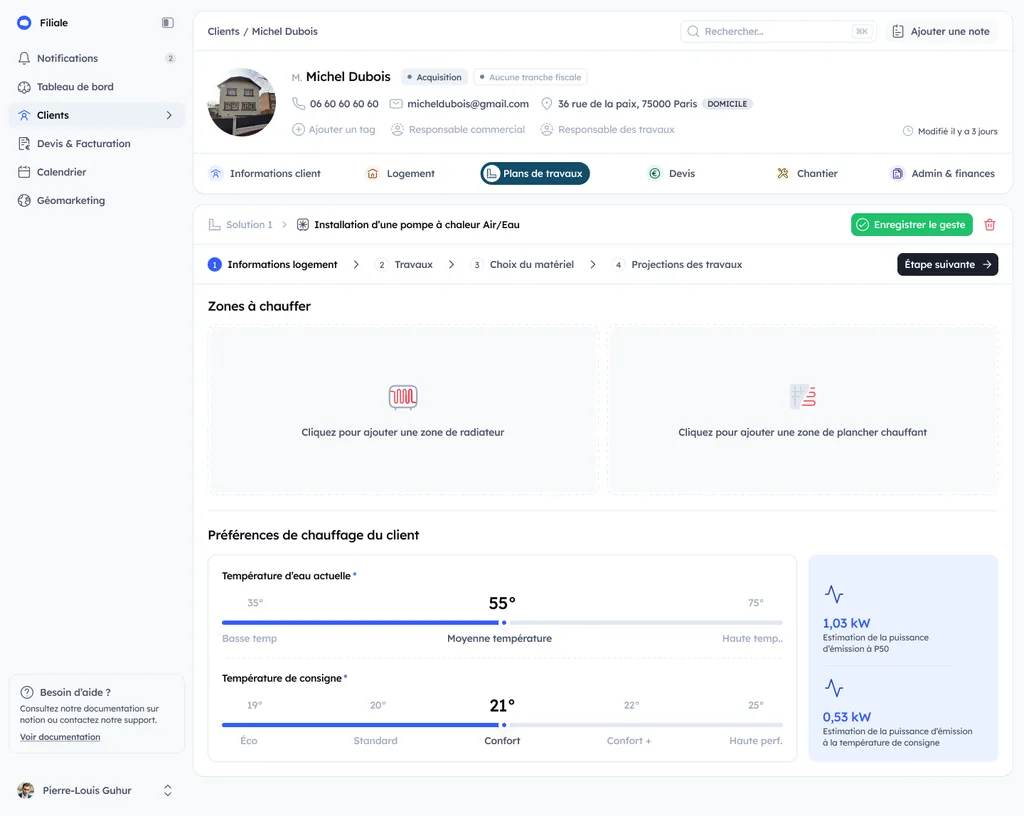
With the fast energy assessment, you start from simple data (area, insulation, emitters, climate) and set consistent assumptions about flow temperatures and usage. In a few clicks, Argile compares several scenarios and estimates a SCOP suited to the context, rather than a "catalogue" figure. In a few minutes, you have a clear basis for discussion.
Feasibility analysis: spotting technical constraints before quoting a SCOP to the client
The feasibility analysis cross-references the address with installation constraints. Outdoor space, acoustics, condensate drainage, available electrical capacity, compatibility with radiators or underfloor heating. You spot blocking issues before quoting a SCOP to the client, then adjust the scenario if needed.
From calculation to quote: integrating SCOP, sizing and funding without re-entering data
Once the sizing is confirmed, Argile carries straight on to the quote. SCOP, output, accessories and labour are carried over automatically, along with an estimate of the funding the household can draw on, based on the profile and the work. The result: a consistent quote, with no re-entry, and better-protected margins. To go further on automating this part, discover how calculating the funding can be simplified. It is the same thread from start to finish, from the technical visit to the sizing report, then to the selected equipment and the savings presented to the client.
Turning the SCOP calculation into a site decision: sizing, costing and securing the signature
Linking SCOP and consumption: explaining the expected bill and the limits of the costing
Start from the heat need (kWh/year) derived from an assessment or an EPC. Estimate electricity consumption with a simple rule: heat need divided by SCOP. State an order of magnitude, since weather, setpoints, backup and defrosting can shift the bill. Present a range, and remind the client that a heat pump is also judged on comfort.
Adapting your offer: additional work (insulation, controls) to improve the real SCOP
To get closer to the "catalogue" SCOP, first cut the losses and the water temperature. Targeted insulation, low-temperature emitters, hydraulic balancing and a well-set heating curve limit cycling. Add simple, clear controls. You get a more stable real SCOP, and therefore a more credible costing.
Justifying your choices in case of an audit: keeping the assumptions, evidence and calculation documents
In case of an audit, keep your sizing assumptions, the calculation report, the datasheets, the photos, the diagrams, the settings, the MCS certificate and proof of commissioning. Build an evidence file from the site visit onward. It makes the client's decision that much easier.