Understanding LPG/propane boilers in rural settings: how they work and their uses
Differences between LPG and propane: what you're actually installing at the client's home
In France, LPG mainly covers butane and propane. In rural renovation, the boiler is almost always fed by tank propane, stored outdoors. It keeps vaporising well in cold weather, whereas butane is more often confined to cylinders and less exposed uses.
How the boiler works: combustion, control and hot water production
The boiler burns the gas via a modulating burner. Heat is transferred to water in a heat exchanger to feed the emitters and produce domestic hot water, either instantaneously or via a tank. The controller (thermostat, outdoor sensor) adjusts output. In the condensing version, part of the heat from the flue gases is recovered.
Specific constraints in rural areas: network access, delivery and storage
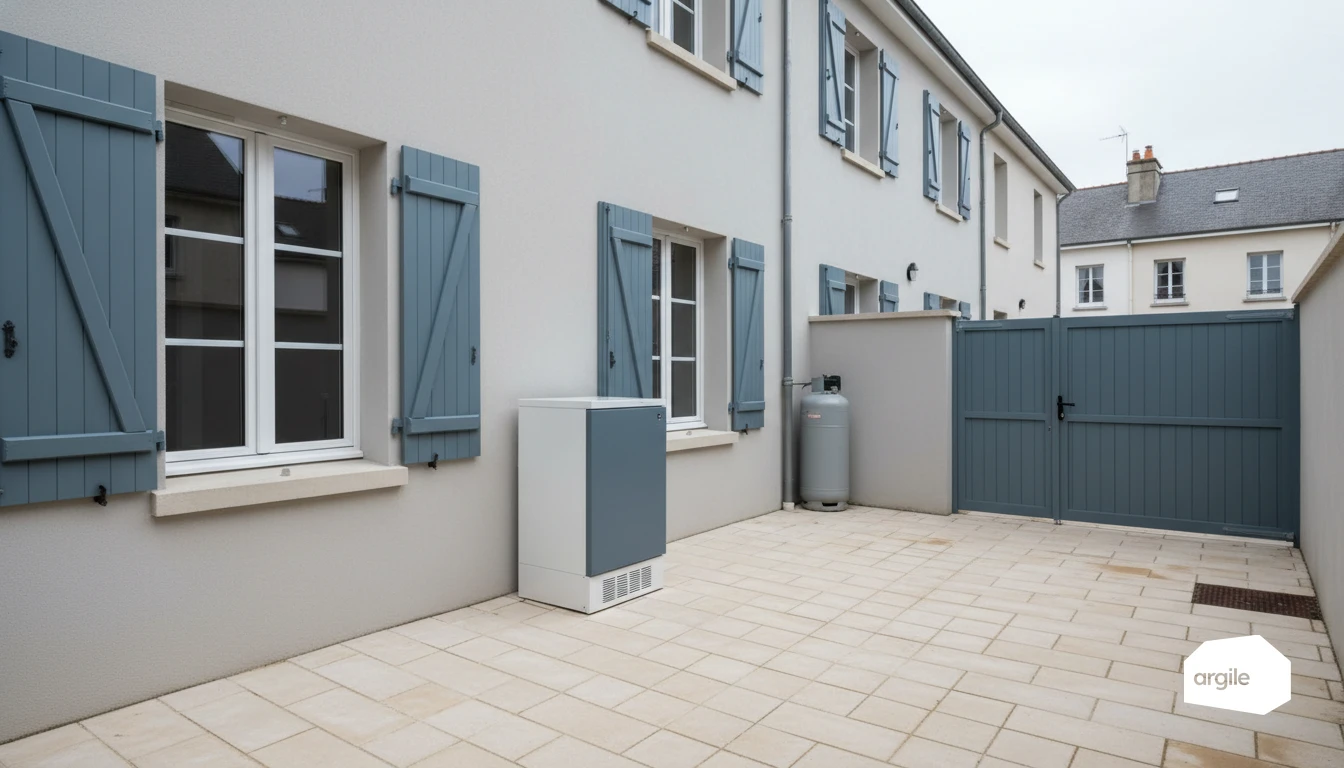
Without a gas network, everything depends on scheduled delivery. You need an above-ground or buried tank, reliable truck access, and level monitoring to avoid running out in winter. Add the safety distances around storage and annual maintenance, as with any boiler. To compare options and frame the choice properly, you can rely on a heating comparison between natural gas, propane and butane.
Choosing the right propane boiler: technical criteria for a reliable installation
Output and sizing: avoiding overheating, short cycles and overconsumption
The right approach is to start from a heat-loss calculation (area, insulation, climate zone, target temperature). An oversized boiler cycles on and off repeatedly. The result is short cycling and rising consumption. In renovation, also check the minimum output. A modulating boiler, able to run at low output, is often more stable day to day. For hot water, check the need (flow rate, number of bathrooms) and the type of tank if required. The chosen output is backed by a sizing report with heat losses broken down and the design temperature stated.
Condensing, low temperature, hybrid: which options for a rural home
Condensing is most beneficial when the heating return stays low, ideally under 55°C. With underfloor heating or radiators sized for low temperature, you gain efficiency. If the emitter is older, things can sometimes be improved with finer settings and balancing. In a rural home, a hybrid solution (heat pump + propane) secures cold snaps while reducing the bill.
Balanced flue, duct, flue system: points to watch in renovation
A balanced-flue boiler often simplifies renovation, but the outlet's position on the façade must comply with regulatory distances and avoid nuisance. If a duct already exists, check its condition and its compatibility with condensing (lining resistant to acidic condensate, slope, condensate drainage). Finally, the flue system must stay compliant with current rules. A tightness check and a CO alarm are good safety measures.
Propane storage: tank, safety and siting on the plot
Above-ground or buried tank: advantages, limits and overall cost
An above-ground tank is quick to install and easy to inspect. It needs space and is visible. A buried tank frees up the garden and protects against impact, but costs more due to excavation, the slab, earthing and inspections. For overall cost, also consider the possibility of renting, maintenance, and replacement of safety components.
Safety distances, ventilation and accessibility: rules to check before quoting
Before pricing a propane boiler, check the minimum distances required depending on the volume, whether above-ground or buried, and the supplier's requirements. Keep a clear zone around the tank, avoid nearby manholes, pits and basement vents, and ensure permanent ventilation. Plan clear access to the valves and a practicable path for the delivery truck.
Supply and delivery contract: anticipating constraints for the client
The gas contract usually sets out the tank supply terms, the commitment period, delivery fees, and the frequency of visits. Anticipate refill frequency, gauge level, delivery windows, and access constraints in winter or with a closed gate.
Costs, consumption and 2026 grants: pricing an LPG/propane boiler project
Purchase, installation and maintenance price: quote lines not to forget
On a quote, count the boiler, the flue system, the hydraulic accessories, the controls and commissioning. Add removal of the old unit and, on the propane side, the tank (supply or purchase), installation fees and the tightness check. Also factor in the annual maintenance contract, mandatory for most boilers. These lines go in faster when equipment, labour and accessories come straight from the work plan, with VAT applied line by line.
Propane consumption: factors that change the bill in a rural home
The bill first depends on insulation, heated floor area and the requested temperature. Domestic hot water, the emitters (radiators, underfloor) and the settings also play a role. In rural areas, the supply method (automatic delivery or on-demand) and storage affect the price. A well-tuned boiler and a simple heating curve improve actual efficiency.
Grants and alternatives in 2026: when the boiler still makes sense against other solutions
In 2026, grants mainly target low-carbon solutions. A propane boiler can still make sense as a like-for-like replacement, when a heat pump is difficult (noise, space, electrical capacity), or as a transitional solution. To limit the bill, look at insulation, room-by-room control and, if possible, a hybrid heat pump or an air-to-water heat pump.
Field arguments and mistakes to avoid: succeeding on rural boiler projects
Pre-project checklist: surveys, flue system, condensate drainage, connections
In rural areas, the real time savings happen before the equipment arrives. Access to the room, the electrical network, water pressure, and the type of supply (gas, propane, oil) quickly change the picture.
- Accurate surveys. output, volumes, emitters, network condition and presence of sludge.
- Flue system. duct condition, condensing compatibility, tightness, air intake, safety distances.
- Condensate. slope, trap, compliant discharge, frost protection.
- Connections. gas and water, bleeding, expansion vessel, drainage, power supply and earthing.
Settings and commissioning: combustion, configuration and explanations to the client
At commissioning, a combustion analysis avoids 80% of callbacks. Calibrate the heating curve, check the safety devices, then run at stable operation. Explain the modes, frost protection and annual maintenance to the client simply.
Common faults and lessons learned: quick diagnosis and prevention
Frequent faults: low pressure, clogged filter, condensate drainage fault, insufficient draught, circulator stuck after seasonal shutdown. Think prevention: sludge trap, flushing, duct inspection, and electrical protection at the end of the line. To frame the duct side, also consider the duct inspection requirements.