Understanding how an ejector heat pump works (no jargon)
What the ejector does in the refrigeration cycle
In a heat pump, the refrigerant passes through an expansion valve that "wastes" pressure. The ejector recovers part of that energy and uses it to help the refrigerant circulate. The result: the compressor works less hard for the same amount of heat.
Concrete differences from a "classic" air-to-water heat pump
You find the same building blocks: evaporator, compressor, condenser. But an ejector is added, often with a separator and dedicated controls. The goal isn't to go faster, but to be more efficient as conditions vary.
What this changes for operating stability in cold weather
When outdoor air temperature drops, the pressure on the intake side becomes critical. The ejector helps maintain a more favourable pressure and flow level. The heat pump holds onto its power and efficiency more easily, running more steadily, even though defrosting remains necessary.
Innovation and expected gains: what the ejector can bring on site
COP and low-temperature performance: what to check
In an ejector heat pump, the idea is to recover part of the energy lost in the expansion stage to support compression. On site, the gain is judged mainly by COP at -7°C and available power when the air turns cold. Ask for tests per EN 14511 standards and seasonal data (SCOP) from the product data sheet. Also compare the bivalence temperature and the share of electric backup.
Comfort and control: impact on the heating flow temperature
If the ejector holds power better, you can target a lower flow temperature for the same comfort level. This is often where controls make the difference. Check the heating curve, mid-season stability, and the ability to modulate smoothly. On radiators, watch the return temperature to avoid short cycling.
Noise, defrosting, consumption: points to check during testing
During testing, check three points. Sound levels under load and during defrosting. Frequency and duration of defrost cycles in humid weather, and their impact on consumption. And finally, instantaneous and cumulative consumption over several days, logging the actual outdoor temperature. To limit nuisance, rely on noise and vibration mitigation solutions suited to the site.
Site applications: where the ejector heat pump is most valuable
On site, an ejector heat pump is mainly worthwhile when you need to keep power and a decent COP in winter, without oversizing.
Single-family home renovation: radiators vs underfloor heating
With existing radiators, you often need 50 to 65°C flow temperature to maintain comfort. The ejector helps as outdoor temperature drops. With underfloor heating (30 to 40°C), the benefit is smaller. It's better to first lower the flow temperature with more generous emitters and good balancing.
Boiler replacement: flow temperatures and hydraulic constraints
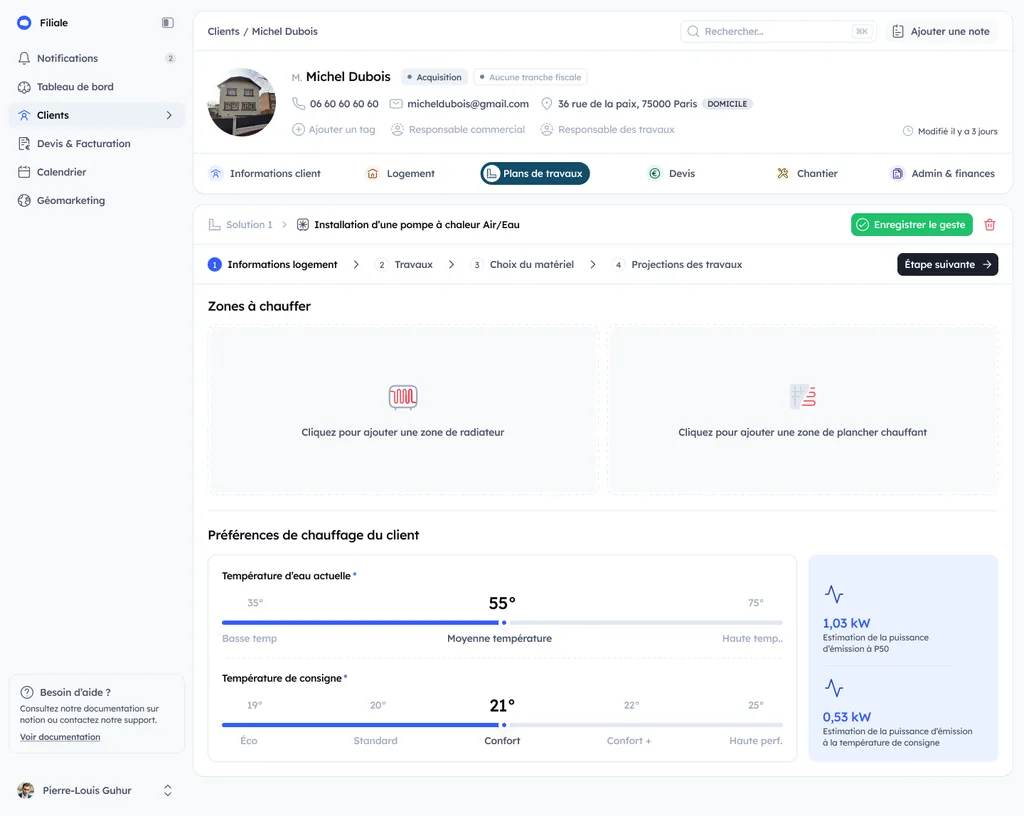
When replacing a boiler, check the flow temperature actually needed room by room. On the hydraulic side, a heat pump doesn't like unstable flow rates. Plan for a guaranteed minimum flow rate (hydraulic separator or buffer tank if needed) and watch for thermostatic valves that close too much. These checks fit into the workflow when the site survey feeds straight into the air/water heat pump sizing and the equipment selection.
Domestic hot water and mixed needs: limits and sizing best practices
For domestic hot water, high setpoints hurt performance. Size first for heating, then secure hot water peaks with a suitably sized tank, scheduling and, if necessary, an electric backup. Keep temperatures consistent to limit short cycling.
Points of attention for tradespeople in 2026: equipment choice, installation, maintenance
Hydraulic compatibility and installation quality: mistakes to avoid
Before installing a heat pump, check the existing system. Emitters, water volumes, buffer tank, expansion vessel, sludge trap and water treatment must all be consistent. Poor balancing or unanticipated pressure losses make the circulator run for nothing. Pay attention to pipe insulation and condensation points. Consistent flow rates and clean filtration prevent many callbacks.
Commissioning and settings: the parameters that drive performance
Performance is won at the settings stage. Configure the heating curve to match the emitters, activate room-by-room control if useful, and limit high-temperature boost cycles. Check the flow temperature, delta T, short cycling and defrosting. An electric backup that runs too often often hides a setting that's too "hot." For more, see how an outdoor temperature sensor determines the accuracy of the heating curve.
Maintenance and monitoring: what to watch on an ejector heat pump
In 2026, plan ahead for refrigerant-related constraints and traceability. On an ejector heat pump, monitor pressures, sensors, heat exchanger fouling and mid-season stability. Plan for an annual check with cleaning, leak testing, purging and parameter updates after any work.
How to follow this technological breakthrough without getting it wrong
Comparison criteria between brands and models: data to request
Before comparing, ask for a full technical data sheet. SCOP per EN 14825, COP at +7°C and -7°C, operating range, minimum and maximum power, sound level, refrigerant, compatibility with your emitters, and certified performance (Eurovent or equivalent). For an ejector heat pump, also look at cold-weather behaviour and defrost management. Keep measured data, not promises.
Field experience, training, RGE: where to build up expertise
To gain efficiency, combine manufacturer manuals, ADEME guides and Qualit'EnR training sessions. In 2026, an RGE qualification (e.g. QualiPAC) remains mandatory to work on grant-funded projects. Also look for field feedback in tradesperson associations and technical workshops, with consumption and flow-rate readings.
Talking to clients: discussing innovation without overselling the ejector heat pump
With clients, present the ejector as a possible optimization, especially useful in cold weather. But the result depends on sizing, insulation and hydraulic balancing. Quote based on a proper calculation, a diagram, and follow-up after installation. You're talking about innovation, but you're selling a result. The calculation lands better when the heat losses come out as an EN 12831-1 sizing report, ready for the client's file.