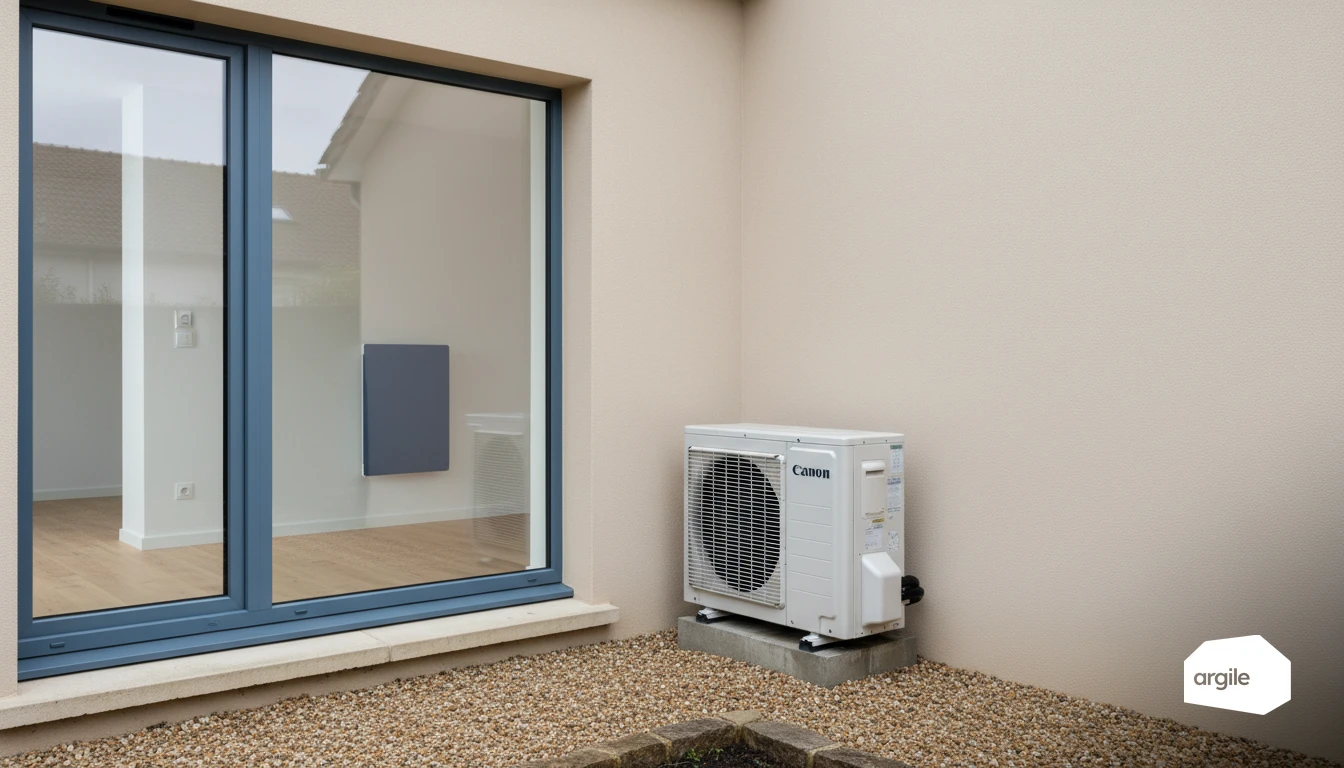
On a new installation or a like-for-like generator replacement, the French NF DTU 65.16 caps heat pump output between 70 and 100 % of the design heat loss D calculated at the design external temperature, and requires heat pump plus backup to reach at least 1,2 × D. The backup is an integral part of the heating system, which rules out counting a stove or storage heaters already in the property, since the client can remove them and make the design comfort temperature unreachable on the coldest days. Those limits are published in the sizing table of NF DTU 65.16 Part 1-1, reproduced by the Agence Qualité Construction in Qualité Construction no. 167.
What the sizing framework requires of the backup
Output limits by job type
The framework separates a new installation, or a generator replacement, from a case where an existing boiler stays on as top-up. The table below sets out the applicable limits, with D the design heat loss of the heated volume at the design external temperature and Php the output delivered by the unit at that temperature and at the planned flow temperature.
| Job type | Heat pump output | Backup |
|---|---|---|
| New, existing or replacement, on/off heat pump | 70 % × D ≤ Php ≤ 100 % × D | Php + backup ≥ 1,2 × D |
| New, existing or replacement, inverter-driven unit, medium or heavy thermal mass | 70 % × D ≤ Php ≤ 100 % × D | Php + backup ≥ 1,2 × D |
| New, existing or replacement, inverter-driven unit, lower thermal mass | 80 % × D ≤ Php ≤ 100 % × D | Php + backup ≥ 1,2 × D |
| Existing installation, boiler kept as top-up | No rule on heat pump output | Pboiler ≥ 1,2 × D |
On a single-phase supply with electric backup, the framework calls for a minimum of two output stages beyond 3 kW of backup. Keep the exact wording in mind, it reads as a clause: the backup is part of the heating system.
Why an appliance already on site can never serve as backup
The text is categorical: the backup considered in the sizing must always be an integral part of the system, and independent appliances, a stove or an electric convector, can never be treated as backup. The reasoning is one of liability. The client can remove a stove for their own reasons, and the installation you signed off then becomes incapable of holding the design comfort temperature in severe cold. Backup counted outside the system is a deferred undersizing, not a saving.
Design external temperature, not the catalogue test point
The recurring mistake is to read the unit's output at the standard test point and set it against the heat loss. The framework asks for the output delivered at the site's design external temperature and at the flow temperature planned for that condition. That temperature varies sharply with location: around -4 °C in Brittany, -15 °C on the Alsace plain in the example given by the Agence Qualité Construction. Taking the output quoted at -7 °C for a site with a colder design condition skews the calculation from the first line.
Pinpointing when the backup triggers on site
The most common triggers: outdoor temperature, setpoint, heating curve
The backup starts when the unit can no longer reach the requested flow temperature. Classic causes are an outdoor temperature below the bivalence point, a setpoint that is too high, or a heating curve that is too steep and quickly demands high temperatures. To fine-tune this, refer to the heating curve.
Settings and controls: heating curve, hysteresis, time schedules
Check the heating curve, then the hysteresis. Too narrow, and it triggers the backup at the slightest deviation. Also look at the time schedules and any permanent comfort mode, which blocks the night setback. A reading from the controller or the app gives the exact moment of switchover, and that trace is what settles a running-cost dispute.
Signs to check when troubleshooting: faults, short cycling, low flow, low charge
If the backup activates without notably cold weather, look for an alarm, short cycling, or low flow (filter, circulator, sludge build-up). A low refrigerant charge or a fouled heat exchanger causes delivered output to drop. Check ΔT, flow rate and backup current draw, and write all three onto the service sheet.
Alternating or parallel operation: what you choose drives the running cost
Alternating, parallel, and the balance point
In alternating operation, the heat pump heats on its own down to a given temperature, stops, and the backup takes over. In parallel operation, the unit keeps running below the bivalence point and the backup tops up, down to a possible cut-out temperature where the backup carries the load alone. The mode you pick changes the share of direct electric heat over the season, so the real SCOP, and it belongs in the sizing note.
Typical cases that overwork the element: emitters, hot water, fabric
The element is triggered mainly when the flow temperature has to climb. Emitters sized for 70 °C, an over-ambitious heating curve, a fabric that is still leaky. Hot water also creates demand spikes, and the anti-legionella cycle calls the backup on many units. Record the flow temperature actually reached at the design condition before concluding there is a hardware fault.
What you put on the quotation and in the sizing note
Show D, the design external temperature used, the heat pump output at that temperature and the integral backup output, with the total set against 1,2 × D. That page, produced to NF EN 12831-1 from the technical survey, protects you in an audit and lets you defend your price against a cheaper bid that specified a smaller unit with no backup. A quotation that says nothing about backup is a quotation that transfers the risk onto you.
Settings that cut consumption without leaving the limits
Bivalence threshold, output limitation, backup authorisation
Set a bivalence threshold consistent with the local design external temperature, not with a factory value. Limit backup output to the strict minimum, authorise it only when the unit can no longer cover demand, and check that the two stages required beyond 3 kW on a single-phase supply are actually wired and active. A badly set heat pump priority hands over to the element well before the calculated bivalence point.
Secure the hydraulics before touching the menus
Balancing the loops, sludge removal on an older system, and pipe insulation in unheated spaces stop the element from making up distribution losses. Also check the water volume in the circuit: the framework requires enough volume to limit short cycling and guarantee complete defrost cycles, with a buffer-volume calculation method given in an annex. Where volume is lacking, a buffer vessel has to be added.
Aim for the lowest possible flow temperature
Set the heating curve, check flow rates, adapt the emitters to bring the flow temperature down at the design condition. Every degree gained pushes the bivalence point further out and cuts the backup share over the season. To lay the groundwork for the calculation, use the heat loss method and the EN 12831 standard.
Audits, schemes and traceability: what gets looked at
What an audit checks on sizing
Audits target correct sizing and baseline settings. A heat loss calculation, a consistent flow temperature and a well-calibrated heating curve avoid overconsumption and comfort gaps. The most frequent weak point is the absence of any justification of the heat pump plus backup pair against 1,2 × D, even though it is the simplest figure to produce.
Cross-check the outputs before commissioning
On site, cross-check three things. The output calculated in the heat loss study, the output actually available from the unit at the design external temperature per the manual, and your readings of run time and kWh dedicated to backup. If the backup activates while the setpoint is modest, look for an inconsistency in settings, emitters or fabric, and avoid the traps listed in the 5 sizing mistakes.
Document commissioning: paperwork, readings and proof of settings
Keep simple proof. A signed commissioning sheet, photos of the settings, heating instructions, temperature readings and, where possible, an operating log after 24 to 48 hours including backup hours. It is your logbook, useful in an audit and decisive in after-sales when the first winter's running cost is challenged.