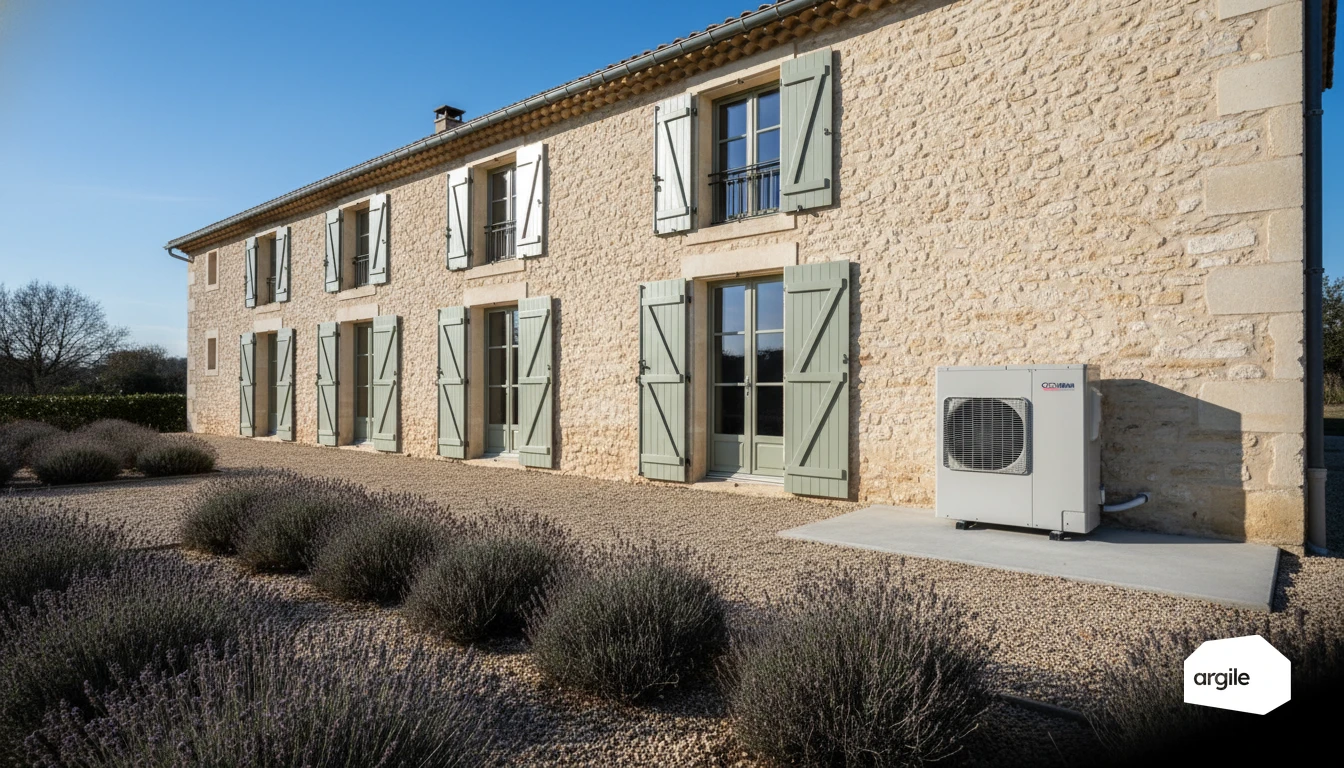
An oversized heat pump in a retrofit loses of the order of 15% in efficiency and costs around €2,000 more to buy, for comfort that does not improve. The most frequent cause lies in the starting point of the calculation: sizing is done on the home once renovated, taking in the work already carried out and the work written into the same quote, not on the condition found on the day of the visit. The calculation is run room by room, with the design outdoor temperature for the location, the fabric losses and the ventilation losses, never through a ratio per square metre. The backup and the changeover temperature are fixed at the quote stage, failing which the immersion heater runs all winter without anyone having costed it.
Underestimating actual post-renovation needs: the heat pump that's oversized or too marginal
Accounting for work already done and work planned for 2026 (insulation, joinery, ventilation)
A heat pump must be sized for the home "once renovated," not for yesterday's condition. Note what's already been treated (loft, ground floor, air leaks) and what's coming in 2026 (joinery, external wall insulation, mechanical ventilation). Otherwise you risk unnecessary power output, short cycling, more noise, and declining performance. The clearest case is the combined heat pump and external wall insulation scenario, where the machine is chosen once the walls are insulated from outside.
Checking heat loss room by room rather than estimating "per m²"
The "per m²" approach is quick, but it overlooks cold rooms, north-facing walls, and high ceilings. Calculate losses room by room through the envelope and through air renewal. You get a genuinely reliable basis for setting the emitters and the heating curve, building on the heat-loss method.
Matching power output to the local design temperature and the requested comfort level
A heat pump must hold the load at the design point, tied to the local design temperature. Add your comfort choices (19 or 21°C, schedules, domestic hot water) and check the backup. Too marginal, and the backup runs constantly. Too big, and the machine struggles at mid-season.
Getting the operating logic wrong: backup, bivalence and short cycling
Avoiding short cycling: impact on consumption, noise and compressor life
A heat pump that starts and stops too often produces short cycling. The result is climbing consumption, more noticeable noise levels, and a compressor that wears out faster. Typical causes are oversizing, a poorly set heating curve, or too little water volume in the network.
Clearly defining the backup (electric, boiler) and the switchover temperature
In renovation, the backup must be framed from the quote stage. Integrated electric element, existing boiler, or both. Set a switchover temperature consistent with the local climate and the flow temperature the emitters need. A clear backup strategy avoids nasty surprises on the bill.
Choosing a modulation range suited to renovation use
The key point is minimum power output. If the heat pump can't turn down low enough, it will cycle as soon as mid-season arrives. Aim for good modulation and adapt the hydraulics accordingly, buffer tank if needed, control settings, zones. In a well-insulated home, needs drop fast, and the machine should be able to keep up.
Neglecting the emitter and the hydraulics: a heat pump doesn't "make up for" a poorly prepared installation
Checking flow temperatures for radiators, underfloor heating and controls
A heat pump performs best when the flow temperature stays low. Before installing, check the real operating regime of the radiators or underfloor heating, and the condition of the thermostatic heads. Set the heating curve and room-by-room controls to avoid on/off cycling and a backup that kicks in as soon as demand rises.
Sizing flow rate, circulator, valves and balancing to secure performance
Without correct flow rate, the machine's COP degrades and it can trip into fault. Calculate the flow rate per loop, choose the circulator based on head loss, then plan for isolation valves, filters and a sludge trap. Finish with balancing, otherwise some rooms overheat, others underheat, and the controls compensate in the wrong place.
Checking water volume, buffer tank and hydraulic decoupling where necessary
The right water volume stabilises cycling and protects the compressor. If the installation is very small, heavily zoned, or has thermostatic valves that close frequently, a buffer tank or hydraulic decoupling can prevent short cycling. The goal stays simple: circulate what's needed, when it's needed, at the right temperature.
Forgetting domestic hot water and usage patterns: a heat pump well sized for heating can still fail at hot water
Assessing domestic hot water needs (number of occupants, habits) and choosing the right tank volume
A heat pump can be perfect for heating and still disappoint on hot water if the tank is undersized. Count the occupants, daily showers, baths, and secondary uses (kitchen, laundry). In renovation, an undersized tank shows up as frequent reheats and a dropping temperature. Aim for a volume matched to habits, often 150 to 200 L for 3 to 4 people, more with regular baths. Good rule of thumb, but adjust to the actual case.
Anticipating draw-off peaks and reheats: settings and scheduling
The weak point is the morning and evening peaks. Set the domestic hot water target to actual need, schedule heating windows ahead of draw-off periods, and limit reheats in the middle of the day. Also plan the anti-legionella cycle for a time when the home consumes less. Fewer spikes, more comfort.
Accounting for renovation constraints (location, condensate drainage, noise)
In an existing home, the location of the tank and the outdoor unit matters. Plan for reliable condensate drainage, maintenance access, and a placement that avoids "sonically" affecting a bedroom or a neighbour. From the quote stage, validate the routing, distances and anti-vibration mounts.
Skipping the method and the evidence: calculation errors, fragile quotes and 2026 support schemes
Relying on a sizing method (heat loss, site surveys, consumption history) and documenting your assumptions
To size a heat pump, start from a heat-loss calculation based on real site surveys (areas, insulation, joinery, ventilation), the climate zone and the design temperature. Cross-check against consumption history and, where possible, on-site measurements. Write down your assumptions in black and white (setpoints, reheat, domestic hot water, emitters). Without that, oversizing happens fast, and performance degrades. Heat pump software that checks each model against that heat loss, at the design temperature, flags the gap before the order goes in. That is exactly what a heat loss report to EN 12831-1, built from the survey readings sets out.
Securing the file: consistency between study, quote, commissioning and settings
The file holds together if everything tells the same story. Same power output, same product reference, same accessories, same emitters and same control strategy between study and quote. At commissioning, keep a report with the key settings (heating curve, limits, balancing). This consistency avoids "fragile" quotes when an inspection comes along.
RGE, CEE, MaPrimeRénov': 2026 points of vigilance to avoid rejections linked to sizing
In 2026, support schemes turn on evidence. Check that your RGE qualification is valid at the quote and invoice dates. For the CEE and MaPrimeRénov' schemes, align the installed power output with the study, and keep all supporting documents (study, product data sheets, commissioning). Unexplained discrepancies are a classic reason for rejection.