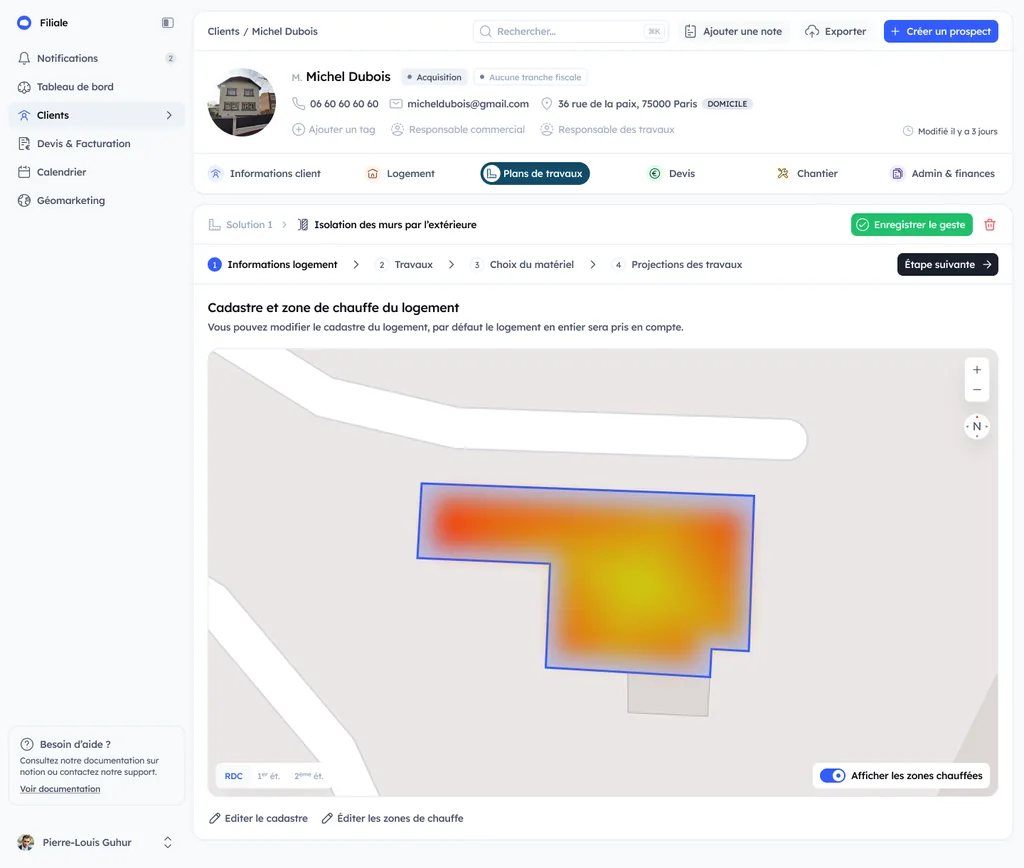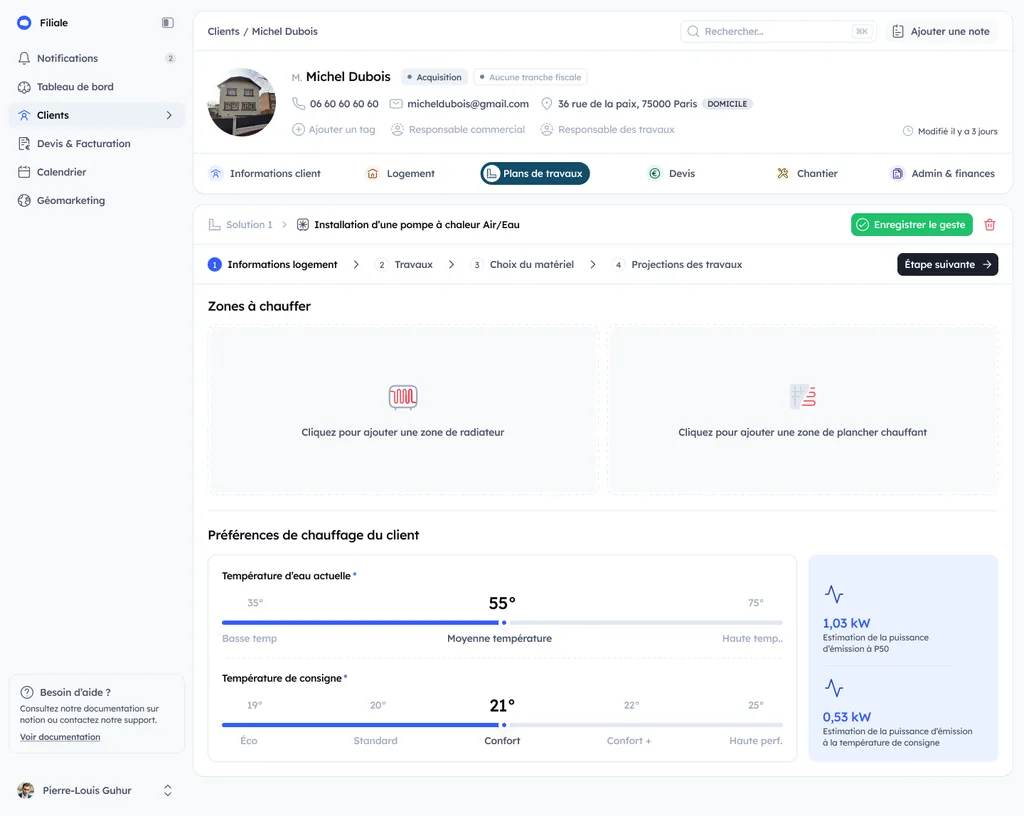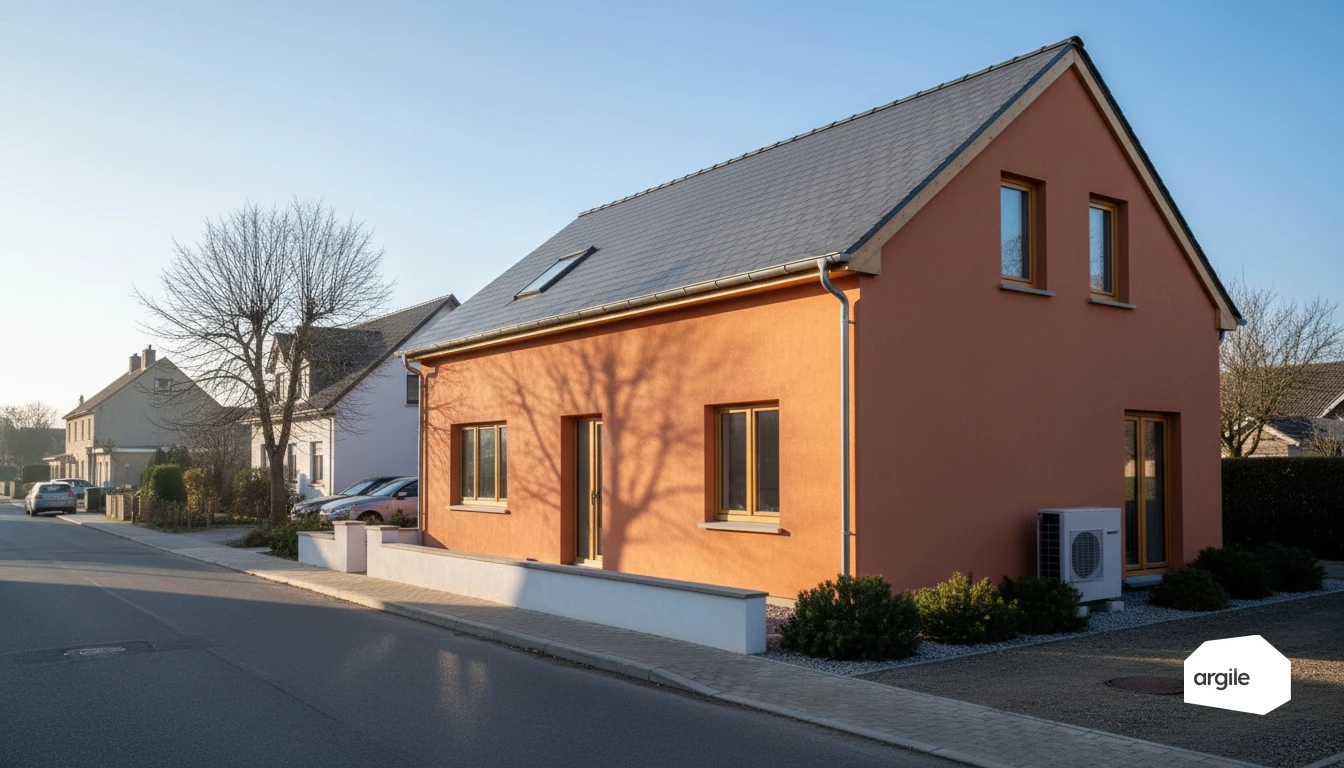
The work plan combining external wall insulation and a heat pump targets a 55 to 70% gain on final energy consumption, for a budget of €20,000 to €40,000 on a house and a B or C band on arrival. The order matters as much as the amount: the external insulation goes on first, the heat pump is then sized on the heat loss of the home once insulated, never on its pre-works condition. Sizing the machine on the initial condition produces surplus output, short cycling and degraded seasonal performance, on an installation already paid for. Phasing imposed by the budget is set out in the quote, with the location, the pipework and the emitters reserved for the heat pump to come.
Why the heat pump + external wall insulation scenario outperforms a piecemeal approach
Understanding the combined effect: reducing heat demand before optimising heating
With this scenario, external wall insulation first reduces heat loss. The heat pump then arrives in a home that is less "demanding," so it is better sized. The result: a smaller unit, fewer short cycles, better seasonal performance and more stable comfort. It's the right order to avoid overpaying for a heating system that's just compensating for a weak envelope.
Spotting the homes where the heat pump + external wall insulation scenario makes a difference (housing types, usage, climate)
This works very well on single-family homes from before the 2000s, with poorly insulated walls and oil heating, an old gas boiler, or electric convectors. In cold or temperate zones, the drop in heat demand changes everything. If occupants are often home, the gain shows quickly. An accessible facade and pronounced thermal bridges are good signs. If you're aiming for a jump in DPE class, this winning combo helps you get there.
Avoiding bad surprises: summer comfort, moisture, ventilation and airtightness
External wall insulation and a heat pump aren't enough if the air doesn't renew. Check ventilation, airtightness and moisture management, or you risk mould or discomfort. Also think about summer comfort, solar shading, thermal mass, internal gains. A thorough site survey and a ventilation system adjustment often make the real difference.
Building a coherent heat pump + external wall insulation scenario: order of works, points to watch, trade-offs
Choosing the right sequence: external wall insulation first, heat pump second... or phasing when constraints require it
In a combined scenario, external wall insulation first remains the most logical. You lower heat demand, secure comfort, then size the heat pump as precisely as possible. If budget or planning rules force phasing, plan for it explicitly. Keep technical margins for the future heat pump (location, hydraulics, emitters). The facade take-off and the insulation chosen are priced to the square metre, openings deducted.
Sizing and settings: what changes once the envelope is reinforced (emission, heating curve, hot water)
After external wall insulation, a heat pump sized too large risks short cycling. You can often aim for lower flow temperatures. You need to recalibrate the heating curve, check the balancing of radiators or underfloor heating, and revisit domestic hot water (output, tank, priorities) to avoid sudden swings. The output is recalculated on the heat losses of the home once insulated, from the site survey through to the sizing note.
Treating thermal bridges and interfaces (windows, floors, roofs) for an effective combination
Performance is decided at the junctions. Take care with insulation returns at window reveals, sills and boxes, the facade-to-floor connection, and continuity at the wall base. A clean detail limits cold spots, protects against condensation, and makes the external wall insulation + heat pump pairing genuinely effective.
Comparing several scenarios without wasting time: performance, cost, grants and remaining cost in 2026
Defining 2 to 3 clear scenarios for the client (essential, optimised, comprehensive renovation)
Offer 2 or 3 clear options. An "essential" scenario addresses the urgent issue (simple insulation or controls). An "optimised" scenario adds the action that truly changes the energy rating. A comprehensive renovation sequences the trades in the right order, aiming for a jump in classes. Each scenario should show the expected performance and site constraints, without overwhelming the client.
Costing and profitability: capex, savings, payback time, and the limits of estimates
Set out a capex figure per scenario, then an estimate of savings (kWh, euros, CO2) and a payback time. Stay factual. Weather, usage patterns and energy prices all cause the result to vary. Give ranges and specify what is measured (heat loss, efficiency, controls) versus what is assumed.
2026 grants: build MaPrimeRénov' and CEE into the scenario from the quote stage, without risky "promises"
In 2026, build MaPrimeRénov' and CEE into the quote from the start. Show an estimated amount per scenario, then the remaining cost to the client. Frame it with a simple caveat: grants are subject to eligibility, filing and approval. Keep the supporting documents, applicable CEE technical sheets and an application timeline to avoid bad surprises.
Real-world cases: examples of combined heat pump + external wall insulation scenarios by housing configuration
1970s "energy sieve" house: heat pump + external wall insulation + ventilation scenario to secure the result
In a very poorly insulated 1970s house, the most robust scenario starts with external wall insulation and treating thermal bridges. The heat pump is then sized on reduced heat demand, and a humidity-controlled mechanical ventilation system is added to limit moisture and mould. The goal: stable comfort and controlled consumption.
House with existing radiators: adapted heat pump + external wall insulation scenario to lower the flow temperature
With radiators already in place, the scenario aims to lower the flow temperature. External wall insulation first, then an air/water heat pump sized for low temperature, with a properly calibrated heating curve and network balancing. Often, reinforcing just a few emitters is enough to avoid needing a "high temperature" heat pump.
Constrained facade (heritage authority, shared walls): scenario variants (partial external insulation, targeted internal insulation, prioritising by trade)
If the facade is constrained, keep the scenario but adapt it. External wall insulation on free gable walls, targeted internal insulation on cold walls, then prioritise loft, ground floor and airtightness. The heat pump comes last, once heat loss has been clarified.
How Argile helps RGE-certified tradespeople frame, sell and secure your heat pump + external wall insulation scenarios
Quick energy diagnosis and work scenarios: propose a combined heat pump + external wall insulation solution in minutes
With Argile's quick energy diagnosis, you go from an address to a heat pump + external wall insulation scenario in 5 minutes. You test several variants, visualise the gains, and produce a clear pitch for the client, with no spreadsheet.
Feasibility analysis and technical constraints: anticipate blocking points before the site visit
Even before the site visit, the feasibility analysis cross-references your field data with Open Data to spot blocking points: available electrical power, outdoor unit location, condition of the emitters, external wall insulation thickness, site access. You arrive with a checklist, and your scenario holds up.
Pre-costing, quotes and grant calculations: save time on paperwork and boost your signature rate
On the sales side, Argile generates a pre-costing then a quote, with a grant calculation (MaPrimeRénov', CEE) and the documents to prepare. In 2026, it's often the remaining cost to the client that decides the sale. Fewer back-and-forths, more signatures.