Why bet on the heat pump + insulation duo to meet demand in 2026
What homeowners are looking for: comfort, savings and a better DPE rating
In 2026, your clients want a home that heats up fast, without draughts, and a bill that genuinely goes down. Many also want a better DPE (France's energy performance certificate) rating to secure a sale or a rental. Homes rated G have already been banned from rental since 1 January 2025. F-rated homes will follow on 1 January 2028, then E-rated homes on 1 January 2034. To clarify the rules, you can refer to the obligations and timeline for energy sieves. Comfort and DPE rating often improve together.
Heat pump without insulation: the limits you run into on site
On site, installing a heat pump in an energy sieve is like putting a new engine in a car that leaks. You end up oversizing, pushing temperatures higher, and multiplying on/off cycles. The result: falling efficiency, noise, and a client who starts to doubt. A treated envelope allows for a smaller, better-tuned heat pump. When it is the walls that are insulated from outside, see the combined heat pump and external wall insulation scenario.
Insulation alone: why heating remains the sensitive point
Insulation quickly improves how a home feels, but if the heating system stays old, the energy bill keeps weighing in. In 2026, with prices still volatile, homeowners want to lock in their spending. Once heat loss is reduced, the heat pump becomes the right lever to move from "decent" comfort to stable comfort.
Heat pump: sizing correctly and choosing the right solution (air/water, hybrid) for the home
Sizing: avoiding an oversized heat pump and callbacks
A heat pump is sized on the home's actual heat loss, not on floor area. You start from the heat demand at the reference outdoor design temperature, then check the output available at that same temperature. Too powerful means short-cycle operation, more wear, more noise and falling performance. In renovation, redo the calculation after insulation and hydraulic adjustments. The output is calculated from the visit data and the equipment is selected from up-to-date catalogues.
Points to watch: noise, units, emitters, flow temperature
Plan for noise. Choose the location of the outdoor unit, distances from neighbours and condensate management. On the heating side, look at the emitters and the flow temperature. The lower it is, the better the efficiency. High-temperature radiators, underfloor heating, buffer tanks and balancing often make the difference. Also check the electrical supply and the backup heater.
Common cases: a 1970s, 1990s house, partial renovation, boiler replacement
A 1970s, 1990s house with radiators: an air/water unit works well if insulation and adjustments are in place. In a partial renovation, a hybrid system limits risk during cold snaps and secures comfort. When replacing a boiler, plan for flushing, controls, and a clear scenario in your quotes.
Insulation: prioritising the work that really makes a difference with a heat pump
Loft, walls, floors: ranking the work by heat loss
For a heat pump to really do its job, start by limiting heat leaks. In a single-family home, losses are often greatest at the top. Loft first, then walls, then ground floors. Good loft insulation (flat or sloped) often delivers the best gain for the budget. Walls come next, especially if you address thermal bridges. Finally, the floor over a crawl space or basement avoids the "cold feet" effect. Keep a simple rule: insulate where the heat is escaping most.
Airtightness and ventilation: securing performance and comfort
A heat pump doesn't like draughts. Airtightness improves temperature stability and reduces short cycling. But you don't "seal up" a home without managing moisture. Air and vapour go together. Careful sealing, membranes, airtight loft hatches, then suitable ventilation (a maintained mechanical ventilation system, properly set flow rates). The result: comfort, air quality, and a heat pump running at low load. To go further on ventilation, see maintained mechanical ventilation.
Order of works: when to insulate before, during or after installing the heat pump
The best scenario: insulate then size the heat pump. You avoid oversizing, repeated start-ups, and you lower the flow temperature. If the heat pump is already in place, insulate anyway. Then have the settings redone (heating curve, flow rate, balancing). During the job, coordinate penetrations, ducts and vents. A solid envelope is the foundation. The heat pump is the engine.
Grants and client journey: securing the heat pump + insulation project (MaPrimeRénov' and CEE)
Heat pump + insulation: how to steer clients toward a comprehensive renovation when it makes sense
When a home is a genuine energy sieve, installing a heat pump without treating the envelope is like heating the outdoors. Propose an insulation-then-heat-pump scenario, or a comprehensive renovation with support, to size correctly and aim for a jump in DPE classes. Common sense, and often more grants.
Eligibility, documents and timelines: what most often holds things up administratively
The same snags keep coming up: MaPrimeRénov' application filed too late, quotes signed before approval, income and household composition entered incorrectly. On the CEE side, the commitment must be made before works start and the final certificate must be consistent. A well-followed modular renovation journey avoids missing documents.
RGE certification and trade coordination: avoiding mistakes that cost you the grants
Check RGE validity at the right time for each trade, and align dates, addresses, equipment references and invoices. In a comprehensive renovation, coordinating insulation, ventilation, then the heat pump limits underperformance. One rule: no work starts without proof of eligibility.
How Argile supports your heat pump + insulation projects: quick diagnosis, scenarios, quotes and paperwork
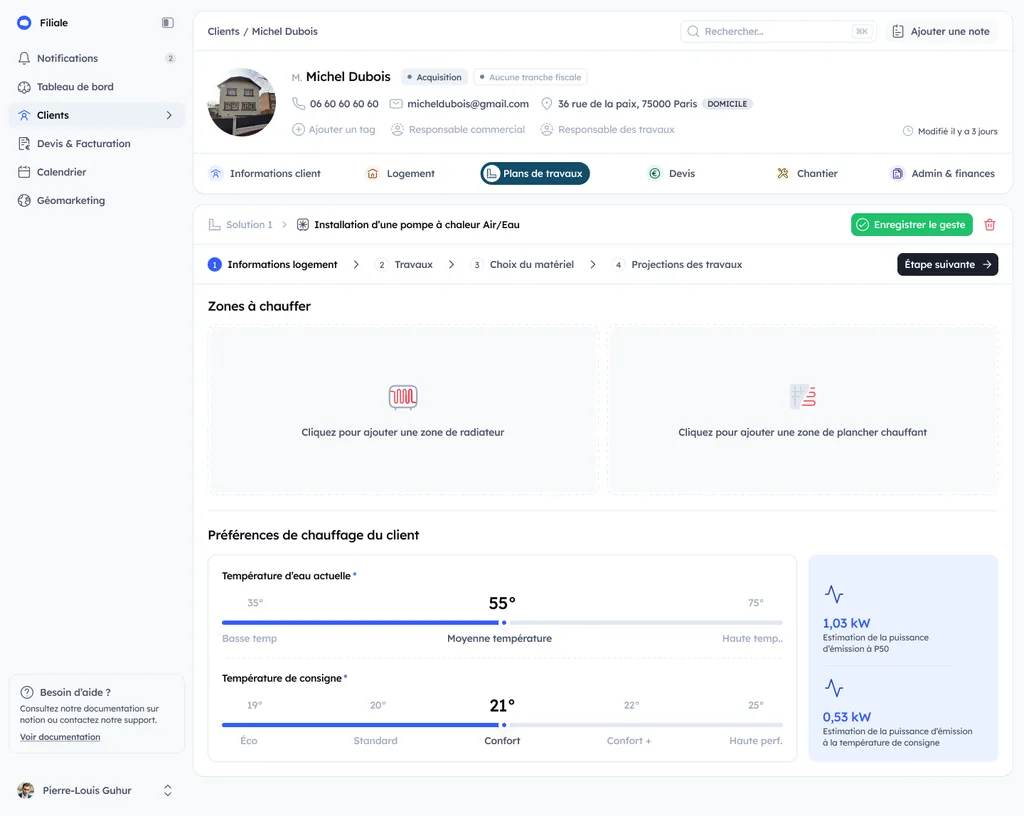
In under 5 minutes: diagnose, compare heat pump + insulation scenarios and prioritise
With Argile, you run a quick diagnosis from the address alone. You compare heat pump + insulation scenarios, with estimated gains, priority order and points to watch. Handy for framing a project and avoiding scattershot planning. The measures retained are composed by objective, from the home to the priced work plan.
A better-framed site visit: feasibility, constraints and on-site evidence
Before the visit, the platform surfaces the likely feasibility and constraints. During the visit, you collect useful on-site evidence, photos, measurements, documents, and attach them to the property. The result: fewer back-and-forths and a stronger file.
Quotes and built-in grants: pre-costing, MaPrimeRénov'/CEE and simplified paperwork
Argile prepares a pre-costing and a clear quote, factoring in RGE eligibility rules and available grants, MaPrimeRénov' and CEE. Supporting documents and forms are centralised to simplify the paperwork and speed up signature (see also how to avoid MaPrimeRénov' application rejections).