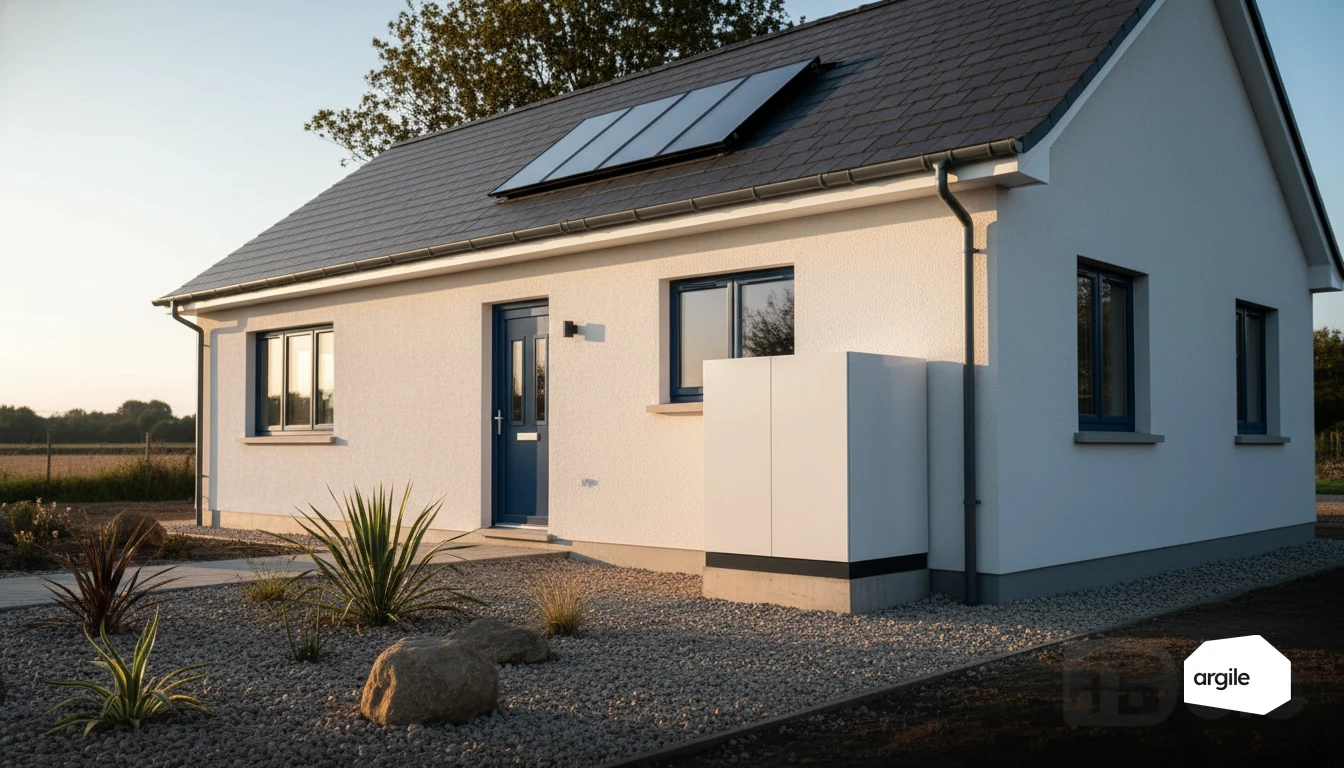
A centralised collective solar water heater brings together collectors, heat exchanger and cylinder for the whole building, the hot water then being distributed through the network and held at temperature by the secondary circulation. The sizing benchmarks are 1 to 1.5 m² of collectors and 75 to 100 litres of storage per dwelling, for annual solar coverage of 40 to 60%, the internal ratio holding at around 50 to 80 litres of cylinder per square metre of collectors. Demand is calculated as daily volumes at 55°C with a diversity factor, from the real occupancy profile, residential block, hotel or premises with shower rooms, and not from a simple count of dwellings. An excess of collectors relative to the storage produces summer stagnation that cooks the fluid, and a poorly balanced secondary circulation cancels the solar gain in distribution losses.
Understanding solar in centralised collective DHW: principles and use cases
Differences between centralised production and decentralised collective solutions
In a collective system, centralised production groups collectors and storage for the whole building. Heat is distributed via the DHW network. Conversely, decentralised solutions place small tanks or backup units dwelling by dwelling. Centralisation simplifies maintenance and energy monitoring, but requires well-tuned hydraulics and clear metering. Solar is often more coherent on the roof when the surface is shared.
How it works: collectors, tank, heat exchangers, DHW recirculation loop
Solar thermal collectors heat a fluid that passes through a heat exchanger. This transfers the energy to a storage tank, then to a backup system (boiler, heat pump, district network). The DHW recirculation loop keeps the water at temperature in the risers to avoid waiting at the taps. Good balancing limits losses and protects performance.
When solar makes sense: building profiles and DHW needs
Solar makes sense when DHW needs are steady all year round. This is typical of collective housing, student residences, hotels, nursing homes, or sports facilities with showers. It becomes less attractive if the roof is too small, heavily shaded, or if consumption is highly seasonal. To go further on this topic, see our article on sizing collective solar DHW in an apartment building.
Sizing in 2026: a field method to avoid extra costs and underperformance
Assessing collective DHW needs: occupants, uses, simultaneity
Start from usage, not from a number of dwellings. Record the occupancy profile (residence, hotel, nursing home), the draw-off points, and the peaks. A simple baseline is to estimate the daily volumes at 55°C, then apply a simultaneity coefficient based on peak hours.
Choosing the collector surface and storage volume: practical benchmarks
To limit summer stagnation and overly frequent backup use, aim for a coherent collector/tank pairing. As a field benchmark, in collective solar, storage often sits around 50 to 80 L per m² of collectors, to be adjusted based on the setpoint temperature and available space.
Solar coverage rate: realistic targets by region and constraint
Set an achievable target before "oversizing." In collective systems, an annual coverage rate around 40 to 60% is often a good compromise. It varies with sunshine, orientation, shading and the backup strategy. Steady production beats unused solar surplus.
Design and integration in a collective plant room: key points for centralised systems
Hydraulics and control: priorities, backup, anti-overheating, anti-legionella
Solar priority in the control logic. The tank is charged when the collectors are hotter, then the backup (boiler or heat pump) takes over if the setpoint isn't met. Plan for anti-overheating management, via dissipation on a dedicated loop or storage, especially in summer. On the health side, schedule an anti-legionella cycle via the backup system with elevated temperatures, without continuously raising the whole network: see anti-legionella cycle.
Compatibility with existing systems: boiler, heat pump, networks and pipe lagging
Check the connection points first. On collective DHW, a suitably sized heat exchanger and storage volume make the difference. On heating, solar is often simpler on the return, by limiting temperatures. Secure the hydraulics, expansion vessel, non-return valves, air vent, and take care with pipe lagging. A poorly insulated network turns your kWh into plant-room heating.
Collector placement: roof, shading, tilt, maintenance access
Easy access and minimal shading. Orient as close to south as possible, with a tilt consistent with usage, often around 30 to 60°. Anticipate the structure, waterproofing, pipe runs, and the distance to the plant room to limit losses. Also think about maintenance, cleaning, fluid checks, and sensor replacement.
Execution and quality: what makes a collective solar job succeed
Waterproofing, fixings, roof safety: essential good practices
On a collective building, success is decided on the roof first. Check load-bearing capacity, the state of the waterproofing and the compatibility of the fixing system with the roof covering. Follow the manufacturer's technical approval, take care with roof penetrations and treat critical points properly. On safety, no improvisation. Access, fall protection and signage are non-negotiable.
Filling, air venting, glycol, tests: commissioning checklist
Before starting up the solar circuit, flush it, fill with a suitable water-glycol mix, then vent air until the flow rate stabilises. Run a pressure test, check the expansion vessel, safety valve, circulators and non-return valves. Record the glycol concentration and the cold pressure. To go further on fluid maintenance and maintenance points, see our guide on antifreeze and the heat-transfer fluid. One final adjustment, and commissioning is clean.
Measurement and monitoring: energy metering, sensors, settings to sustain performance
Install energy metering and sensors (flow-return temperatures, flow rate). Configure the controls, check the hydraulic balancing and monitor the solar kWh produced during the first weeks. With simple monitoring, you quickly spot any drift and maintain lasting performance.
Maintenance and operation: guaranteeing solar performance over time
Maintenance plan: annual checks, fluid replacement, safety
A solar installation is monitored like a boiler. An annual check verifies pressure, waterproofing, air venting, pipe insulation and settings. The heat-transfer fluid is tested (pH, antifreeze) and replaced if needed to avoid corrosion and efficiency losses. On safety, the expansion vessel, safety valve, non-return valves and overheating protections are checked.
Common faults and diagnostics: circulator, control, heat exchanger, collectors
Falling output. Often, the circulator is stuck, the control is poorly configured, or a sensor has failed. A scaled or fouled heat exchanger limits heat transfer. On the collectors, dirty glazing, an infiltration, or insulation defects can be spotted via thermography and flow-return temperature differences.
Collective operating contract: useful clauses and proof of performance
In a collective setting, plan for scheduled visits, an on-call service, and key spare parts in stock. Require monitoring of solar kWh via metering, monthly readings, and an alert in case of drift. A performance clause (coverage rate, expected output) secures quality, backed by evidence. To go further on control and operation, structured consumption monitoring helps quickly detect drift.