An eligible solar water heater is a forced circulation system made up of glazed solar thermal collectors, a solar cylinder and a backup, together covering the whole domestic hot water demand of the dwelling. Two architectures answer that definition. In the integrated version, the backup sits inside the solar cylinder. In the separate version, the solar cylinder preheats and an independent hot water source takes over. The choice is not made on comfort, which is equivalent when both are properly set, but on the declared water heating efficiency, on available space, and on the number of service points you commit to holding.
What the term solar water heater actually covers
The eligible definition, and what it rules out
The scope is narrower than most people assume. Forced circulation is mandatory, which immediately rules out thermosiphon systems and integral collector storage units, both explicitly excluded. Collectors have to be glazed, non-hybrid, running water or a water and glycol mixture, and carry third-party certification from an accredited European body. Total gross installed area has to be at least 2 m². A kit that misses any of those boxes opens no entitlement, whatever its intrinsic quality.
Integrated backup: one cylinder, one production point
The solar cylinder does everything. The collectors feed a coil in the lower part, the backup works in the upper part through an electric element or a coil connected to the generator. The main constraint is preserving a cold cylinder base so the collectors keep collecting, which calls for a low backup setpoint and a backup connection high enough up. The product and its class are covered in the twin energy solar cylinder.
Separate backup: the solar cylinder as a preheat vessel
Here the solar cylinder takes no backup at all. It preheats, and the water then passes through an independent source, a combi boiler, a heat pump cylinder or an electric cylinder. The advantage is never reheating the solar volume, so the collectors always work at the coldest point. The difficulty shifts to the switchover threshold: too high and the backup runs constantly, too low and comfort drops away at peak.
Comparing the two architectures on the criteria that decide
The decision table
| Criterion | Integrated backup | Separate backup |
|---|---|---|
| Hot water production | One twin energy cylinder | Solar preheat cylinder, then an independent generator |
| Coils in the solar cylinder | Solar coil low, backup high | Solar coil only |
| Plant space | One appliance | Two appliances and their pipework |
| Main commissioning risk | The backup reheats the cylinder base | Switchover threshold badly set, backup running for nothing |
| Efficiency figure to declare | That of the solar and backup package | Depends on the downstream appliance |
| Solar cylinder class | Class C minimum at 500 litres or less | Same requirement on the solar cylinder |
| Service points | One appliance plus the solar circuit | Two appliances plus the solar circuit |
What changes hydraulically and in the controls
Both layouts have a glycol filled primary loop, a pump, sensors and differential controls. The difference lies elsewhere. The integrated layout needs controls able to hold a strict solar priority on a single volume, with the permanent risk of the backup encroaching. The separate layout mainly needs a correctly set blending valve and temperature control on the outlet, and a logic that only calls the generator when the solar cylinder outlet is genuinely too cool.
What changes in the paperwork
This is the point commercial comparisons ignore. Water heating efficiency is declared for the tapping profile, with a threshold that shifts according to the backup fuel. With an integrated backup you declare the figure for the twin energy package, available on the system product sheet. With a separate backup the figure depends on the downstream appliance, and you have to check it can reach the applicable threshold. Two layouts that look alike on site are therefore not evidenced with the same documents.
Choosing according to the building and what is already there
Available space and an existing cylinder
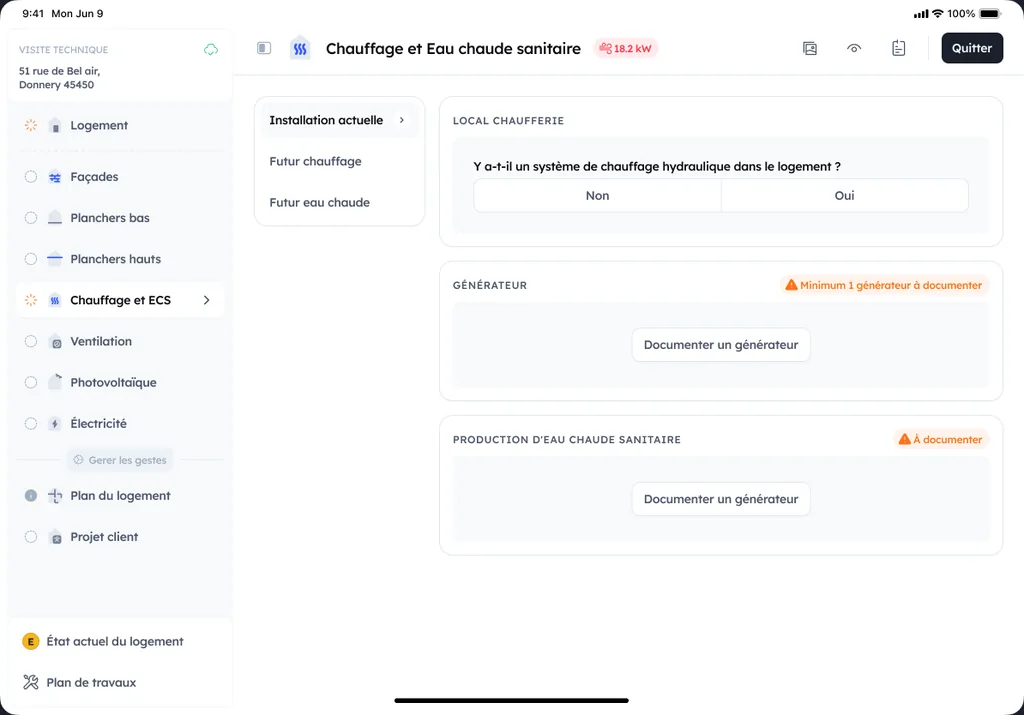
The starting point in retrofit is almost always space. Plant room, ceiling height, access for handling. An existing hot water cylinder does not become a solar cylinder: it would need a coil added, which most appliances do not accept. Keeping it as an independent source leads naturally to the separate backup, and avoids a strip-out. Replacing it with a twin energy unit simplifies the plant space, at the cost of a longer hot water outage to organise. That stock-take is recorded during the technical visit, where Argile captures the readings, the photos and the position of the equipment straight into the file.
The nature of the existing generator
With a recent modulating boiler, the separate backup makes sense, since the generator already provides hot water and only needs to sit downstream of the preheat. With an electric cylinder near end of life, the twin energy unit is often simpler and more compact. With a heat pump, the trade-off is made on the achievable hot water temperature and on the hygiene cycle, which constrains the upper part of the cylinder.
Roof and access constraints
The choice of architecture does not remove the need for a proper roof survey. Orientation, real shading, feasibility of penetrations and durable weathering, routing of the pipework to the cylinder keeping runs short. Access also drives the cost of future work, and therefore the maintenance contract you will be able to offer.
Securing eligibility and compliance
The product requirements to check before pricing
Gross collector area of at least 2 m², glazed non-hybrid certified collectors, a declared tapping profile among M, L, XL or XXL, water heating efficiency meeting the applicable threshold, and a solar cylinder of at least class C where its capacity is 500 litres or less. These values are read on the product sheets and carried into the declaration. Setting the collector and volume pairing is covered in sizing a solar water heater. Those requirements are read off the catalogue rather than a PDF datasheet: Argile keeps the technical characteristics of each reference verified and up to date.
The installer and their qualification
Schemes require the installer who carried out the work to hold a recognised quality mark covering the measure. On solar thermal in France that is the Qualisol qualification, which has to be valid on the dates of both the quotation and the invoice.
Watch the exclusions between measures
Support measures are routinely made mutually exclusive. The French solar water heater measure, for instance, cannot be combined with the air to water or water to water heat pump measures. On a job that replaces the generator and adds solar, that arbitration happens before the quotation goes out, not at submission.
Decision and installation check-list
Questions to ask before deciding
Number of occupants and draw-off pattern, presence of baths, morning or evening peaks, tolerance to variation. Existing backup fuel and condition of the generator. Real floor space and available height. Usable roof area and orientation, shading, access. Distance from cylinder to draw-off points. Those answers are enough to point at one architecture or the other before opening a catalogue.
Installation check points
- Fixings, roof weathering, electrical protection, identification and labelling of valves.
- Solar circuit: careful venting, pressure matching the calculation, expansion vessel sized and thermally protected.
- Heat transfer fluid matching the collector manual, concentration measured on a refractometer and recorded.
- Hot water side: safety group, non-return valves, thermostatic blending valve on the outlet.
- Continuous insulation of the cylinder, the pipework and the singular points, especially in unheated spaces.
Commissioning settings and first season follow-up
Set the storage setpoint, the backup time band and the hygiene cycle to the manual, leaving solar the productive window. Record top and bottom cylinder temperatures, flow rates and pressure, and date those values. Book a check after a few weeks, then at the end of the first season, including the condition of the heat transfer fluid. That baseline record is what will later let you tell a settings drift from a genuine fault.