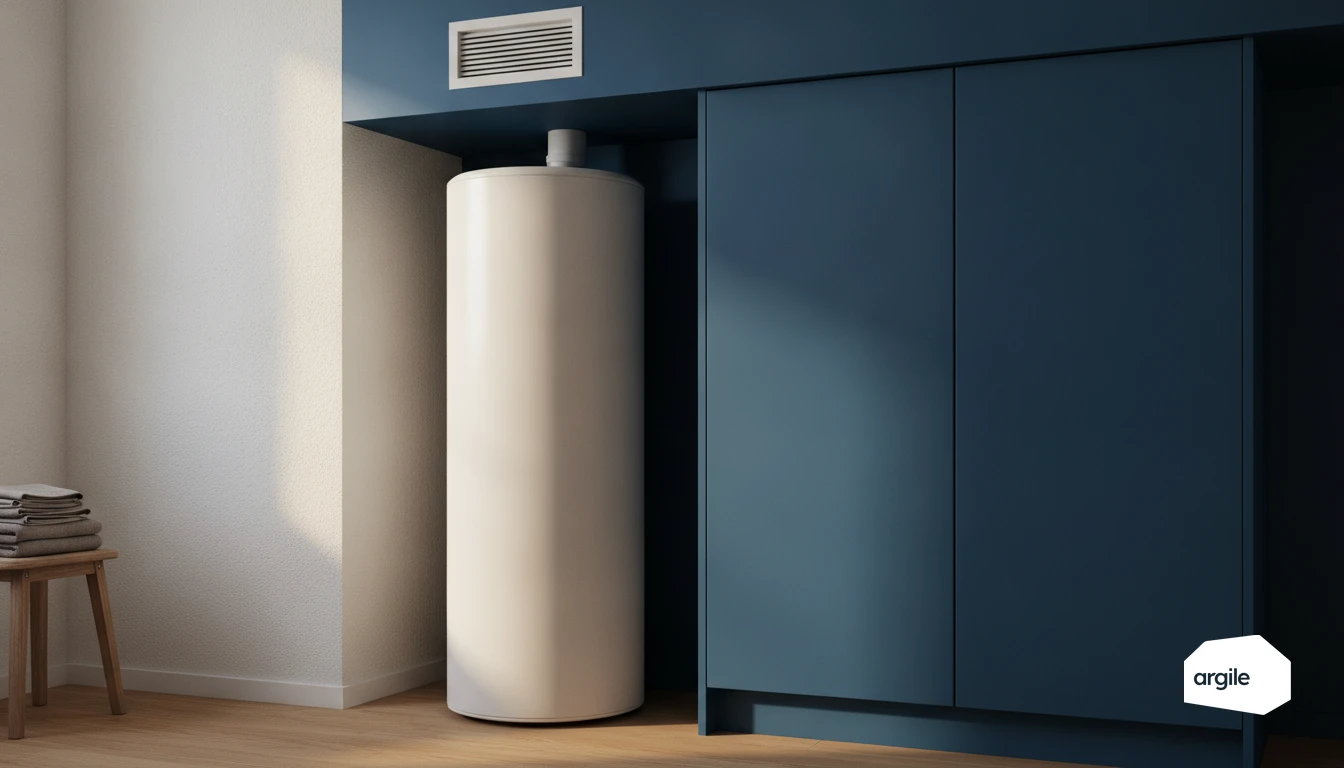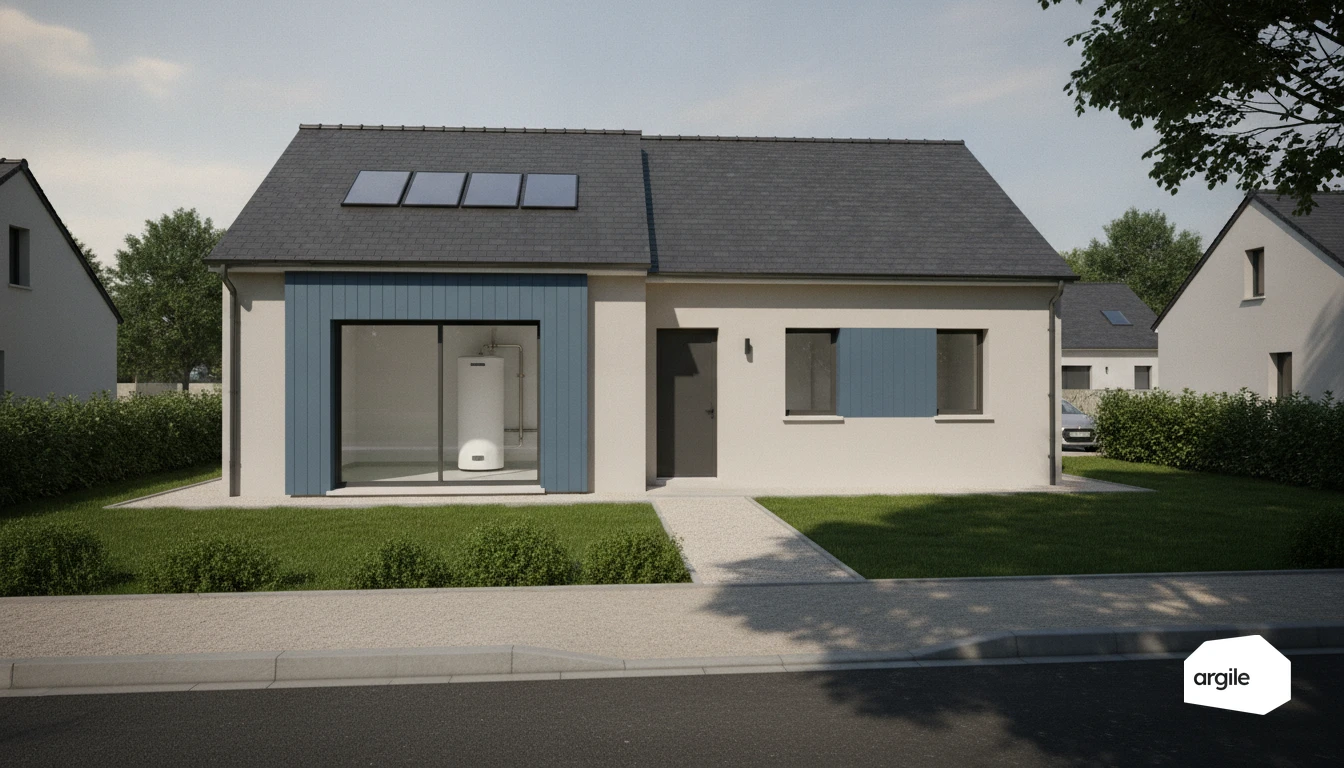
A twin energy solar cylinder stores the water heated by the collectors through a low level coil and brings it to setpoint with a backup connected in the upper part. It is not simply a vessel: it is a regulated product whose energy efficiency class, determined in accordance with Annex II point 2 of Regulation (EU) 812/2013, decides whether the job qualifies for support. Schemes commonly require class C at minimum where capacity is 500 litres or less, which caps the standing loss at around 62 W for 200 litres and 72 W for 500 litres. The rest of the work consists of not wasting that potential at the pipework stage.
What a twin energy solar cylinder is, beyond the sales term
Solar coil low, backup high: stratification as the operating principle
The whole arrangement rests on stratification. The collectors feed a coil placed low down, where the water is coldest, which keeps a favourable temperature difference for collection. The backup works in the upper part, on the volume actually drawn off. All the value of the layout lies in maintaining that separation: as soon as any flow mixes the cylinder, the collectors see warmer water, their output falls, and the backup makes up the difference. The cylinder then becomes an ordinary water heater with decorative panels on the roof.
The families of integrated backup
The backup can be an electric element sited above the solar coil, a second coil connected to a boiler, or a heat pump. The choice is not only about running cost: it determines the water heating efficiency threshold the package will have to reach, which differs sharply according to whether the backup energy is Joule effect electricity or not, as set out in pairing with a gas backup.
Why the cylinder is a regulated product in its own right
Regulation (EU) 812/2013 covers hot water storage tanks with a storage capacity of 500 litres or less and requires them to be labelled. The cylinder therefore has its own label and its own class, independently of the water heater it is paired with. On a file that means capacity and class are recorded product by product, with a section to repeat for each solar cylinder installed.
Standing losses, the criterion that decides eligibility
Class C, the floor below 500 litres
The requirement is short and leaves no margin: class C at minimum where capacity is 500 litres or less. Many cylinders on the market sit in class B or C, but entry level products remain in D. The audit looks at the declared value, so at the label of the product actually fitted, not at a range. Checking that at pricing stage avoids discovering at submission that the chosen cylinder declassifies the whole job. That declared value belongs in the catalogue: Argile builds catalogues with the manufacturers, where the efficiency class and the technical data are verified.
Turning a class into watts actually lost
| Storage volume | Class C ceiling | Class B entry threshold | Class A entry threshold |
|---|---|---|---|
| 200 litres | 62.0 W | 50.2 W | 22.8 W |
| 300 litres | 65.5 W | 52.9 W | 24.2 W |
| 500 litres | 72.5 W | 58.1 W | 27.0 W |
Standing losses S derived from the formulas in Annex II point 2 of Regulation (EU) 812/2013, where V is the volume in litres: class A if S is below 20 + 0.0140 × V, class B if S is below 45 + 0.0262 × V, class C if S is below 55 + 0.0349 × V.
What the gap represents over a year
Between a 300 litre cylinder just inside class C and one of the same volume in class B, the standing loss difference approaches 13 W. Left on standby, that is of the order of 110 kWh a year the backup will have to supply, regardless of draw-off and regardless of sunshine. It is a solid commercial argument, because it depends neither on the weather nor on habits: it is structural to the product.
Piping it without destroying stratification
Connection heights and flow direction
- Solar coil in the lower part, collector flow at the top of the coil and return at the bottom, with an accessible vent.
- Backup connected above the solar coil, on the volume useful to draw-off only, never over the full height.
- Secondary return, where one exists, connected high and controlled, otherwise it stirs the cylinder continuously.
The secondary return, the most expensive trap
A badly connected secondary return is the most frequent and the most invisible cause of degradation. It keeps the pipework hot, so it draws continuously on the cylinder, and if it re-enters halfway up it destroys the stratification the layout depends on. In a house the first question is whether it is needed at all. If it is, it is run on time bands, insulated continuously and connected in the upper part.
Non-return valves and isolation
At night, a circuit without non-return valves establishes a parasitic circulation that empties the cylinder of its heat through the collectors. Non-return valves against thermosiphon go on the primary and on the backup connections, and their direction is verified physically at commissioning. A valve fitted backwards will not show on the pressure gauge, it shows on temperatures recorded early in the morning.
Setting the backup so it does not replace the solar
Setpoint, hysteresis and time bands
A backup setpoint that is too high cancels the benefit of solar, since the backup reaches target before the collectors have had time to work. The rule is to set the backup setpoint at the minimum compatible with comfort and to programme it on bands where solar has no remaining chance of producing, typically late in the day. Hysteresis avoids the rapid cycling that wears the appliance without contributing anything.
A legionella cycle that keeps solar priority
The periodic temperature raise is programmed on the backup and placed outside productive hours. Check that the controller allows that cycle without disabling solar priority, and that the thermostatic blending valve on the outlet is set to prevent scalding when the cylinder runs hot. The point matters particularly when the backup is a heat pump, whose output temperature is more constrained.
What you measure before leaving site
Record top and bottom cylinder temperatures cold and at the end of a cycle, the flow direction on each loop, the actual opening of the valves, the solar circuit pressure and the absence of air noise. That set of readings is what will let you say, a year later, whether a drop in performance comes from the settings, the fluid or the product. It is completed by checking solar circuit pressure.
Choosing the right family of cylinder and defending it
A quick comparison of the three options
- Heat pump cylinder. Produces all year, consumes electricity and needs an air volume, with no solar contribution.
- Solar cylinder without integrated backup. Assumes an independent hot water source downstream, so a second appliance and more space.
- Twin energy solar cylinder. One volume, one draw-off point, at the price of a strong requirement on stratification and on the class of the product.
What component service life changes at pricing stage
Published figures give 20 to 30 years for quality flat plate collectors, 15 to 20 years for a good cylinder, and around 10 years for the pump, the temperature sensors and the controller. Those differences have a direct consequence on siting: the short lived components must stay accessible without removing the cylinder or working at roof level. A cylinder wedged into a cluttered plant space will be expensive to maintain, whatever its class.
The servicing that goes with the product
The cylinder itself asks for little, but the circuit feeding it needs follow-up. Pressure checks, condition of the heat transfer fluid, operation of the air vents and safety valve, verification of the hot water safety group. The collector and volume pairing is set upstream, as covered in sizing a solar water heater, and it is that sizing which determines whether the cylinder works in its useful band or spends its summers overheating.