The match-up is rarely decided where the customer expects. Neither the COP nor the headline price settles it: what settles it is the tapping profile the installation has to hold, and a non-combination rule that took effect on 1 January 2026. Since that date the heat pump cylinder loses its energy-scheme payment as soon as a heat pump appears on the same quotation, which redraws the whole choice on jobs that pair the two.
The tapping profile, not the COP
Regulation (EU) No 814/2013 defines ten standardised tapping profiles, from 3XS to 4XL. Each is a precise draw-off sequence with its own reference energy Qref. It is that declared profile, and only that, which sets the energy efficiency threshold the appliance has to meet, and therefore what you can commit to on a quotation.
| Profile | Reference energy Qref | Equivalent in litres at 40 °C | What it covers |
|---|---|---|---|
| M | 5.845 kWh | about 168 L | 2 to 3 occupants |
| L | 11.655 kWh | about 334 L | 4 to 5 occupants |
| XL | 19.070 kWh | about 547 L | 6 occupants or more, or a small block |
The conversion into litres is not in the regulation: it has to be worked out. Qref is an energy, and turning it into litres means dividing by the energy needed to raise one litre of water, 1.163 Wh per litre per kelvin. With cold water at 10 °C and draw-off at 40 °C, a litre costs 34.9 Wh. Always state the cold water temperature used on the calculation sheet, otherwise the figure cannot be relied on.
The funding table, and the rule that changed in 2026
| Heat pump water heater | Solar water heater | |
|---|---|---|
| Energy scheme measure | BAR-TH-148 | BAR-TH-101 |
| House payment | 14,700 kWh cumac | read it on the official sheet |
| Flat payment | 11,800 kWh cumac | not applicable, individual measure |
| Parameters in the scale | dwelling type only | collector certification |
| Installer accreditation | QualiPAC | Qualisol |
| Combinable with a heat pump payment | no, since 01/01/2026 | yes |
The line that matters is the last one. The order of 15 December 2025 makes the cylinder measure non-combinable with the air-to-water and water-to-water heat pump measures, in every configuration, and no longer only where the heat pump also produces the hot water. On a job that replaces a boiler with an air-to-water heat pump and adds hot water production, only one payment now lands, and it is the heat pump's.
In practice, thermodynamic hot water becomes unsubsidised on those jobs, where it still earned €110 to €139 in 2025. Solar keeps its payment. It is not a decisive amount in itself, but it is the only parameter in the choice that has moved recently, and the one competing quotations most often miss.
Note also that the cylinder payment depends only on the dwelling type. Cylinder volume, air source and COP play no part in the calculation, so the technical choice is made with no subsidy steering it.
An arrêté of 17 August 2026 adds a Coup de pouce bonus on both technologies, for operations committed between 1 September and 31 December 2026 only: the cylinder payment (BAR-TH-148) is multiplied by 7 for low-income households and by 4 for the others, the solar payment (BAR-TH-101) by 5 and by 4. It only applies if no equipment able to burn a fossil fuel remains in the installation, not even as a backup or top-up. The conditions and two worked examples are in our article on the CEE bonus for heat pump and solar water heaters.
What the survey has to produce
Three readings are enough to decide, and they come before any equipment is proposed:
- the tapping profile targeted, derived from occupancy and draw-off habits, set against the 59 litres per person per day taken as an order of magnitude;
- the air volume available for an ambient-air unit, or the feasibility of connecting to extract air, which decides whether the appliance will hold its COP in winter;
- the azimuth, pitch and shading of the roof for a solar system, recorded at the useful hours and not at midday.
The third reading is what most often rules solar out. A roof facing east or shaded by a neighbouring gable cannot be rescued by adding collectors: it changes the annual solar fraction, therefore the share taken by the back-up, therefore the actual saving.
Where each solution wins
The heat pump water heater wins when replacing an electric cylinder, where the roof does not suit solar and where no heat pump appears on the quotation. It installs like a conventional cylinder, with an air supply and a condensate drain, and it holds its profile all year without depending on the weather. Its real constraint is not the COP but the air flow: in a small closed room it cools the space and falls back on the immersion heater. Connecting it to extract air resolves that where the layout allows.
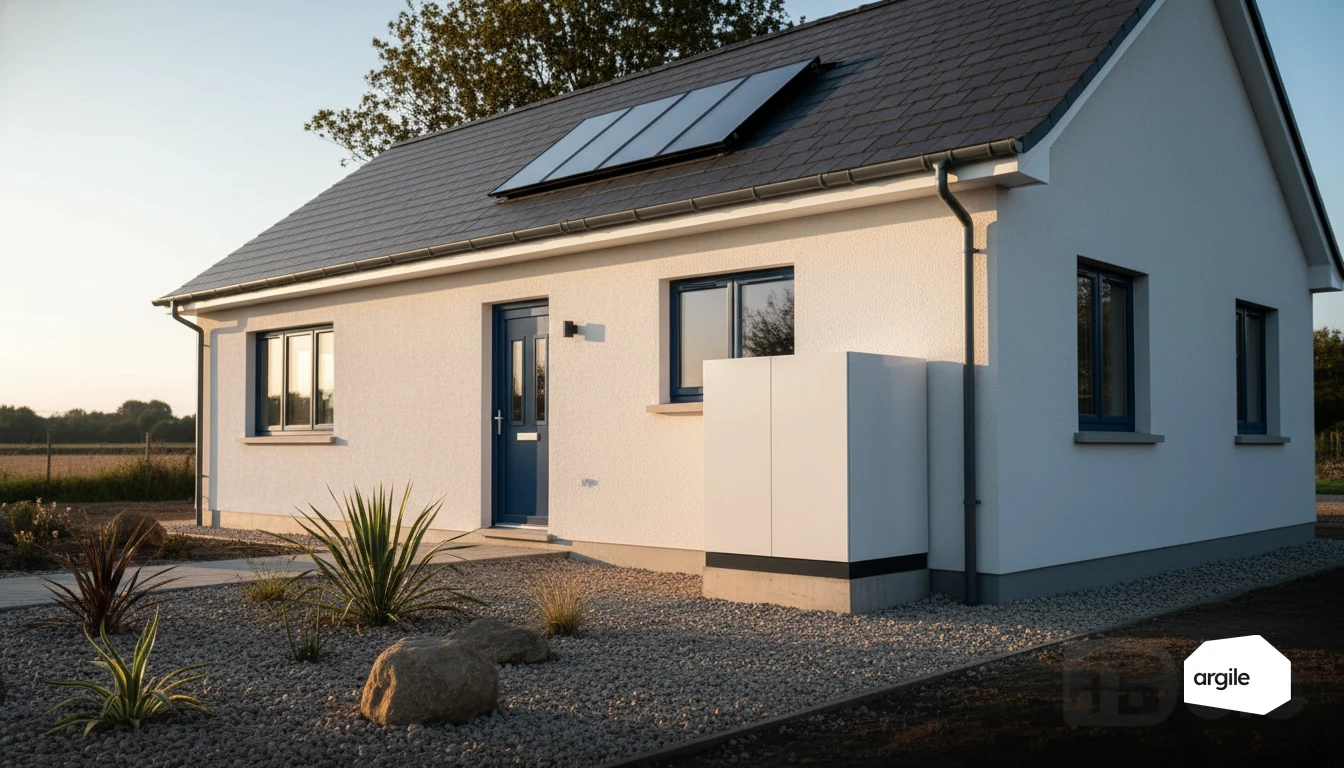
The solar water heater wins where the roof is favourable, where demand is high and regular, and above all where a heat pump is already on the quotation, since it is then the only one of the two to keep its payment. It is sized in two stages, and collector area and storage volume are calculated separately against the annual solar fraction targeted.
In both cases, cylinder volume is the parameter most often oversized, and it costs in standing losses all year round. It is set against the profile, not against a comfort margin: volume is sized as tightly as it will go, and the back-up absorbs the peaks.
To put both options in front of the customer with their funding deducted, the tool prices each measure from the characteristics of the dwelling and the objective set.
The temperatures to respect, whichever solution you fit
Article 36 of the order of 23 June 1978 applies to both technologies. It sets the maximum domestic hot water temperature at 50 °C at draw-off points in rooms intended for washing and 60 °C in other rooms, and requires water at no less than 50 °C at every point of the distribution system once the volume between the source and the furthest draw-off point exceeds 3 litres.
Both requirements are met at the thermostatic mixing valve and in how the pipework is run, never by lowering the cylinder set point, which has to stay high for legionella control. It is a common confusion at commissioning, and it shows on the commissioning record.
What to take away
- The choice is made on the tapping profile of Regulation (EU) No 814/2013, not on the COP.
- Profiles M, L and XL come to roughly 168, 334 and 547 litres at 40 °C with cold water at 10 °C.
- A solar water heater never holds a profile on its own: its back-up does.
- Since 1 January 2026 the cylinder payment can no longer be combined with a heat pump payment.
- The cylinder payment is 14,700 kWh cumac for a house, regardless of volume and COP.