Clearly tell a “solid-fuel boiler” from a “boiler stove/appliance” before you price the job
Wood/biomass boiler: main heat generator connected to the heating circuit
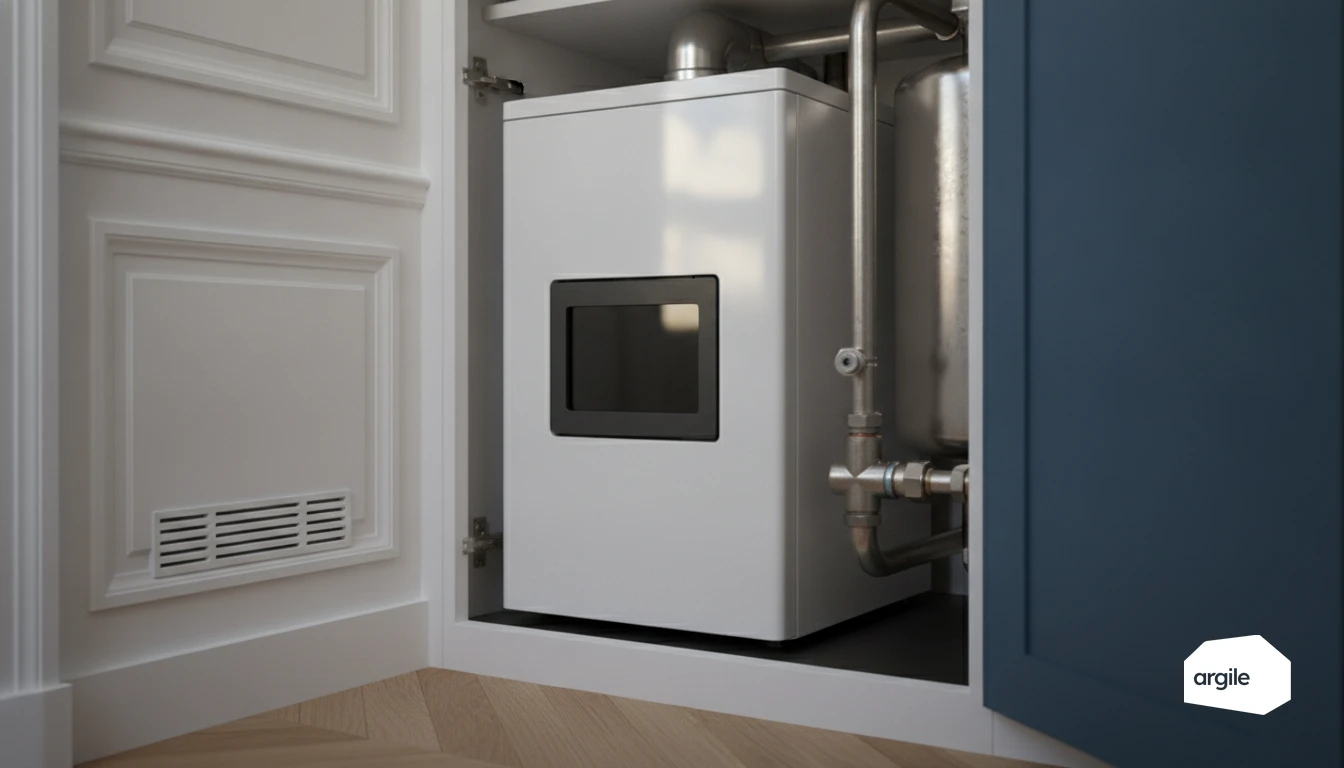
A solid-fuel boiler is a central heat generator designed to supply a wet heating system. You price it as a complete heating package. Location, fuel access, flue gas evacuation, combustion air supply, primary pipework, controls and a buffer tank matter just as much as the unit itself.
Boiler stove or boiler insert: room heater with a water heat exchanger
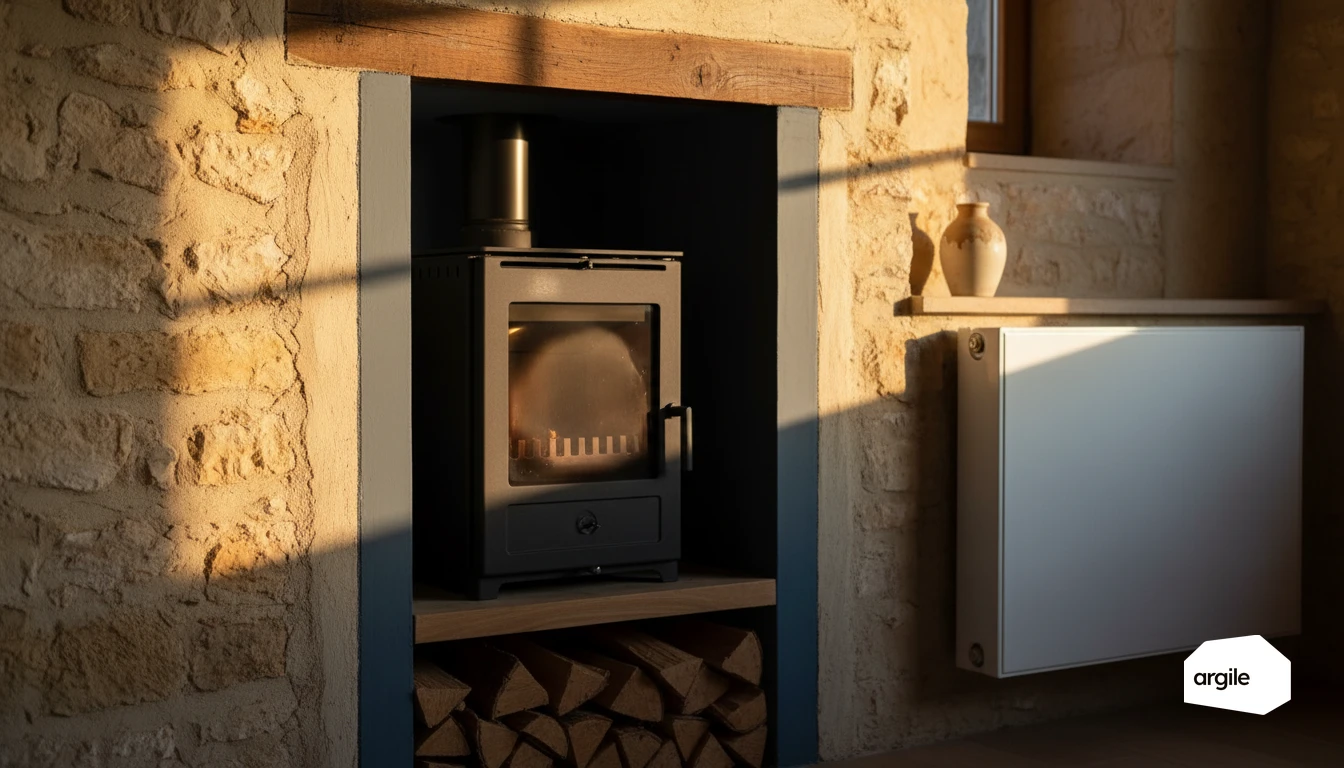
A boiler stove or boiler insert—often loosely called chaudiere bouilleur in enquiries—remains a room heater. It heats the room it’s installed in first, and only transfers part of its output to the water via the heat exchanger. The air/water split, cold-return protection and safety devices drive the system design and installation time.
Direct consequences: output, modulation, autonomy and realistic use cases
On your quote, separate nominal heat output from heat output to water. A boiler is sized to cover the base load and modulate with a buffer. A boiler stove is sold as hydraulic support, not as the only heat generator in a poorly insulated building. Clarify loading frequency, burn time and the back-up strategy before you price.
Sizing: avoid mistakes on output and how much of the load you can actually cover
Don’t confuse nominal output with heat output to water (boiler stove side)
On a chaudiere bouilleur, the nominal heat output is not necessarily what goes into the heating circuit. On a room-heater boiler stove, part heats the room and only part is to water. Price and size from the heat output to water stated in the manual, the Declaration of Performance and the test reports. Otherwise you overspec the buffer tank, or you end up with radiators that never reach design temperature.
Assess the dwelling’s real heat demand: insulation, heated volume, existing heat emitters
Base your design on a calculated heat demand. Record floor areas, heated volume, insulation levels and any identifiable thermal bridges. Check the temperature regime of existing heat emitters and whether it makes sense with wood heat production. A circuit designed for high flow temperatures calls for appropriate useful output and storage—otherwise the appliance runs outside its operating range.
Risk case: boiler stove as the only heat source in a poorly insulated house—and complementary solutions
The typical job that goes wrong: a boiler stove as the sole heat source in a poorly insulated house. You risk under-coverage at peak demand, then overheating as soon as the fire is strong. Plan a controllable back-up heat generator and hydraulics that make inertia safe:
- buffer tank sized to the energy to be stored and the charging strategy
- back-up (electric, heat pump, existing boiler) as lead/lag or bivalent operation
- prioritise building envelope upgrades in the works plan
Hydraulics and controls: a buffer tank is mandatory, but not for the same reasons
Why a buffer tank is essential with a log wood boiler (loading, cycles, comfort)
With a log wood boiler, you operate in full-burn loading. Output doesn’t modulate finely and “clean” combustion happens during sustained burn phases. The buffer tank absorbs energy when instantaneous demand is lower, limits short cycling, and lets you control distribution (mixing, weather compensation) without choking the heat generator.
Why a buffer tank makes a boiler stove safe (energy spikes, stability, protecting heat emitters)
A boiler stove, including in a chaudiere bouilleur configuration, sends heat spikes into the water in step with the fire. Because you can’t “stop” combustion instantly, the buffer tank acts as a hydraulic landing zone. It stabilises flow temperature, prevents shocks to radiators or underfloor heating, and makes hybridising with another heat source simpler.
System layouts to anticipate: anti-condensation, 3-way valve, relief valves, expansion vessel
When pricing, set the schematic before selecting pipe sizes and pumps. The aim is twofold: protect the heat generator from cold return, and guarantee heat rejection in the event of overheating. To go further, lean on typical schematics suited to common set-ups.
| Component | Role | Watch point |
|---|---|---|
| Anti-condensation | Maintain a hot return | Short bypass, setpoint matched to the generator |
| 3-way valve | Control distribution | Valve authority and correctly located sensor |
| Safety devices, vessel | Absorb expansion, discharge | Useful volume and service access |
Safety in 2026: managing an appliance you can’t just turn off
Safety mode: overheating, thermal safety discharge, gravity circulation and power supply
With a chaudiere bouilleur or a wood boiler stove, combustion continues after you shut the air inlets. The design must therefore include heat rejection independent of controls. Provide a safety relief valve, a suitable expansion vessel, and above all a thermal safety discharge fed by cold mains water, with discharge to a drain. Add a gravity heat dissipation circuit capable of working without a pump.
Points to watch in a power cut: inertia, heat rejection, alarms
A power cut stops the pump and controls. Check firebox inertia, the ability of the buffer tank to absorb a peak, and the performance of the gravity loop. A backed-up power supply can keep the circulator and an overheat alarm running. Document the emergency procedure in the operating instructions and in the commissioning/hand-over report.
Installation and maintenance: access, fuel storage, safety clearances
Keep access clear for loading, sweeping and servicing the heat exchanger. Arrange fuel storage outside high-risk volumes, on a stable, ventilated base. Respect safety distances to walls and through-penetrations, and plan documented maintenance, including a check of safety devices at every visit.
Flue, combustion air, performance: secure compliance and access to incentives
Connection to the flue: compatibility, draught, airtightness, sweeping and access doors
For a chaudiere bouilleur or an insert boiler unit, validate the flue before you quote. Diameter, material, safety distances, accessibility and continuity. Document a flue check in line with DTU 24.1. Include access doors, a soot tee, and a sweeping clause with an airtightness test after installation.
Combustion air supply: volumes, grilles, spillage risks and interactions with mechanical ventilation
Size the combustion air supply with the heat generator. An existing vent grille is not always enough. Secure a dedicated air supply close to the appliance, protected against blockage, and measure pressure drops with the mechanical ventilation running. Adjust if needed (balancing, ventilation changes) to avoid spillage and CO.
Efficiency and emissions: check the requirements in the incentive data sheet applicable in 2026
For eligibility for incentives in 2026, request the Ecodesign label and test reports. Distinguish nominal output from heat output to water. Check seasonal efficiency and emission thresholds (dust/PM, CO, VOCs) in the applicable CEE data sheets . Put these references on the invoice and archive the supporting documents for any audit.