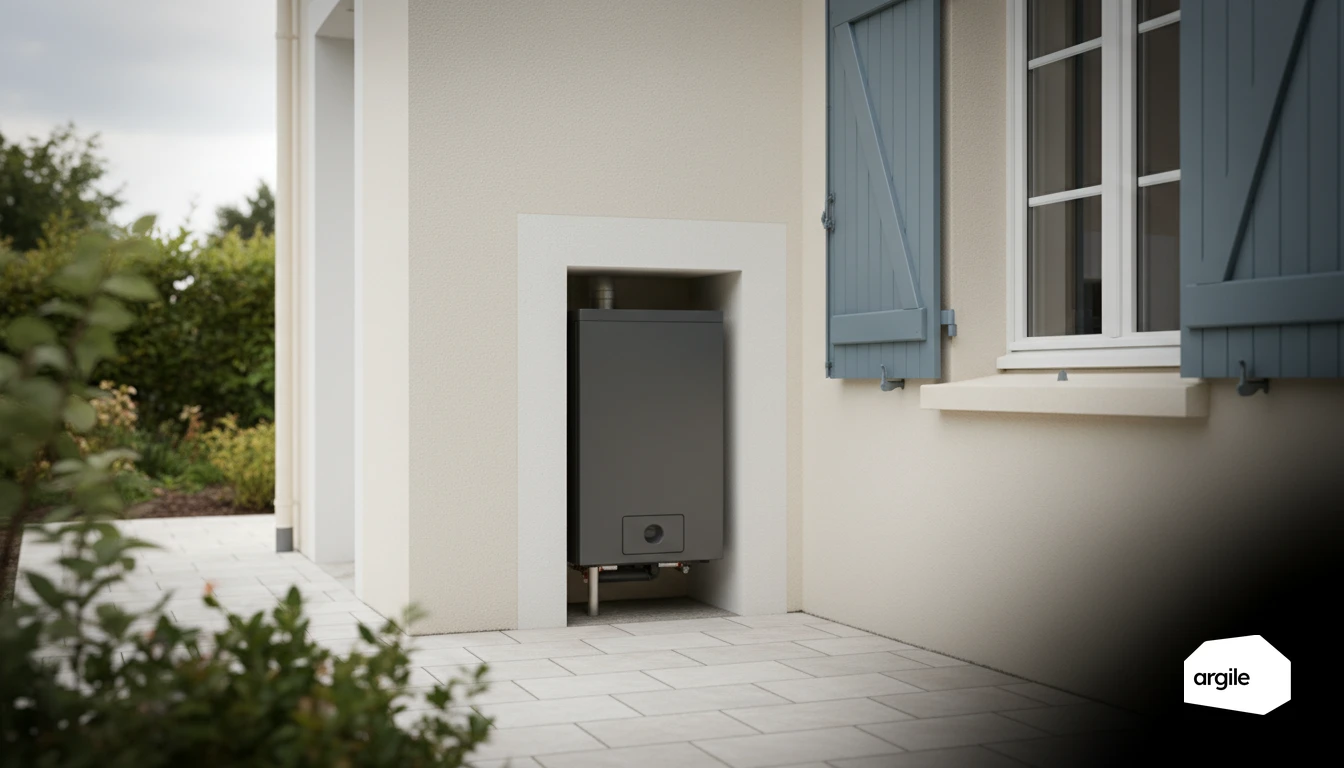
"Low-temperature boiler" names two different things, and only one of them can still be installed. As a product category inherited from the old boiler efficiency directive, it left the market on 26 September 2015: on that date Annex II of Regulation 813/2013 required fuel boilers of 70 kW and under to reach a seasonal space heating energy efficiency of at least 86%, a floor no non-condensing appliance clears. One exception survives, the type B1 boiler up to 10 kW, allowed at 75% because it serves a shared natural-draught flue in an existing building. As an operating regime, on the other hand, low temperature is still the whole question on a retrofit: it is the return temperature that decides whether a condensing boiler actually condenses.
Two meanings for one phrase, and only one still available
The product category went on 26 September 2015
Regulation 813/2013 repealed the boiler efficiency directive apart from a few residual articles and annexes, and with it went the star-rating logic that placed low temperature between the standard boiler and the condensing one. What replaced it is a single seasonal efficiency threshold, and that threshold closes the door.
| Appliance category | Floor applicable since 26/09/2015 |
|---|---|
| Fuel boiler up to 70 kW, other than type B1 | seasonal efficiency at least 86% |
| Type B1 up to 10 kW and B1 combination up to 30 kW | seasonal efficiency at least 75% |
| Fuel boiler above 70 kW and up to 400 kW | useful efficiency at least 86% at full output and 94% at 30% |
| Electric boiler | at least 30%, then 36% from 26/09/2017 |
| Heat pump other than low-temperature | at least 100%, then 110% from 26/09/2017 |
| Low-temperature heat pump | at least 115%, then 125% from 26/09/2017 |
Watch the false friend on the last line: the regulation's low-temperature heat pump is one designed for the 35 °C application and unable to deliver 52 °C flow at minus 7 °C outdoors. It has nothing to do with a low-temperature boiler.
The one exception, the type B1 boiler
The regulation defines the B1 by its draught diverter, its connection to a natural-draught flue and the fact that it draws combustion air straight from the room it stands in. It may only be placed on the market as a type B1 boiler. It is the technical answer to older blocks with a shared flue that can be neither lined nor abandoned flat by flat. The text also imposes a standard notice on its documentation: designed for connection solely to a flue common to several dwellings in an existing building, its use in other conditions increases consumption and running costs and is to be avoided.
Low temperature as a test regime
The phrase survives on the product fiche, with a different meaning. The information table asks the manufacturer to tick a "low-temperature boiler" box, then to declare the output and useful efficiency at 30% of rated output in the low-temperature regime. That regime is defined by the return temperature at the appliance inlet.
| Appliance type | Return temperature of the low-temperature regime |
|---|---|
| Condensing boiler | 30 °C |
| Low-temperature boiler | 37 °C |
| Other heaters | 50 °C |
That is the line to read on a data sheet, because it says at what return the quoted efficiency was measured. An efficiency stated at a 30 °C return does not survive on a circuit that comes back at 55 °C.
The real retrofit question: the water regime
Why the return temperature governs everything
A condensing boiler only recovers the latent heat of the flue gases if the return temperature drops below their dew point. Above it, the appliance behaves like a conventional boiler and its efficiency collapses towards the one it replaced. That is why the question on a retrofit is not whether to go low temperature but at what temperature this circuit returns in winter conditions, and why a condensing gas boiler keeps its promises on one job and not on the next.
Check emitter output at the target regime
The check is simple and it belongs before the quote. Take the catalogue output of the radiators at 55/45/20, not at the 75/65/20 of older documentation, then set it against the room-by-room heat loss. Argile calculates that heat loss to EN 12831-1 from the survey data, which fixes the output without a spurious comfort margin. Where the output falls short there are only two ways out: more heat transfer surface, or less heat loss.
What actually brings the return down
Three interventions lower the return temperature at constant comfort, and none costs what a boiler costs: hydraulic balancing, which puts the flow rates back where they belong; setting the weather compensation curve as low as it will go, with an outdoor sensor; and thermostatic valves with one reference room left free. On an old circuit they are done in that order and checked over several heating days.
What the job has to carry
The Building Regulations floor, and what it is not
Approved Document L Table 6.2 puts gas-fired wet heating in an existing dwelling at a minimum of 92% ErP, with a SEDBUK 2009 fallback of 78% for natural gas and 80% for LPG allowed only in exceptional circumstances as defined by the Condensing Boiler Installation Assessment Procedure. Oil-fired wet heating sits at 91% ErP for a regular boiler and 86% SEDBUK 2009 for a combi. Read those as floors: a boiler installed at the floor on a circuit that returns at 60 °C will not deliver the seasonal figure printed on its label.
What the client should hear about running costs
A fossil generator no longer carries an incentive story anywhere in Europe, and selling one on the promise of a percentage saving puts the quotation at risk. The subject worth raising instead is the fabric, whose treatment reduces the output to install and mechanically lowers the water regime. The order of works then follows the reasoning in our piece on insulation before heating, with the point that insulating first is what avoids an oversized generator.
Commissioning and the record
Commissioning is where the water regime becomes real. Fill and vent, stabilise the cold pressure to the manufacturer's figure, check the expansion vessel, the pressure relief valve and the gas tightness, then run a combustion analysis and set the compensation curve. Record the flow and return temperatures measured at the end of the run, alongside the design heat loss and the emitter outputs used. That record is what answers the question later if the installed output is challenged, and it is the same record that shows whether the appliance is running in its condensing range at all.