Radon, a radioactive gas found everywhere in France
Where radon comes from and why it's a real public health issue
Radon is a naturally occurring radioactive gas produced by the decay of uranium present in granite and volcanic subsoils. Colourless and odorless, it rises through cracks in slabs, pipe penetrations, and joints in below-grade walls, and builds up in poorly ventilated rooms. Inhaled chronically, it is the second leading cause of lung cancer in France after tobacco, with 2,500 to 3,000 deaths a year according to the IRSN and Santé Publique France.
The risk particularly concerns older buildings with a solid slab in direct contact with granite ground, unventilated basements and cellars, and undrained crawl spaces. Energy retrofits, which aim for airtightness, can paradoxically worsen radon concentration if ventilation isn't redesigned at the same time.
IRSN zones 1, 2 and 3: reading the map before a quote
The IRSN classifies municipalities into three zones based on the ground's radon potential. Zone 3 (significant potential) covers granite massifs (Brittany, Massif Central, Vosges, Corsica), where measurements frequently exceed the thresholds. Zone 2 carries localized risk, often tied to karst formations. Zone 1 has low but not zero potential: elevated concentrations can appear locally due to very local geology or building ventilation.
For the tradesperson, the right move is to cross-reference the IRSN map with a detailed geological map. The map.argile.ai tool lets you overlay several natural hazards on a plot, which helps you avoid missing a zone-3 client who deserves a dosimeter before a quote.
Measuring radon before intervening
The passive dosimeter: €30-50 for two months of measurement
The reference measurement remains the passive dosimeter (solid-state track detector), deployed for 2 to 3 months during the heating season (October to April), in the lowest living room. Cost: €30 to €50 per dosimeter, including lab analysis. It's a simple, reliable and inexpensive tool for assessing the risk objectively before starting work. Electronic dosimeters (€300 to €800) provide continuous measurement and are valuable for checking a solution's effectiveness after works.
Offering to place a dosimeter as part of an energy audit is a good commercial differentiator. You arrive with technical information that 95% of tradespeople overlook, and you build the trust needed to sell the whole-house retrofit that follows.
Regulatory thresholds: 100, 300 and 1,000 Bq/m³
The WHO recommends a reference level of 100 Bq/m³. French regulation sets the action threshold at 300 Bq/m³ in workplaces and ERP (buildings open to the public), with a works obligation. Above 1,000 Bq/m³, intervention is urgent. For private homes, no threshold is legally binding, but the ELAN law and the upcoming indoor air quality regulation could change that.
Technical solutions for lowering radon concentration
Slab airtightness: the first line of defence
Radon first enters through weak points at the ground/home interface: slab cracks, perimeter joints, pipe penetrations, gaps behind baseboards. The first move is to seal every airtightness defect: epoxy resin on cracks, silicone sealant on pipe penetrations, bituminous tape around the perimeter. This simple measure can halve the concentration in moderate cases, for a cost of a few hundred euros.
On heavily cracked slabs or old screeds, an anti-radon membrane (polyethylene film at least 200 microns, or a specialized product) laid under a new floor covering adds further sealing. For a crawl space, see our dedicated article on ventilated crawl spaces.
Redesigned ventilation: humidity-controlled type B or double-flow mechanical ventilation
Without sufficient airflow, no sealing solution is enough on its own. Humidity-controlled type B mechanical ventilation remains a good compromise for an existing home, since it adapts airflow to humidity while guaranteeing a minimum renewal rate. For a deep retrofit, double-flow mechanical ventilation gives the best result: constant renewal, heat recovery, and slight pressurization of the home that opposes radon rising up. Budget €4,000 to €8,000 installed in a house.
Controlling ventilation based on air quality (CO2, VOCs, radon) is gaining ground. We cover this approach in detail in controlling mechanical ventilation by air quality.
SSD (Soil Suction Depressurisation): the reference solution in zone 3
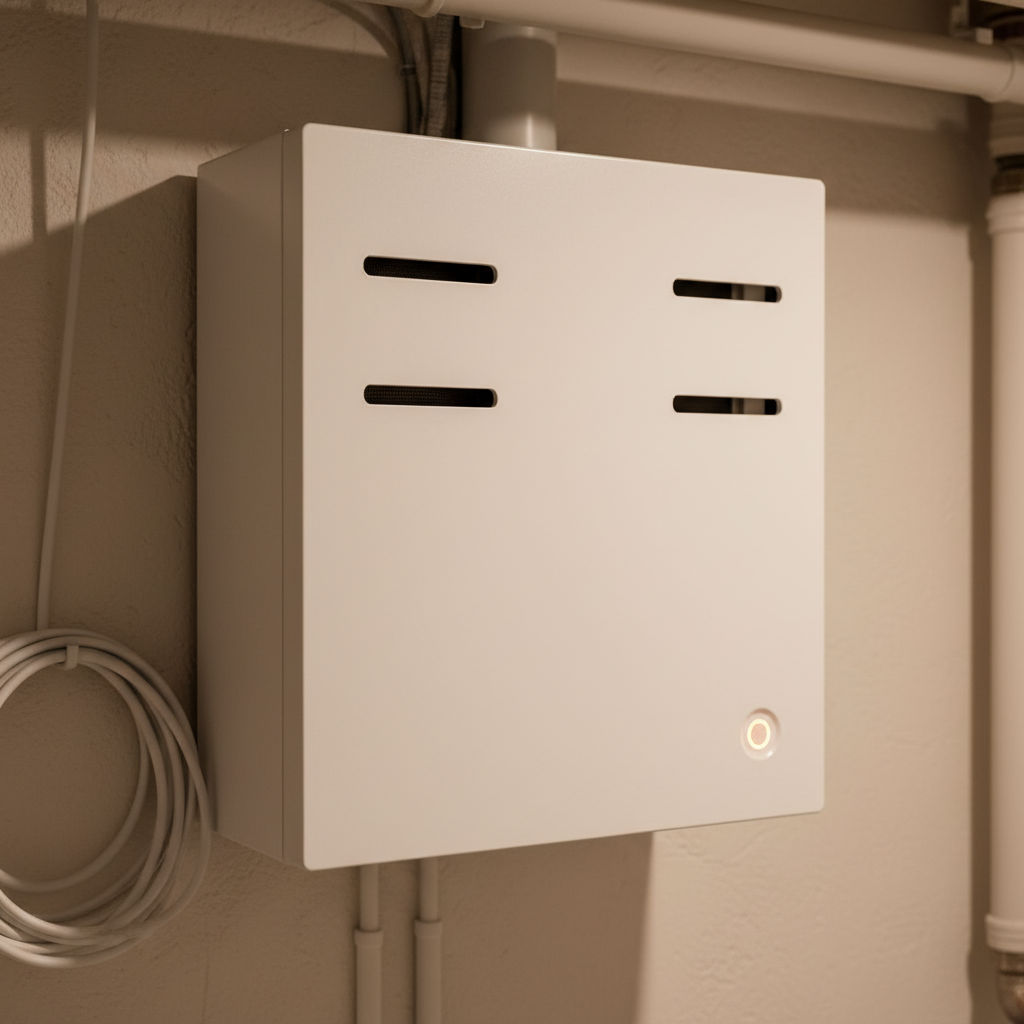
When readings stay high despite sealing and ventilation, the reference technical solution is SSD (Soil Suction Depressurisation): a suction well dug under the slab or in the crawl space, connected to an extractor fan that creates negative pressure under the building. Radon is vented outside before it can enter the home.
Budget: €2,000 to €5,000 for a single-family house, depending on the configuration (solid slab, crawl space, earthen floor). SSD is the most effective solution (80 to 95% reduction in concentration) and the most durable, provided it is properly sized and maintained (extractor replacement every 10-15 years).
The energy-retrofit paradox
Here's the trap many tradespeople fall into. You retrofit a home in zone 3, you improve airtightness to gain thermal performance (airtightness test at 0.6 vol/h), and you forget to adapt the ventilation. The result: the radon that used to escape through airtightness defects now builds up inside the home, and the concentration can double or triple. The Climat et Résilience law hasn't addressed this issue yet, but it's becoming a serious argument for selling a coherent whole-house retrofit. Our article on the whole-house retrofit market details how to package this offer.
Mapping the risk to avoid bad surprises
Before any quote in a radon-potential zone, map the plot. The IRSN map gives the municipal zoning but isn't enough to assess the risk for a specific property. The map.argile.ai tool cross-references several geological hazards (radon, clay soil, flooding) and gives you a useful overview for framing the audit. A dosimeter placed at the client's home remains the only way to settle the question objectively afterward. From the address alone, the plot, the building and its hazard constraints are pieced together before the visit.
Key takeaways
Radon is a silent but measurable risk, with well-documented technical solutions. For the RGE tradesperson, it's profitable on two counts: a differentiating diagnostic (€30-50 dosimeter) that opens the discussion on whole-house retrofitting, and remunerative works (sealing, ventilation, SSD) that can combine with insulation and a heating system change. In IRSN zone 3, refusing to raise the subject just leaves a better-informed competitor to do it in your place.