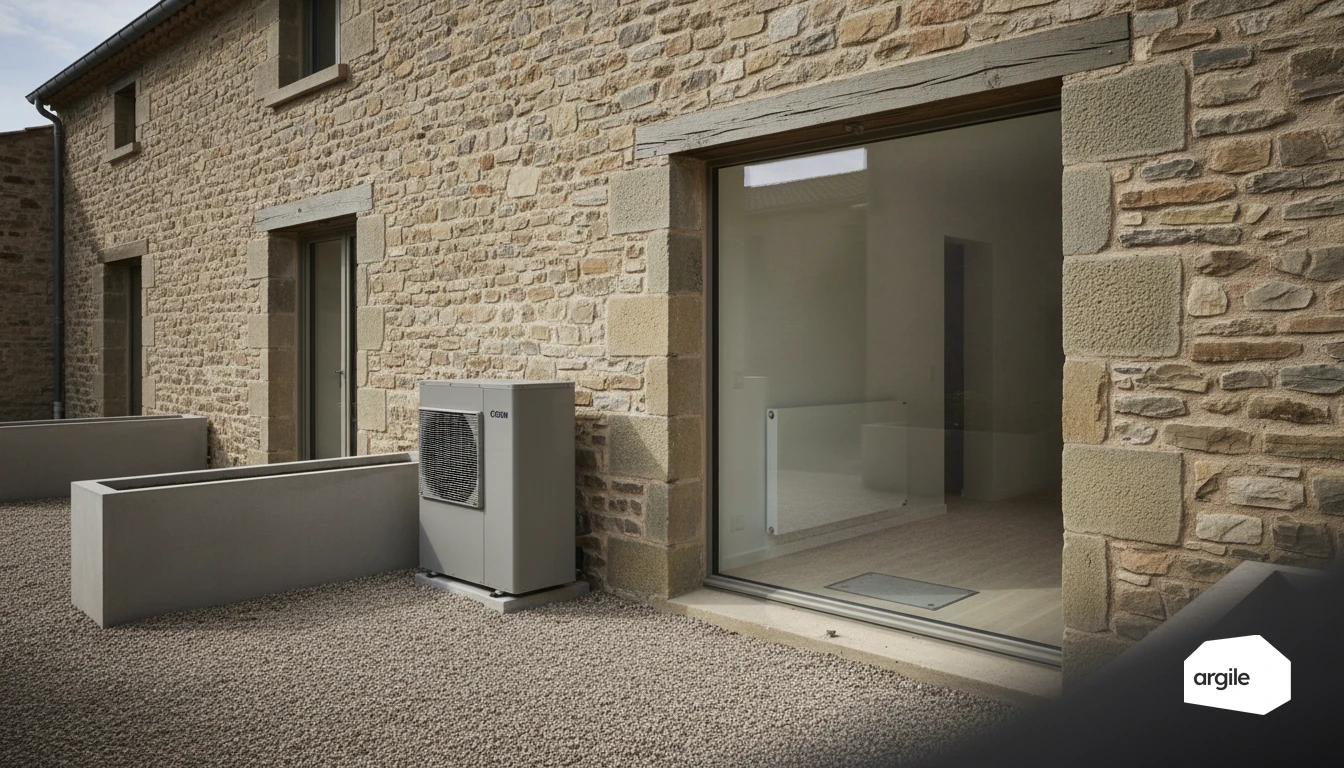
A radiator does not lose a little output at low temperature, it loses most of it. Catalogue output is quoted at the BS EN 442 reference regime of 75/65/20, a ΔT of 49.8 K. At 45/35 into a room at 20 °C, ΔT falls to 19.6 K and delivered output to roughly 30% of the catalogue value, because it varies as (ΔT / 49.8) to the power 1.3. Holding the same useful output therefore calls for about 3.4 times the heat-exchange surface, not the factor of 1.5 to 2 often quoted.
Understanding how a low-temperature radiator behaves on a retrofit installation
Flow temperature, ΔT and power: what you need to compare on site
A radiator's power is always stated for a given flow temperature, return temperature and room temperature. On site, compare the target flow temperature against the manufacturer's reference ΔT, almost always ΔT 50. Three reference points are enough to frame the conversation with the customer, room at 20 °C.
| Regime | Output left | Surface needed |
|---|---|---|
| 75/65, catalogue reference | 100% | reference |
| 55/45, high-temperature heat pump | 51% | × 1.96 |
| 45/35, standard heat pump | 30% | × 3.37 |
The full regime-by-regime table and the conversion formula are in our article on the heat-loss method.
Emitters and heat source: heat pump, condensing boiler, existing network
A heat pump favours low flow temperatures, often 35 to 55°C, to keep good efficiency. A condensing boiler performs best when the return temperature is low, generally under 55°C. With an existing network, check balancing, flow rates, thermostatic valves and distribution losses. Otherwise, some radiators will be fed properly and others won't.
When the radiator becomes the "weak link" (cold rooms, cycling, discomfort)
If the radiator is undersized for the new regime, you'll see cold rooms, a heat pump that short-cycles, or a temperature rise without real comfort. The fixes are straightforward: increase the emitter surface, add a second radiator, choose a fan-assisted model, or reduce the heat need through insulation.
Oversizing: when it's genuinely needed (and when it isn't)
Poorly insulated older buildings vs. high-performance retrofits: direct impact on power needs
In an old, still-leaky building, power sizing follows high heat losses. A small useful margin can secure performance during cold peaks or a retrofit carried out in stages. But after a high-performance retrofit (insulation, airtightness, joinery), the heat need drops sharply. Size for the final state, otherwise the installation costs more and runs too often at low output.
A "bigger" or "better-performing" radiator: exchange surface, type, placement
A bigger radiator mainly adds exchange surface. That's valuable for heating at low temperature, for example with a heat pump. Output also depends on the type (panel, cast iron, convector), flow rate, and placement (under a window, clearance in front). Sometimes it's better to add an emitter than to push the heat source's power. To go further, you can rely on the heat-loss sizing method.
Typical cases where you should avoid oversizing: free gains, intermittent use, lightly occupied rooms
Avoid oversizing if free gains are significant (sun, cooking, appliances), if the home is used intermittently, or if certain rooms see little use. Too much power creates short cycling, less stable comfort, and lost efficiency. Good control and simple zoning often work better than excess power.
A field method for sizing a low-temperature radiator without getting it wrong
Start from a room-by-room heating need: heat loss, volumes, uses
Start room by room. Record floor area, ceiling height, exterior-facing walls, window type, ventilation, and the target temperature for each use. From heat losses, you get a heating power figure in watts. Keep a small margin for cold peaks, without oversizing. An oversized radiator yo-yos and complicates control.
Reading and using manufacturer charts: power correction at low temperature
Catalogues often give a radiator's power for "reference" regimes (often 75/65/20). At low temperature (e.g. with a heat pump), power drops. Use the manufacturer's chart or the correction formula from the EN 442 standard. You convert a catalogue power into a useful power at the actual regime. Only choose after making that conversion.
Essential checks: flow rate, balancing, thermostatic valves, return temperature
Check the available flow rate. The rule of thumb is P = 1.16 × flow rate × water ΔT. With a heat pump, a ΔT of 5 to 10 K is common. Balance each loop, adjust the return tees, and fit suitable thermostatic valves. Watch for a consistent return temperature. Too high, and the heat pump loses performance while the radiator heats poorly elsewhere.
Radiators and comfort: tuning low temperature to avoid customer complaints
Warm-up time: setting realistic expectations and settings
With a heat pump and a low-temperature radiator, heat arrives more slowly. Say so at commissioning. Program long heating windows, avoid short boosts, and favour a gradual rise. If the home is poorly insulated, the customer will mostly feel the dips. The right move is to address the losses first, then fine-tune the settings.
Tuning the heating curve and sensor: stable heat without overconsuming
Adjust the heating curve in small steps. Look for the lowest water temperature that still holds the setpoint. A well-placed outdoor sensor helps smooth out variations and avoids the hot-then-cold effect. Also check room-by-room control to limit swings, without falling into needless overheating.
Noise, circulation, bleeding: checkpoints that make the difference
- Check the flow rate, balancing, and absence of air. A proper bleed cuts down gurgling.
- Watch the pressure, the circulator, and the valves. Whistling often comes from too high a flow rate.
- Confirm each radiator heats across its full surface. If not, redo the balancing.
2026 aid schemes and requirements: what your radiator choice can change for the job
Compatibility with a heat pump: points to justify in the 2026 application file
With a heat pump, a well-chosen radiator often comes down to the flow temperature. To secure the file, attach a heat-loss calculation, the target water regime (e.g. 45/35), the heating curve, and the emitter power room by room. If you keep existing radiators, specify the planned adaptations, such as balancing and control.
RGE certification and traceability: documents, datasheets, sizing evidence
For MaPrimeRénov' and CEE, traceability is your lifeline. Keep the radiator's technical datasheets, exact references on the quote and invoice, installation instructions, hydraulic diagram, before/after photos, and the commissioning report. Add the heat loss report drawn up to EN 12831-1 and the company's RGE certificate for the relevant field.
Common mistakes that complicate aid applications: unrealistic temperatures, unsuitable emitters, power inconsistencies
Applications get stuck when the project states 35°C but keeps radiators designed for 70°C. Other pitfalls: power figures that don't match between the study, the quote and the invoice, rooms overheated from oversizing, or a mix of emitters without justification. The result: the reviewer asks for more documents, timelines stretch out, and the job loses its green light. To avoid these blockers, draw on lessons learned about MaPrimeRénov' application rejections.