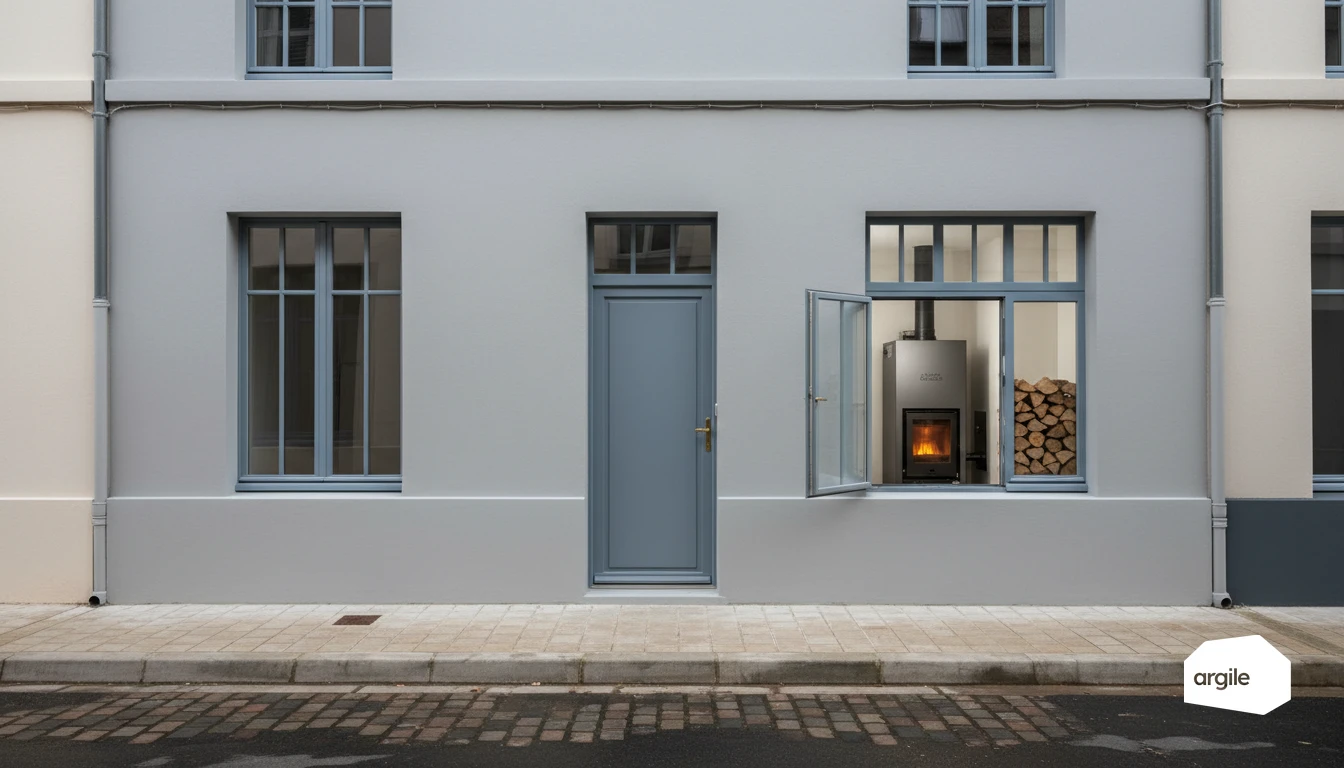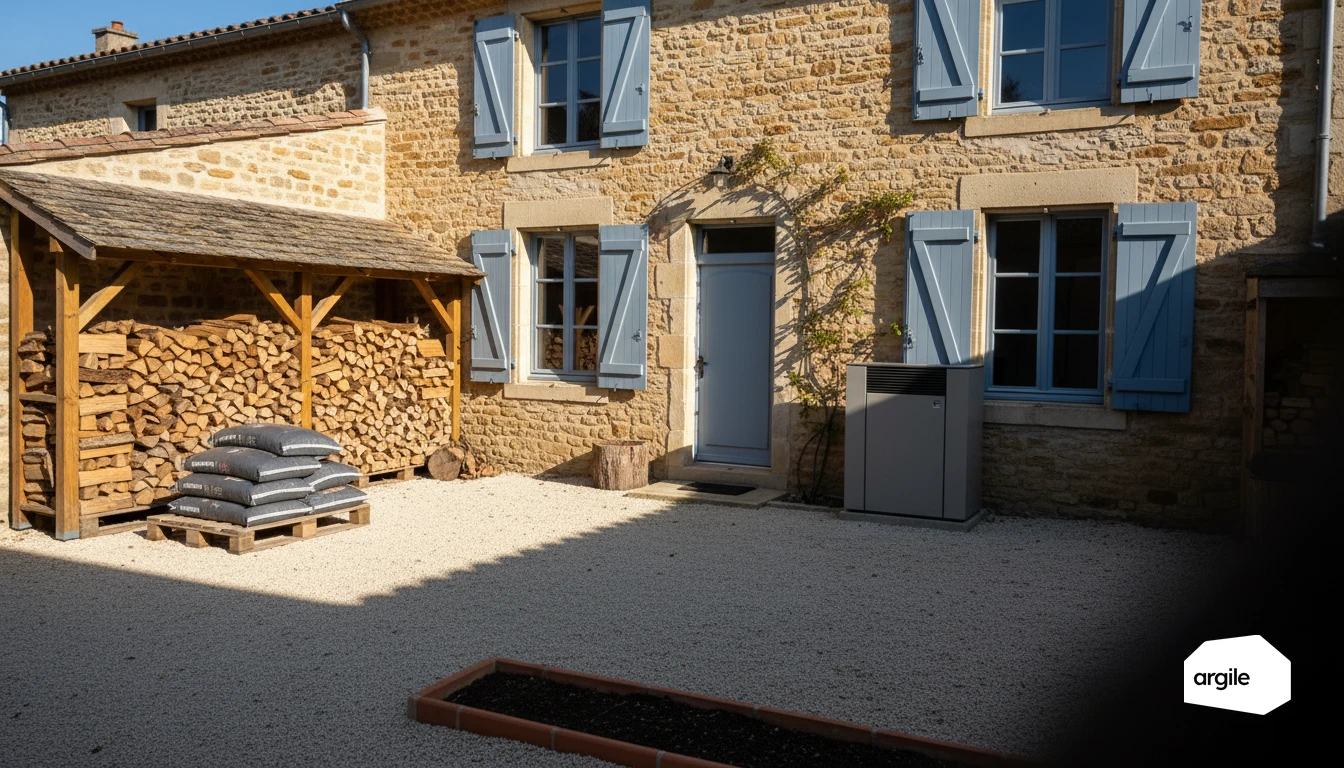
Logs or pellets, both sit under the same ecodesign regime for solid fuel boilers, but they are not judged on the same emission limits: the regulation separates automatically stoked from manually stoked appliances, and it is the stoking method, not the fuel name, that sets the numbers. The seasonal space heating efficiency floor does not move with the fuel either, it moves with the rated output, at 75 % up to 20 kW and 77 % above. What actually decides the job on site is the storage that follows from the stoking method, a silo the delivery lorry can reach on one side, a buffer tank and a covered drying area on the other.
Understanding the two types of wood boiler: logs vs pellets
Log boilers: principle, efficiency and day-to-day use
A log boiler runs on manual loading. You feed the firebox once or several times a day depending on the season, often with a buffer tank to even out the heat output. Efficiency depends heavily on well-dried wood and combustion quality. With a properly tuned installation, you can expect a solid efficiency and controlled fuel costs.
Pellet boilers: automatic feed, regulation and comfort
The pellet boiler uses calibrated pellets. Feed happens automatically from a hopper or a silo, which cuts down on manual handling. The controller modulates output and can manage time schedules, with simple start-up. The result is consistent comfort and an autonomy measured in days, or even weeks depending on storage.
Shared constraints: flue, wood storage and safety
In both cases, the flue system must be suitable. The duct, air intake and safety distances need checking before the boiler is installed. Also plan for dry, accessible storage space and ash management. Safety comes down to regular maintenance and, in a home, a CO detector where required.
Wood boiler comparison: costs, installation and maintenance
Purchase price and installation cost: differences by output and options
Budget mostly depends on output, the silo or the buffer tank. A log boiler is often cheaper to buy than a pellet model, but the installation can vary depending on the room, the flue and the hydraulics.
What Ecodesign requires by stoking method
The two stoking methods are not held to the same limits. The figures below are the seasonal values Annex II sets from 1 January 2020, and they apply to the preferred fuel and to any other suitable fuel for the boiler.
| Requirement | Manually stoked (logs) | Automatically stoked (pellets) |
|---|---|---|
| Particulate matter | 60 mg/m³ maximum | 40 mg/m³ maximum |
| Organic gaseous compounds | 30 mg/m³ maximum | 20 mg/m³ maximum |
| Carbon monoxide | 700 mg/m³ maximum | 500 mg/m³ maximum |
| Nitrogen oxides, biomass | 200 mg/m³ maximum | 200 mg/m³ maximum |
The seasonal space heating efficiency floor follows the rated output rather than the fuel: 75 % up to 20 kW, 77 % above. On fuel cost, compare per kWh delivered rather than per tonne or per load, and include delivery and storage. Those figures are quicker to read from a catalogue where outputs and seasonal efficiency come from verified manufacturer data.
Maintenance and chimney sweeping: frequency, wear parts and time spent
Budget for annual maintenance and regular chimney sweeping. Pellets require less handling, but more parts to monitor, such as the igniter and the auger.
Performance and comfort: which boiler for your job site?
Efficiency, emissions and control: what changes between logs and pellets
With a pellet boiler, combustion is fed automatically and modulated. You get high efficiency and comfort close to gas. Recent models include sensors, scheduling, and sometimes remote control. With logs, efficiency depends more on loading and draught. The cycle runs in batches, with more variation and emissions if the wood is damp.
Space needs: silo, boiler room and delivery access
Pellets require a silo, fabric or masonry, and a dry room. Check truck access and the blowing distance to the silo. With logs, there's no blown delivery, but you need storage volume, a drying area, and simple handling up to the boiler.
Client profiles: primary residence, second home, intensive use
For a primary residence, especially with intensive use, pellets have the edge thanks to autonomy and control. For a second home, or a client who wants a simpler investment and is willing to load fuel, a log boiler can work well, ideally with a buffer tank to even out the heat.
Choosing without getting it wrong: a simple method for deciding between logs and pellets
Decision checklist: budget, wood availability, feeding time
To decide, bring it back to your budget, fuel access, and the time you want to spend on it. A log boiler often costs less in fuel, but requires more handling.
- Overall budget. Purchase price, installation, maintenance, and the kWh price in your area.
- Availability. Local, dry wood, or pellets easily deliverable year-round.
- Comfort. Logs need regular feeding. Pellets feed automatically but need electricity.
Questions to ask during the site visit: insulation, emitters, home constraints
Before output, look at insulation and the heating network. That's where the project's coherence is decided. If needed, use a decision matrix to choose the system best suited to the building. Once those two points are recorded, heat losses are calculated room by room in the NF EN 12831-1 format and give the output to install.
- Insulation and ventilation. Heat loss, humidity, flue draught.
- Emitters. High- or low-temperature radiators, underfloor heating, buffer tank.
- Constraints. Space for storage or a silo, truck access, flue evacuation.
Common mistakes to avoid: undersizing, poorly planned storage, noise
Problems arise when sizing and storage are neglected.
- Undersizing. Cycling, overconsumption and discomfort.
- Poorly planned storage. Wood too damp, silo too small, impossible delivery access.
- Noise. Auger, fans, vibrations. Avoid proximity to bedrooms.