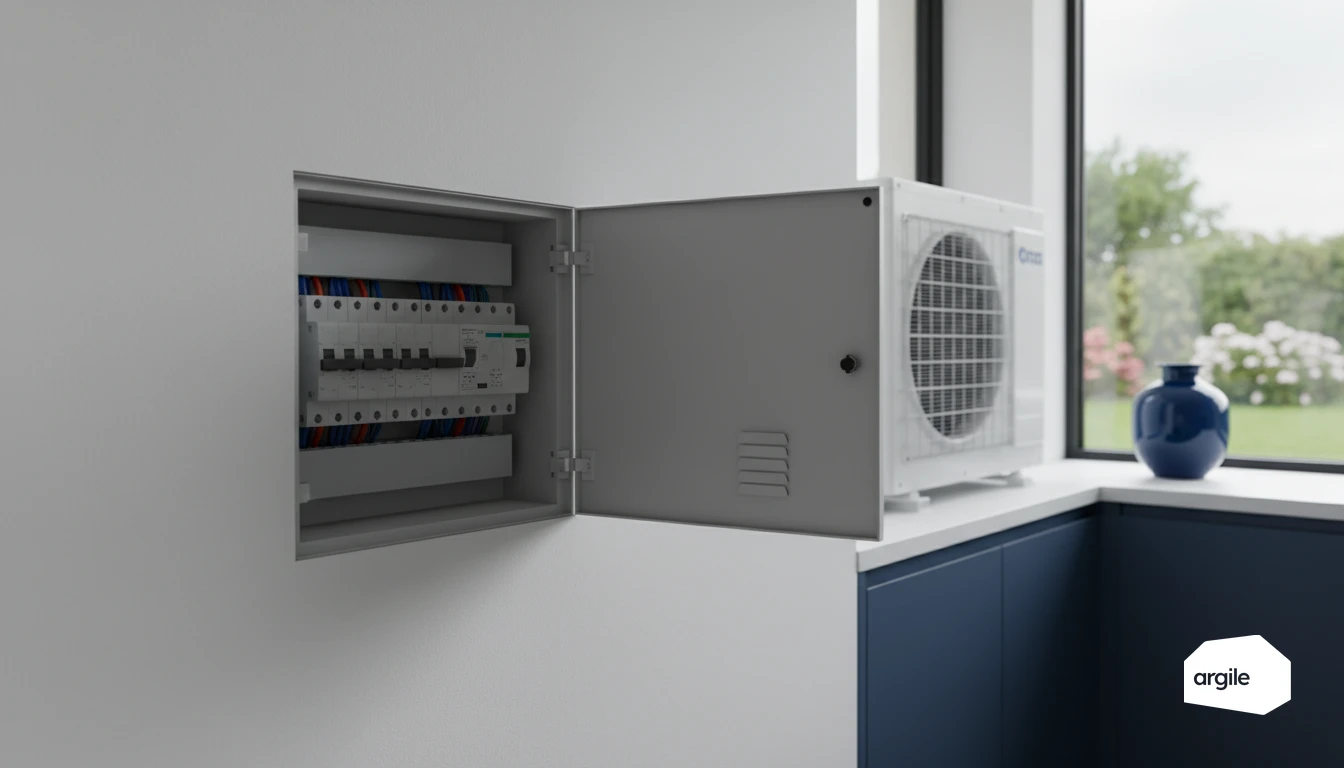
A heat pump is protected by its own type D circuit breaker, and its starting current must not exceed 30 amps single phase. The reason lies with the grid: the French order of 24 December 2007 sets supply characteristics at 230 V or 400 V, plus or minus 10 %, averaged over ten minutes. An inrush current outside that envelope drops the voltage at the neighbour's house, and it is the network operator who comes to see you.
Understanding the electrical risks of a heat pump and the protection objectives
Why a heat pump is sensitive: compressor start-up, current draw and micro-outages
A heat pump is not a radiator. On start-up, the compressor can draw a high inrush current. Add the power electronics and fans, and you have equipment that reacts to voltage dips and micro-outages. Without suitable protection, you risk tripping, overheating and premature wear.
What circuit breaker, RCD and earthing protect: complementary roles
The circuit breaker mainly protects the cables and the machine against overload and short circuit. The RCD monitors current leakage linked to an insulation fault and trips to limit the risk of electric shock. Earthing provides a fault path and improves the RCD's effectiveness. Together, they reduce the risk of fire and accidents.
Identifying the heat pump type and its power supply: single-phase, three-phase, outdoor/indoor unit
Before sizing the protection, identify the type of power supply shown on the rating plate and in the manual. Single-phase and three-phase don't imply the same currents, nor the same cable cross-sections. On many split systems, the outdoor unit is powered, then the indoor unit is interconnected. When in doubt, follow the manufacturer's documentation. To go further on grid-side sizing, see the power and meter needed for a heat pump's electrical connection.
Type D, not type C: the difference is in the inrush
A heat pump compressor draws several times its rated current at start-up, for a few tens of milliseconds. A type C breaker trips between five and ten times rated current, which lands squarely in that inrush: the protection trips at start-up with no fault whatsoever.
| Point | What is required | Where it comes from |
|---|---|---|
| Breaker curve | type D | AQC sheet E10, separate protection |
| Circuit | dedicated protection for the heat pump | AQC sheet E10 |
| Starting current, single phase | 30 A maximum | AQC sheet E10 |
| Supply voltage | 230 V or 400 V, ± 10 %, averaged over 10 minutes | order of 24 December 2007 |
The word that matters in that table is "dedicated". Sharing the heat pump's protection with another load guarantees a trip on the first simultaneous start, and a client calling you on a Sunday evening. A dedicated circuit from the board is not a refinement, it is the condition for the type D curve to do its job.
What it changes on the quotation, and the trap in older housing
Two checks before pricing. First, the client's contracted supply capacity: a heat pump added to a contract sized for gas heating will trip the supply breaker, and it is the client who has to have the contract changed, which takes time. Say so on the quotation rather than at commissioning.
Second, the state of the board. In older housing you often have to add a row, or replace the board, to fit a dedicated breaker and its RCD. That is an electrical package in its own right, to be priced alongside the other secondary works on the quotation, and it is the one people forget when selling a heat pump: the client compares two quotations, one of which includes it and one of which does not, and yours is the one that looks expensive.
The sentence to put in writing: what you supply on the electrical side, what you assume already exists, and what remains the client's responsibility. That is what stops you discovering a full consumer unit on installation day.
Choosing the right circuit breaker for your heat pump installation
Rating the circuit breaker based on the heat pump's power and nominal current
The circuit breaker's rating is chosen first from the nominal current shown on the heat pump's rating plate. A rating just above this current is selected, while staying compatible with the cable's capacity. If the outdoor and indoor units are powered together, rely on the values given in the manufacturer's manual.
Trip curve (C, D): avoiding start-up trips without under-protecting
On start-up, the compressor can draw a higher current. A C curve is often enough. If tripping occurs despite a correct rating, a D curve may help, provided the installation can handle this inrush and the protection stays effective in the event of a fault.
Dedicated line and upstream protection: cable cross-section, length, voltage drops
Plan a dedicated line from the panel. Adjust the cross-section based on current, installation method and length. Over long runs, voltage drop can cause overheating, extra consumption, or tripping. Measure, calculate, then validate on site before commissioning.
Selecting the RCD for a heat pump: type, sensitivity and compatibility
Type A, AC, F: which choice depending on the heat pump's technology (variable-speed drive, inverter)?
A heat pump with inverter technology carries power electronics on board. In this case, avoid type AC, which is more sensitive to "classic" faults only. Aim for at least a type A. If the manufacturer mentions leakage currents with high-frequency components, a type F can limit nuisance tripping.
30 mA sensitivity and selectivity: limiting nuisance outages in the home
In housing, personal protection is provided at 30 mA. To prevent a heat pump fault from cutting everything off, dedicate an RCD to it. Spread large appliances across several RCDs, keeping a good circuit distribution.
RCD at the panel: placement, coordination with other electrical circuits
At the panel, the RCD is placed upstream of the circuit breaker dedicated to the heat pump, on a specialised circuit sized to match the conductors. Also check compatibility with surge protection and load shedding. The goal is simple, readable coordination.
Implementing compliant, lasting electrical protection for the heat pump
Installation diagram: labelling, local isolation switch, connection and earthing
For a heat pump, start with a dedicated circuit from the panel. Clearly label the feeder, the circuit breaker, and the 30 mA RCD suited to the equipment (often type A, sometimes type F depending on manufacturer recommendations). Plan an accessible, lockable local isolation switch near the unit. Connect the protective conductor without interruption, with checked earthing and careful tightening.
Surge protection: SPD, risk zones and 2026 good practice
Heat pump circuit boards don't like surges. In 2026, the good baseline remains a type 2 SPD at the panel, coordinated with upstream protection. In exposed areas, with overhead supply, or if the building has lightning protection, a type 1 may be required. Keep earth connections short and avoid loops.
Sealing and cable routing to the outdoor unit: enclosure, cable glands, fixing
Outdoors, aim for a suitable IP rating. Use a sealed enclosure, correctly sized cable glands, and UV-resistant sheathing. Form a "drip loop" before the cable enters the enclosure, fix every 40 to 60 cm, and protect the wall penetration. Separate power and communication cables to limit interference.
Checks, tests and troubleshooting: securing commissioning and reducing callbacks
Commissioning is like closing the windows before winter. If the electrics are clean, the heat pump starts without a bad surprise, and your callbacks drop sharply.
Pre-commissioning checklist: tightening, insulation, earth continuity, polarity
Cut the power then check the tightness of connections at the panel and on the machine. Check phase-neutral polarity, earth continuity, and conductor insulation before the first heating cycle.
- Earth properly connected, no mixing of neutral and earth.
- Cross-section and protection consistent with the rating plate.
- Cable routing without crushing or moisture in the enclosures.
Heat pump tripping the breaker: diagnosing RCD vs circuit breaker (field method)
Identify which device trips. If it's the RCD, look for an earth leak (moisture, damaged cable, EMC filter, shared neutral). If it's the circuit breaker, look for an overcurrent (compressor start-up, insufficient cross-section, poorly tightened terminal).
Traceability and maintenance: readings, labelling, advice for the customer to preserve the protection
Record your measurements (earth, insulation, voltages) and label the heat pump circuit. On the customer side, remind them not to add sockets to the dedicated line, to keep the panel accessible, and to report any repeated tripping before it damages the protection. To go further on good practice and obligations, see also heat pump maintenance.