Before protection comes supply, and supply is what derails jobs. A heat pump added to a contract sized for gas heating will trip the main breaker, and changing that contract is the client's business, not yours. The technical envelope is set by the French order of 24 December 2007: the grid is guaranteed at 230 V or 400 V, plus or minus 10 %, averaged over ten minutes, and starting current must not exceed 30 amps single phase.
Checking available electrical power before installing a heat pump
Reading the meter and identifying the subscribed power (kVA) correctly
Before installing a heat pump, start by identifying the subscribed kVA. On a Linky meter, scroll through the screen to display the subscribed power. Failing that, the information is also shown on the contract or an invoice. Be careful not to confuse kVA (subscription) with kW (useful power).
Taking stock of the home's electrical uses (heating, DHW, cooking, EV)
List the major loads. Existing electric heating, DHW cylinder, induction hobs, tumble dryer, and EV charging. Estimate the power drawn simultaneously at peak times. Simple load shedding or scheduling can sometimes avoid increasing the subscription.
Anticipating voltage drops and the limits of the existing installation
Check the consumer unit, the protections, the cable cross-section and the lengths to the heat pump units. An ageing or undersized installation can cause trips and voltage drops. Plan for a dedicated circuit and, if needed, an upgrade or a higher power subscription with the network operator. Load shedding remains a useful option, and also consider carrying out an electrical diagnostic to secure the installation before work begins.
What to check before pricing
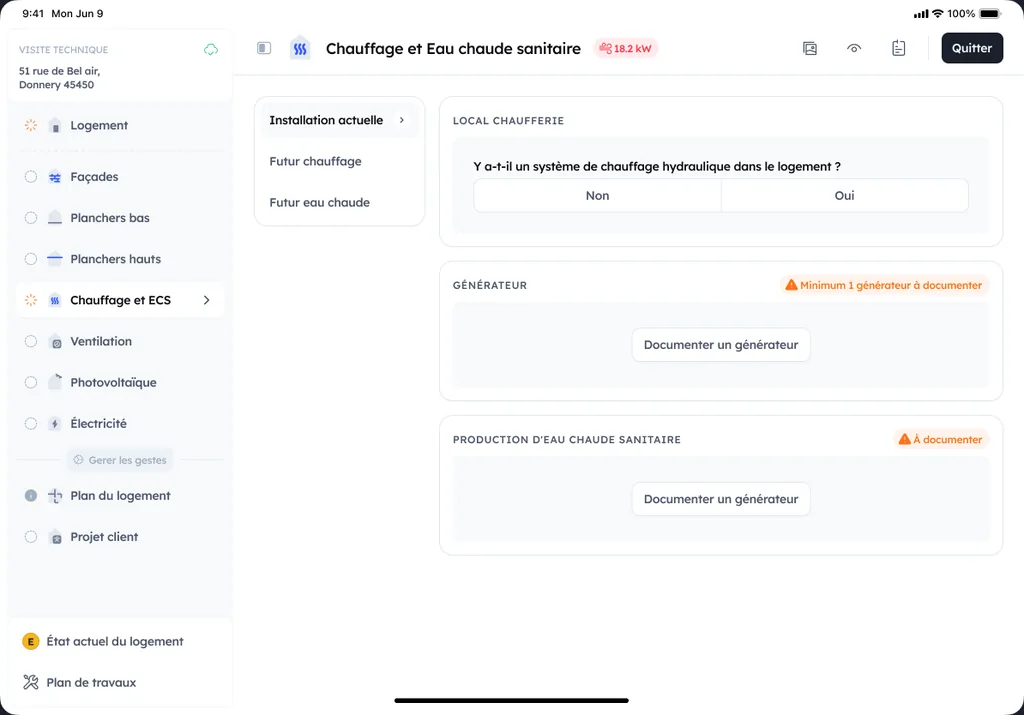
Four points, all observable during the survey, at the moment the technician documents the property step by step, and all expensive if discovered on installation day.
| To check | Why | Who handles it |
|---|---|---|
| Contracted supply capacity | a heat pump on a contract sized for gas trips the main breaker | the client, with their supplier, and it takes time |
| Single or three phase available | starting current caps at 30 A single phase, which bounds the output you can install | observed at the board and the meter |
| Voltage envelope | 230 V or 400 V ± 10 % averaged over 10 minutes, order of 24 December 2007 | the network operator, but the inrush is your responsibility |
| Space on the board and cable size | a dedicated circuit needs a free way and a cable sized for the run | you, and it costs money |
The first row is the problem, because it is not yours to fix and it takes time. A client who discovers at commissioning that they must upgrade their supply will wait weeks, and they will remember it as your failing.
Supply and protection are two separate questions
They get conflated, and neither excuses the other. Supply asks whether the dwelling can deliver the current: contract, phase, cable size, space on the board. Protection asks whether the circuit disconnects properly on a fault without tripping at start-up: breaker curve and RCD. The disconnection requirements are covered in our article on electrical protection for a heat pump.
What goes on the quotation, in both cases: what you supply, what you assume exists, and what remains the client's responsibility. It is the only wording that holds up when the consumer unit turns out to be full and the job stops for half a day.
Choosing the right electrical connection for your heat pump
Single-phase or three-phase: selection criteria based on power and configuration
Most homes run on 230V single-phase. Your heat pump can stay single-phase if the required current and your subscribed power allow it. Three-phase becomes relevant when the unit is more powerful, when the start-up current is high, or if you need to spread loads across three phases. When in doubt, start from the nameplate (A) and the manufacturer's instructions.
Dedicated circuit, cable cross-section and length: avoiding overheating and trips
Plan for a dedicated circuit from the consumer unit to the unit. The cable cross-section is sized according to the current and the length to limit voltage drop, overheating and trips. The longer the run (plant room, garage, outbuilding), the more you'll often need to oversize the cross-section and take care with the connections.
Protections at the consumer unit: breaker, RCD and surge arrester (points to watch)
At the consumer unit, install a breaker matching the rating specified by the manufacturer, sometimes a D-curve if the heat pump has a high inrush current. Add a 30 mA RCD, often type A for equipment with power electronics. Also consider a surge arrester, which is recommended, and sometimes required depending on the installation's exposure and configuration.
Sizing the meter and subscribed power to avoid outages
Calculating the power margin with the client: simple method and common cases
With the client, list the loads that can run at the same time. Add up their power ratings (heating, hot water, cooking, charging). Aim for a 30% margin to absorb peaks. Common case after installing a heat pump: hot water cylinder + induction hobs + oven. Depending on the profile, you often move from 6 to 9 kVA, or even 12 kVA for all-electric homes.
- Base: heating + ventilation.
- Peak: cooking, hot water, tumble dryer.
- Option: charging point or workshop.
Managing load shedding and control: reducing the winter consumption peak
When power is tight, load shedding avoids outages. Heating is prioritised, hot water is shifted to off-peak hours, and non-critical loads are temporarily cut. Fine-tuned control of the heat pump (weather compensation curve, stable setpoints) also limits power draw during recovery cycles.
Requesting a power increase: steps and timelines to plan for in 2026
The request is made through the electricity supplier, who tasks Enedis. With a Linky meter, the change is often carried out remotely within 24 to 48 working hours. Without Linky, plan for an appointment and a longer timeline, sometimes one to two weeks. Plan ahead of winter, as schedules get tight.
Securing commissioning and electrical compliance on site
Essential checks before energising: earthing, continuity, torque
Before first energising a heat pump, set aside 20 minutes to check the essentials. A missing earth connection or a forgotten torque setting can cost you a circuit board. Work with the power off and lock out.
- Measuring the earth connection and continuity of equipotential bonding where present.
- Checking conductor continuity, polarity, and the absence of overheating on the terminal blocks.
- Retightening connections to the recommended torque, especially the breaker, contactor, and outdoor/indoor unit terminals.
Siting rules and distances: outdoor unit, cable runs, mechanical protection
Follow the manufacturer's instructions for clearances and accessibility. Cables must follow a clear path, without rubbing or pinching. Where passing through a wall, fit a conduit and moisture protection. Outdoors, favour mechanical protection and UV resistance.
Coordination with the electrician and traceability: diagrams, labelling, site photos
Agreeing who does what with the electrician avoids duplication. Keep an up-to-date single-line diagram, label circuits and isolation devices, and take 4 to 6 dated photos before closing up the ducting. This is your safety net for after-sales service, inspection, and sign-off.
Common special cases: renovation, old consumer unit, multi-unit housing
Consumer unit to modernise: signs that call for an upgrade before the heat pump
Before installing a heat pump, check the consumer unit. Cartridge fuses, no 30 mA RCD, circuits without earthing, signs of overheating, a consumer unit already full, or undersized cables. In these cases, electrical safety comes before performance. An inspection (and sometimes a switch to single-phase or a subscription adjustment) avoids trips when the compressor starts.
Connection in a co-owned building: common areas, plant room and approvals
In multi-unit housing, the outdoor unit, drilling, pipe/cable runs and condensate drainage quickly touch on common areas. Ask for approval at the general meeting, validate the location (courtyard, roof, plant room) and plan ahead for the noise and vibration issue. The managing agent may require a file with plans, instructions and the installer's insurance certificate.
Heat pump and other equipment: solar, thermodynamic water heater, charging point
The heat pump must coexist with solar, a thermodynamic water heater or a charging point. Avoid combined loads that exceed the subscribed power by adding energy management, load shedding or scheduling. Plan for dedicated protections at the consumer unit, and consistent sizing across heating, hot water and the home's electrical uses.