Understanding what a ductable pellet stove can (and cannot) really do
Ductable pellet stove vs standard stove: how air outlets and the fan work
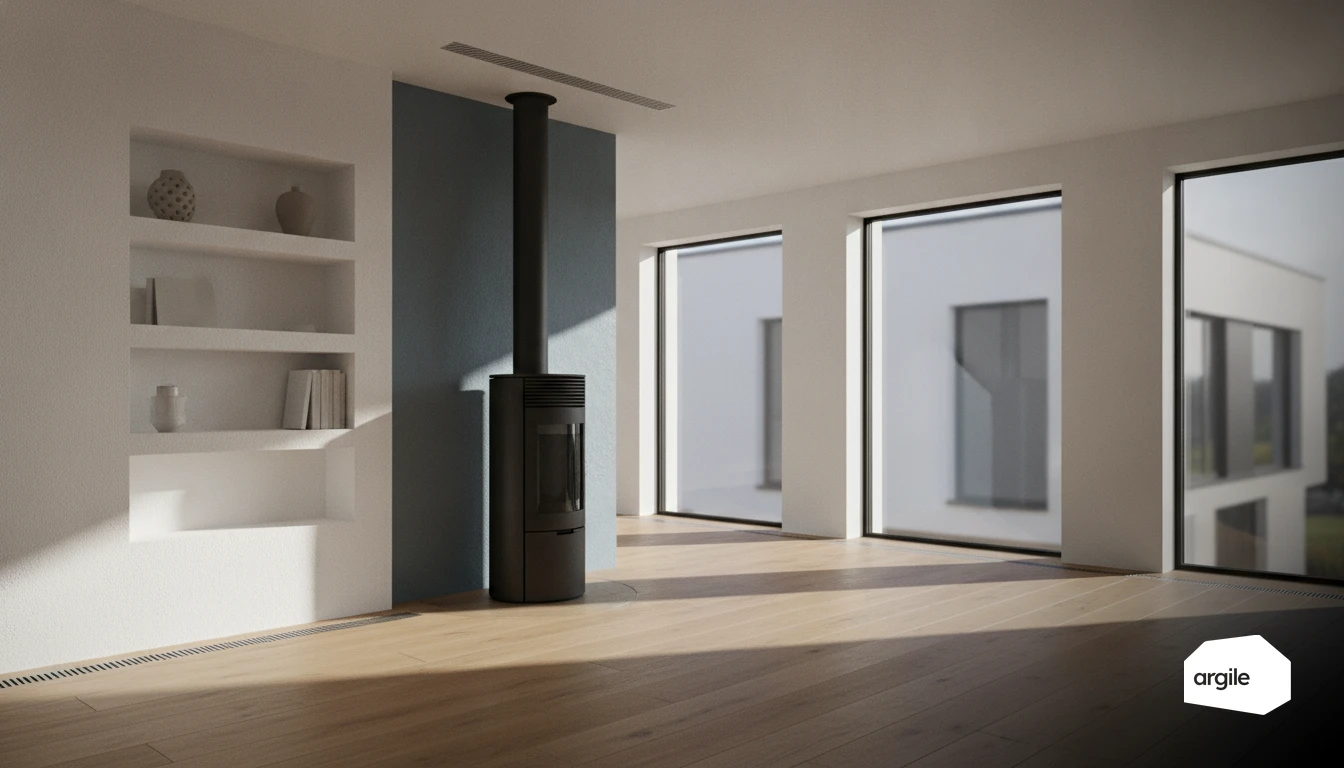
A ductable pellet stove still uses a heat exchanger and forced convection like a standard stove, but it adds one or more dedicated outlets for ducting. A distribution fan pushes part of the hot air into an insulated duct toward a remote outlet. The result: you can heat an adjoining room, provided you stay within the airflow and pressure-drop limits set by the manufacturer.
Hot-air distribution with a stove: why it is not central heating
Ducting carries air, not water. It cannot “balance” rooms the way a hydronic system can. Length, bends, cross-section and filtration all reduce airflow. And the harder the fan works, the more noise you hear at the outlets. So you are sizing a room supplement, not a multi-zone heating system.
Pellet stove for several rooms: where it works, and where it disappoints
It works when the spaces are close together, doors are often left open, and the ducts are short, straight and properly insulated. It disappoints as soon as you aim for remote bedrooms, upper floors or different setpoints from room to room. Beyond that, you should consider a second heat source or a dedicated hot-air distribution solution.
Permissible duct length: how far can you go without losing too much airflow
Length, diameter, number of bends: what makes performance drop
| Parameter | Site guideline | Main effect |
|---|---|---|
| Duct diameter | Increase it as soon as possible | Lower pressure drop and less noise |
| 90° bend | 1 bend = equivalent length | Airflow collapses on small diameters |
| Routing | As straight as possible | Less strain on the fan |
On a ductable pellet stove, the limit is not “length” on its own, it is the total pressure drop. Small diameter + a series of bends = useful airflow drops, then noise issues follow.
Airflow loss and temperature: field cues to avoid a lukewarm room
When commissioning, check airflow at the outlet (anemometer) and supply-air temperature. If the most disadvantaged outlet loses too much airflow, the temperature rises at the appliance but never reaches the room. In that case, reduce the equivalent length, increase the diameter or reduce the number of branches.
Good installation practices: duct insulation, routing, outlet balancing
Insulating runs in unheated spaces reduces losses and condensation. Pay attention to bend radii, avoid crushing the ducts, and plan balancing devices (dampers) to hold the design airflow rates. Note lengths, diameters, bends and acoustic accessories on the quotation. That is what stands up to inspection and to a competitor bidding lower.
Noise: the number one source of dissatisfaction with ductable stoves
Where the noise comes from: fan, vibration, outlets, duct resonance
On a ductable pellet stove, the noise first comes from the duct fan, then from casing vibration transmitted into the building structure. Add turbulence at the outlets and resonance in a duct that behaves like an acoustic conduit. During a site visit, assess the nuisance by identifying at which fan speeds the sound level changes, and where it is “made” — appliance, branch connection, outlet.
When ducting amplifies noise: common mistakes (tight bends, poor outlet selection)
Tight bends, diameter reductions, wrongly oriented tees and unnecessary lengths all increase pressure drop. The natural reaction is to raise the speed, and the air discharge becomes audible. Another trap is an outlet that is too restrictive, or mounted on a lightweight partition, turning a faint whistle into a complaint.
Reducing noise without sacrificing airflow: settings, accessories and workmanship
Aim for a simple, stable network. Wide bend radii, acoustic-insulated ducts if possible, mounts with anti-vibration isolators. For practical pointers on noise and vibration attenuation solutions, the same principles apply: decoupling, limiting transmission and choosing the right supports. Balance with dampers rather than by “choking” the outlet. Then set the fan speed as low as possible while remaining acceptable, and validate the outlet airflow with an anemometer.
Limits not to exceed: when another heat source is needed
Warning signs: too much length, too many rooms, unmanageable pressure losses
The measurements that settle the matter are straightforward: available fan pressure, airflow at the outlets, supply-air temperature and noise. As soon as you lengthen the ducts or multiply the branches, pressure loss rises. With a ductable pellet stove, keep these reference values in mind to make your decision, then verify them against the manufacturer’s instructions.
| Sizing indicator | Equivalent length (m) | Number of outlets (u) | Outlet noise dB(A) |
|---|---|---|---|
| From | 10 to 15 | 3 | 35 |
Real comfort vs the promise: surface area and temperature-difference thresholds to accept
This system is not a central heating system. In practice, once the served area becomes too spread out, you end up with one warm reference room and lukewarm rooms downstream of the fan. Set a target for the steady-state temperature gap. If you go beyond these acceptable thresholds, you create dissatisfaction and call-backs.
| Sizing benchmark | Served area (m²) | Difference between reference room and supplied room (°C) |
|---|---|---|
| Site target | 60 | 3 |
Alternative solutions in 2026: second appliance, air-to-air heat pump, dedicated air network, targeted backup heat
When you exceed the limits, avoid over-ventilation and overly long duct runs. In 2026, the cleanest exits on site are often the fastest: cost-effective heating solutions to propose in 2026.
- Add a second appliance in the remote area.
- Switch to a multi-split air-to-air heat pump, balanced room by room.
- Move to a dedicated air network, such as a ducted system, sized by pressure drop.
- Keep the generator and add targeted backup heat in critical rooms.
Sizing tips for a “multiple rooms” project without overselling
Questions to ask the client before quoting: layout, volumes, doors, usage, noise expectations
Before promising multi-room distribution with a ductable pellet stove, start from a dimensioned plan. Record floor areas, ceiling heights, doors and air paths. Note how the spaces are used (doors closed at night, office in the day) and the real objective: backup heat, temperature maintenance, or primary heating. Set out the acoustic expectation clearly: nuisance threshold, sensitive hours, outlet positions.
Simple distribution method: prioritise the living room and manage the bedrooms
Size the living room first. That is the space that carries the useful output. Bedrooms are treated as temperate zones. Keep the network short, with few bends, and diameters compliant with the manual. Plan for simple balancing (dampers, shutters) and verify on site the direction of flow, outlet airflow and air return paths (door undercuts, transfer grilles).
Be explicit about the limits: what you guarantee and what you do not
State what you do guarantee: flue compliance, safety, settings, target comfort in the living room. Also say what you do not guarantee: the same temperature in every room, absolute silence, or a replacement for central heating. Beyond a long network or too many outlets, propose a second emitter or another heat source rather than trying to stretch the ducting further.