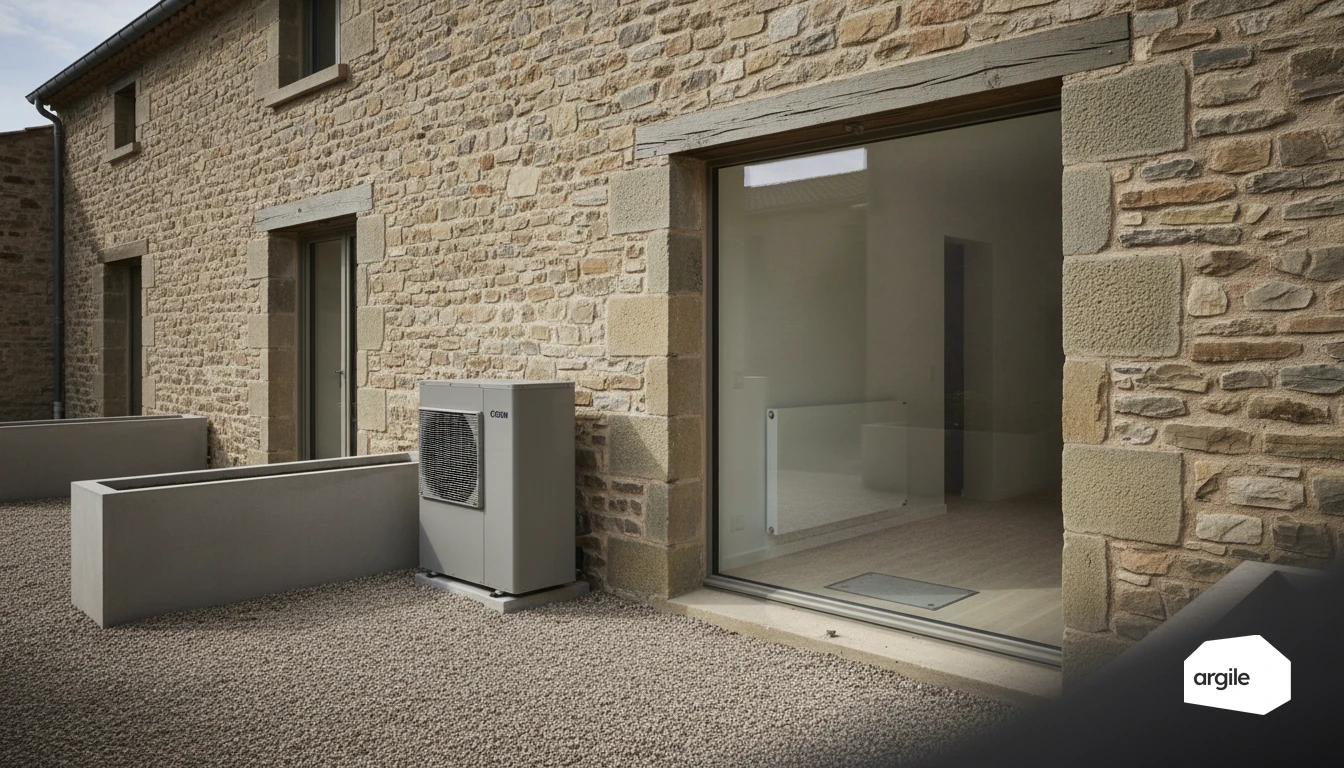
Understanding the high-temperature heat pump for process heat in industry
What a high-temperature heat pump does on an industrial site
A high-temperature heat pump produces process heat by harnessing a cold source available on site (extracted air, warm water, cooling loop, effluents). The goal is simple: replace part of the gas or steam with more efficient heat, while keeping fine control over temperatures.
Achievable temperatures: what you can actually guarantee on site
On site, you don't "guarantee" a temperature by rule of thumb. The flow temperature depends on the hot source/cold source pairing, the flow rate and the temperature lift. In practice, many solutions target 80 to 95°C, some reach around 120°C. Beyond that, you often move to specific architectures and tighter sizing.
When a heat pump makes sense against a gas or steam boiler
It's relevant when you have waste heat to recover, continuous needs, and process temperatures that are compatible. The boiler stays useful for peaks, very high temperatures, or when hydraulic integration would be too heavy. The right choice comes down to seasonal COP, the load profile and the space available.
Targeting the right needs: processes, temperature levels and site constraints
Mapping your process heat uses: hot water, baths, drying, cleaning
List the points that consume heat and note, for each, the flow rate, inlet temperature and useful temperature. Keep it simple. A heat pump doesn't perform the same at 35°C as at 65°C. This survey saves you from oversizing.
Identifying recoverable losses: waste heat and process discharges
Spot what's already going into the air or down the drain. Condensers, warm-water discharges, extracted air, chillers. This waste heat can preheat process water or a buffer tank, sometimes continuously. To go further, see heat recovery from a chiller unit.
Checking constraints: service continuity, heat quality, noise and placement
Validate the on-site requirements. Backup in case of a stoppage, temperature stability, material and fluid compatibility. Think about noise, maintenance access, and space for heat exchangers and pipework. A well-thought-out placement saves kWh and avoids callbacks.
Correctly sizing a high-temperature heat pump: points of vigilance in 2026
Power output, water regimes and performance: avoiding oversizing
Base the heat pump's power output on heat losses at the local design point, not on the existing boiler. Target the emitters' actual water regime (often 60°C and above in renovation) and set a progressive heating curve. Too powerful, and you get short cycling, more noise, and a COP that collapses as soon as the flow temperature climbs. Correct power output means a machine that runs for long periods, even at mid-season. Those design-point heat losses are calculated: the EN 12831-1 method applied to the survey produces a sizing report ready for the file.
Choosing the refrigerant and anticipating regulation
In 2026, choice of refrigerant is no longer a detail. F-Gas regulation continues to phase down high-GWP HFCs. Head toward more efficient solutions (R290, R32, A2L), checking safety constraints, volumes, and installation competencies. Low GWP, yes, but without cutting corners on the rules.
Integrating the hydraulics: buffer tank, decoupling, backup and safety devices
Take care with the hydraulics to stabilise the heat pump. A buffer tank or a minimum volume avoids repeated start-ups. Add decoupling if there are several circuits, and control the backup (element or boiler) with a clear bivalence strategy. Plan for an expansion vessel, safety valve, filter, and sludge trap. Clean schematic, calm job site.
Installing and commissioning: methods that limit callbacks
Integration schematics: partial replacement, hybrid, heat pump cascade
Choose the schematic before installing the heat pump. For partial replacement, keep the boiler on relief, with isolation valves and a simple switchover logic. For hybrid systems, prioritise the heat pump and lock in the switchover temperatures. For cascades, standardise the lengths, plan for hydraulic decoupling and a clear backup mode.
Measurements and settings: flow rates, balancing, heating curves and process setpoints
Commissioning is done with a pressure gauge and a thermometer. Check the correct flow rate on both the emitter and source sides. Balance the loops, then set a progressive heating curve. Validate process setpoints, hysteresis, and domestic hot water management. Log the reference values, they'll help with diagnostics.
Maintenance plan: checks, performance drift and operational monitoring
Plan a simple schedule. Visual inspection, filters, pressures, temperatures, noise, and tightness if refrigerant is involved. Track the gap between consumption and useful heat to spot drift. A monthly reading and a periodic visit avoid surprise breakdowns and a flurry of callbacks. To frame the key points, also draw on the essential commissioning checks.
Support schemes and requirements: how to secure funding and compliance in 2026
Overview of schemes available to industry: CEE certificates, local support, calls for projects
In 2026, the CEE certificates remain the backbone for funding insulation, heat recovery or heat pumps. You can also tap regional support and ADEME or France 2030 calls for projects. The right reflex is to check eligibility before signing, and to secure combined funding from the start.
Files and evidence: what you need to prepare (measurements, data sheets, traceability)
To avoid rejections and inspections that stall, prepare a simple, complete file.
- Approved standardised operation sheet and key dates.
- Quote, purchase order, invoices, sworn statement.
- Dated photos, identification, serial numbers, technical data sheets.
- Before-and-after measurements, commissioning reports.
RGE and subcontracting: organising your work to stay eligible
When a support scheme requires it, the RGE-certified company must retain control over execution and evidence. In subcontracting, clarify the roles, keep traceability of the work, and avoid cascading subcontracting.