Reading a boiler pressure gauge at a glance (pointer, bars, cold)
What the gauge really measures: relative pressure in the heating circuit
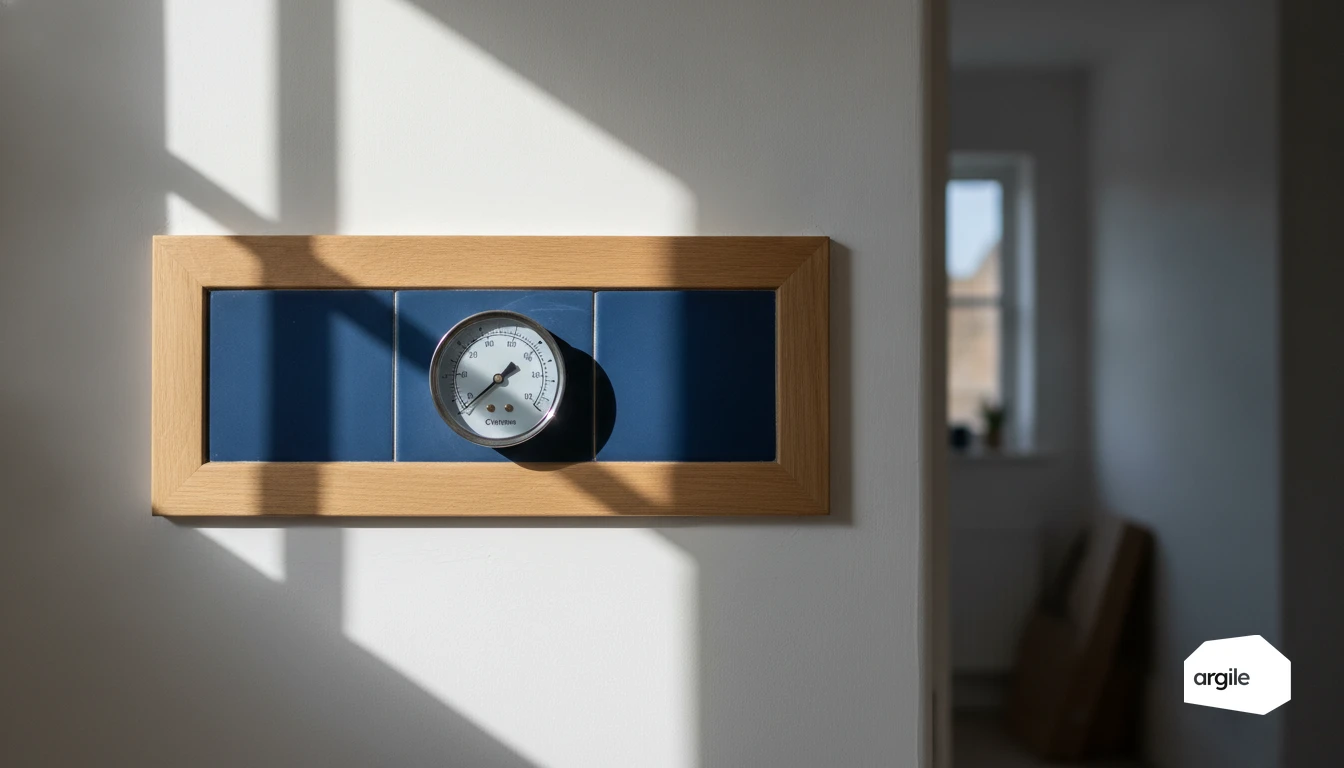
A boiler pressure gauge shows the relative pressure in the heating circuit. The value is read in bar, relative to atmospheric pressure. Take the reading with the system cold and the pump off, otherwise you mix static pressure with operating effects. On two-pointer gauges, only the “moving” pointer gives the actual reading. The reference pointer is set by hand and is only a visual marker.
Typical values in a house: the reference range when cold
| Context | Cold pressure (bar) | Practical reading |
|---|---|---|
| Detached house, 1 to 2 storeys | 1.0 to 1.5 | Most common range at filling |
| Below the reference | < 0.8 | Risk of air at high points, top-up to check |
| Above the reference | > 2.0 | Monitor before temperature rises |
Keep a cold reading as your baseline. That is the value you use to record your readings before repressurising or bleeding.
Why system height changes the fill pressure
The fill pressure depends on the static head between the boiler and the highest emitter. Allow about 0.1 bar per metre of water column, then add a margin to stay pressurised at high points.
| Static height (m) | Recommended minimum cold pressure (bar) |
|---|---|
| 3 | 0.6 |
| 5 | 0.8 |
| 8 | 1.1 |
Two-pointer boiler gauge: don’t confuse the reading with the reference
Identify the measuring pointer and the setpoint pointer (adjustable)
On a two-pointer boiler pressure gauge, only one pointer is linked to the sensor. That is the actual measuring pointer; it moves as the system heats up and is refilled. The other pointer, often driven by a front bezel or the centre knob, is only a reference. It does not measure anything.
Setting the reference without upsetting the system: a simple method
Work with the circuit cold, the pump off, and the pressure stabilised. Read the value, then align the setpoint pointer with the measuring pointer by turning only the adjustment ring. Do not compensate for a poorly positioned reference pointer by adding water or bleeding. For more on the gauge and circuit pressure, keep the expected cold and hot values in mind.
Common brand-specific cases: dual dial, colours, zones
Depending on the manufacturer, the reference pointer may be red and the measuring pointer black, or the other way around. Some dials have a printed green zone, but it remains indicative. On some models, the two pointers overlap. Check the adjustment symbol or the presence of a serrated ring to identify the reference pointer.
Quick diagnosis based on needle behaviour (during heating, at rest)
On a boiler pressure gauge, reason from the cold reading first, then compare the drift during heating and at rest.
| Behaviour | Observed change (bar) | Priority check |
|---|---|---|
| Rises when heating | Rapid increase | Expansion vessel |
| Drops slowly | Progressive loss | Tightness, vessel |
| Rises when stopped | Increase with burner off | Top-up, heat exchanger |
Pressure rises when heating: suspect a deflated or undersized expansion vessel
If the needle quickly gains +0.5 bar or more, up to the safety valve range, suspect an undercharged or undersized expansion vessel.
- Measure the vessel precharge with the circuit drained, at the Schrader valve.
- Recalculate the vessel size based on water volume and flow temperature.
Pressure drops slowly: leak, micro-leak, or punctured vessel
A decline spread over hours or days points to a micro-leak (fitting, air vent, safety valve) or a punctured diaphragm.
- Visually check hot spots, signs at the safety assembly, and the safety-valve discharge.
- Test the Schrader valve. If water comes out, the vessel is faulty. Replace it and repressurise.
Pressure rises with the boiler off: filling valve left open or domestic hot-water heat exchanger leak
A rise with no heating often comes from a filling valve that is letting water through. Less commonly, a domestic hot-water heat exchanger links the cold-water mains to the heating circuit.
- Close the top-up line, disconnect the hose, and monitor pressure for 30 minutes.
- Isolate the domestic cold-water inlet. If the pressure stabilises, suspect the heat exchanger.
On-site checks: safe actions before calling technical support
Measure and adjust vessel precharge: drained circuit, zero pressure
| Static height (m) | Target vessel precharge (bar) | Reference cold fill pressure (bar) |
|---|---|---|
| 5 | 0.7 | 1.0 |
| 10 | 1.2 | 1.5 |
| 15 | 1.7 | 2.0 |
Isolate the vessel if possible. Bring the circuit to zero pressure (drain down) and check the boiler pressure gauge. Measure the precharge at the Schrader valve, then re-inflate. If water comes out on the air side, the diaphragm is punctured.
Check the safety valve, air vents, and filling valves: points to inspect
- Safety valve. Discharge into the trap, clogged seat, outlet cap not blocked.
- Air vents. Cap, float leak, seepage at the fitting. For more on this point, see automatic air vents.
- Filling loop. Loop and valves properly closed, pressure reducing valve not stuck.
After the safety valve has opened: why the pressure drops sharply and what to check
A valve that has discharged empties the system quickly. Check whether it reseats or drips. Look for the cause of overpressure. Deflated vessel, insufficient volume, or filling valve left open. Re-adjust the vessel with the circuit drained, then refill cold to the reference mark and confirm the hot rise.
Common troubleshooting mistakes: avoid incorrect adjustments
Do not adjust pressure when hot: risk of underpressure when cooling down
In a closed circuit, pressure follows temperature. If you “square up” the system while it is heating, you are validating a value inflated by expansion. When it cools, the boiler pressure gauge can drop below zero relative to the high point, causing loss of prime, noise, and flow faults. Always adjust and confirm cold, after stabilisation and bleeding, then check the rise during heating to assess the expansion vessel.
Do not confuse heating pressure, cold-water pressure, and refrigerant pressure
Heating pressure is the pressure in a closed circuit. Domestic cold-water pressure is mains pressure, often much higher and controlled by a pressure reducing valve. Refrigerant pressure, by contrast, depends on the fluid and temperature and is not read on a heating gauge. Identify the test point, the type of gauge, and the valve involved before taking any action. One wrong turn in the wrong place can trigger a safety valve or flood a circuit.
When the gauge reading is no longer enough: signs that require a full check
- Strong rise during heating or safety valve opening. Suspect a deflated or undersized expansion vessel.
- Slow drop despite top-ups. Look for a leak, air vent, safety valve, or punctured vessel.
- Pressure rises with the boiler off. Check for a filling valve left open or a faulty domestic hot-water heat exchanger.
In these cases, move to a full inspection. Measure the vessel precharge with the circuit drained, and record the values before and after intervention. If you have any doubt about overall tightness before refilling, also carry out a pipeline pressure test.