Compare efficiency: open hearth, closed fireplace and stove
Rules of thumb for efficiency: what you gain by switching to a closed hearth or fireplace insert
An open hearth mostly heats… the sky. In practice, you go from “decorative” warmth to a real share of space heating as soon as you close the firebox.
| Equipment | Typical efficiency (%) |
|---|---|
| Open hearth | 10 to 15 |
| Insert or closed hearth | 65 to 80 |
| Modern log stove | 70 to 85 |
Closed fireplace vs stove: output, thermal mass, comfort and everyday use
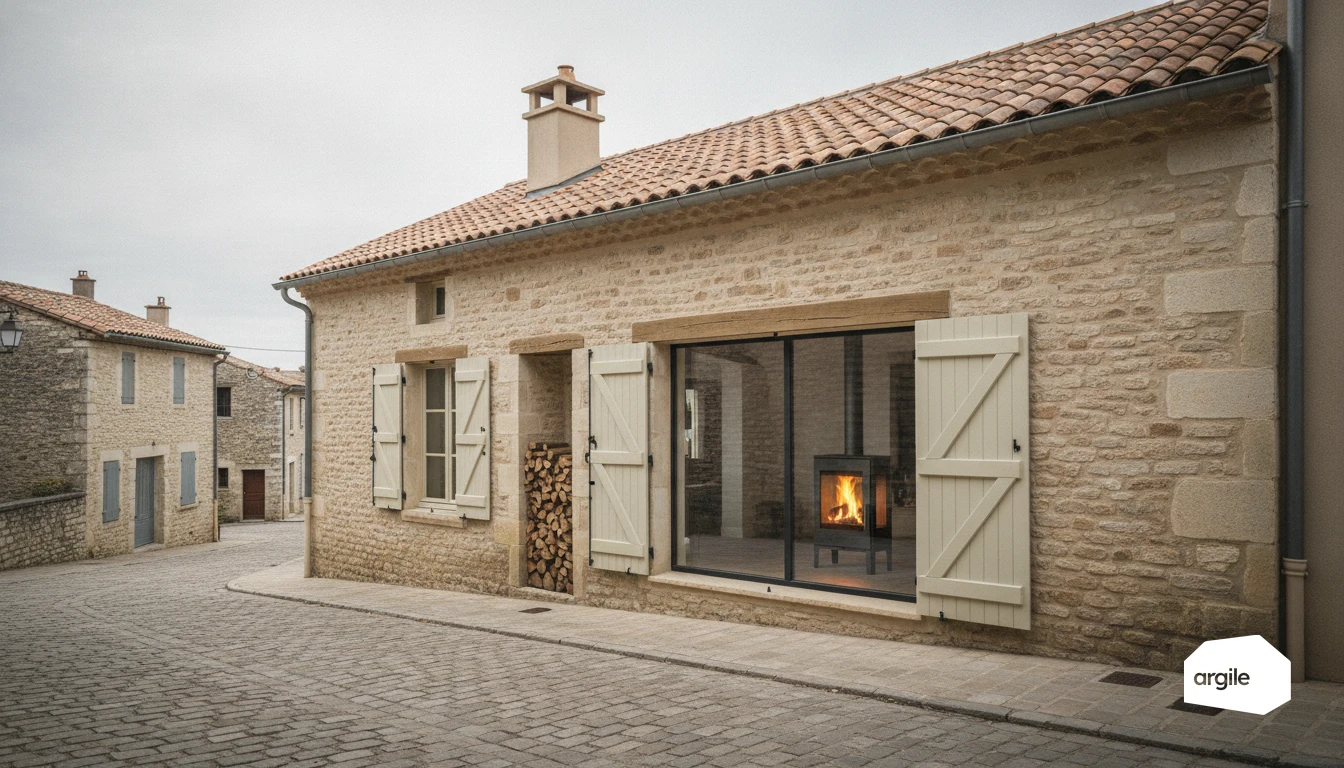
A closed fireplace often makes use of an existing hearth, with a “fireplace” flame effect and mostly convective heat delivery. A stove offers a clearer, more predictable output, and depending on its mass (cast iron, soapstone, masonry heater) greater thermal mass.
Insert efficiency and savings: what really makes the difference (wood, settings, maintenance)
- Dry wood, ideally under 20% moisture.
- Proper air settings, without choking the fire.
- Clean maintenance, seals and glass, regular sweeping.
Check whether an existing flue can take a fireplace insert before installation
Flue condition: inspection, smoke test, sweeping and warning signs
Before fitting any insert, start with the flue. Visual inspection, ideally with a camera, then a smoke test to identify leaks, backdrafting or stray air leaks in the loft. Mechanical sweeping is required before commissioning. Common warning signs include creosote buildup, cracked clay liners, overly tight offsets, chimney-fire marks, and a damaged stack.
Flue lining: when it is mandatory, material choice, and continuity rules up to the stack
On an old flue, lining is often required to secure airtightness and stabilize the flue gases. Flexible stainless steel if the flue is sinuous, rigid stainless steel if the run is straight. The target is a continuous liner from the appliance to the stack, with suitable connectors, a sealing plate at the base and a compliant terminal.
Flue cross-section and height: draught, sizing and appliance compatibility
Draught depends on height, cross-section and bends. The cross-section must remain compatible with the outlet and the manufacturer’s requirements. Too small, and a closed fireplace will struggle and soot up. Too large, and the flue gases cool and condense. Do not miss the combustion airflow: in an airtight home, a dedicated air supply can determine whether the installation is feasible.
Don’t miss the key point: combustion air in airtight homes (building regs, high-performance renovations)
Why combustion air flow determines whether the installation works: negative pressure, backdrafting and safety
In a renovated, tighter home, a hearth that draws air from the room can put the building under negative pressure. Possible consequences are smoke backdrafting, poor combustion and CO risk. This is often the issue that derails an otherwise well-installed closed fireplace.
Dedicated air supply: air inlets, penetrations and airtight appliances
The most robust solution is a dedicated air supply, correctly sized and protected. It can come from a crawl space, an external wall or a floor penetration, with a rodent screen. “Airtight” appliances (ductable models) limit interaction with the room, provided the air intake and seals are truly continuous.
Special cases in 2026: mechanical ventilation, extractor hoods, heat recovery systems and very well-insulated homes (simple site tests)
In 2026, watch out for mechanical ventilation systems, powerful extractor hoods and heat recovery systems that can create imbalances. Carry out simple tests: hood on full, doors closed, then check ignition and absence of backdrafting (smoke pen or paper). If it draws “the wrong way,” sort out the combustion air before signing off the handover.
Deliver the job successfully: installation, settings and safety for a high-performance closed fireplace
Connection and airtightness: joints, inspection hatch, safety clearances
For a closed fireplace, aim for a simple, accessible and airtight connection. Pay close attention to the joints (clamps, suitable high-temperature seals) and provide an inspection hatch to check the flue and liner. Keep the safety clearances to combustible materials in line with the appliance manual and good practice. In very airtight homes, plan for combustion air in advance, as it is often the deciding factor in preventing backdrafting and smoke.
Combustion settings: primary/secondary air, clean glass and stable flame
Start with a strong draught, then adjust the primary air to get the fire going and the secondary air to complete combustion. A lively flame without “pumping,” and glass that stays clear, are good signs. Explain to the client that they should use properly dry wood and avoid overloading the firebox.
Maintenance and compliance: sweeping, liner checks and good practice to explain to the client
Schedule sweeping at the frequency required locally and by the insurer. At each visit, check the condition of the liner, seals, fixings and air inlets. Recommend a CO alarm and remind the client of simple steps, such as emptying ashes without blocking airflow.
2026 incentives: what a closed fireplace may qualify for (and when)
Overview of possible support in 2026: MaPrimeRénov’, CEE and common conditions
In 2026, a closed fireplace may qualify for support if it replaces an inefficient heating system and if the appliance is genuinely used for heating. The two most common routes are MaPrimeRénov’ (depending on income and the dwelling) and CEE incentives, often applied for through an energy supplier’s bonus scheme.
Eligibility criteria: appliance performance, installation by a qualified company, evidence required
On the technical side, the target is an appliance that meets current requirements (EcoDesign type) and, in practice, a Flamme Verte rating or equivalent makes applications easier. Installation must be carried out by a qualified company (often RGE Qualibois). You should expect: a signed quote before work starts, itemised invoices, technical data sheet, CEE certificate and installation photos.
Situations where it gets blocked: simple replacement, property type, combining incentives and points to check before quoting
Problems arise if the project looks like a purely decorative surround, if the appliance does not meet emissions thresholds, or if the property does not meet the eligibility criteria (main residence, age). Combining MPR and CEE is possible, but the order of steps must be clearly planned. Before quoting, check the combustion air supply, the state of the flue and the planned liner.