Understanding geothermal systems: the role of the loop on site
What does a geothermal loop do in an installation (collector, exchange, efficiency)?
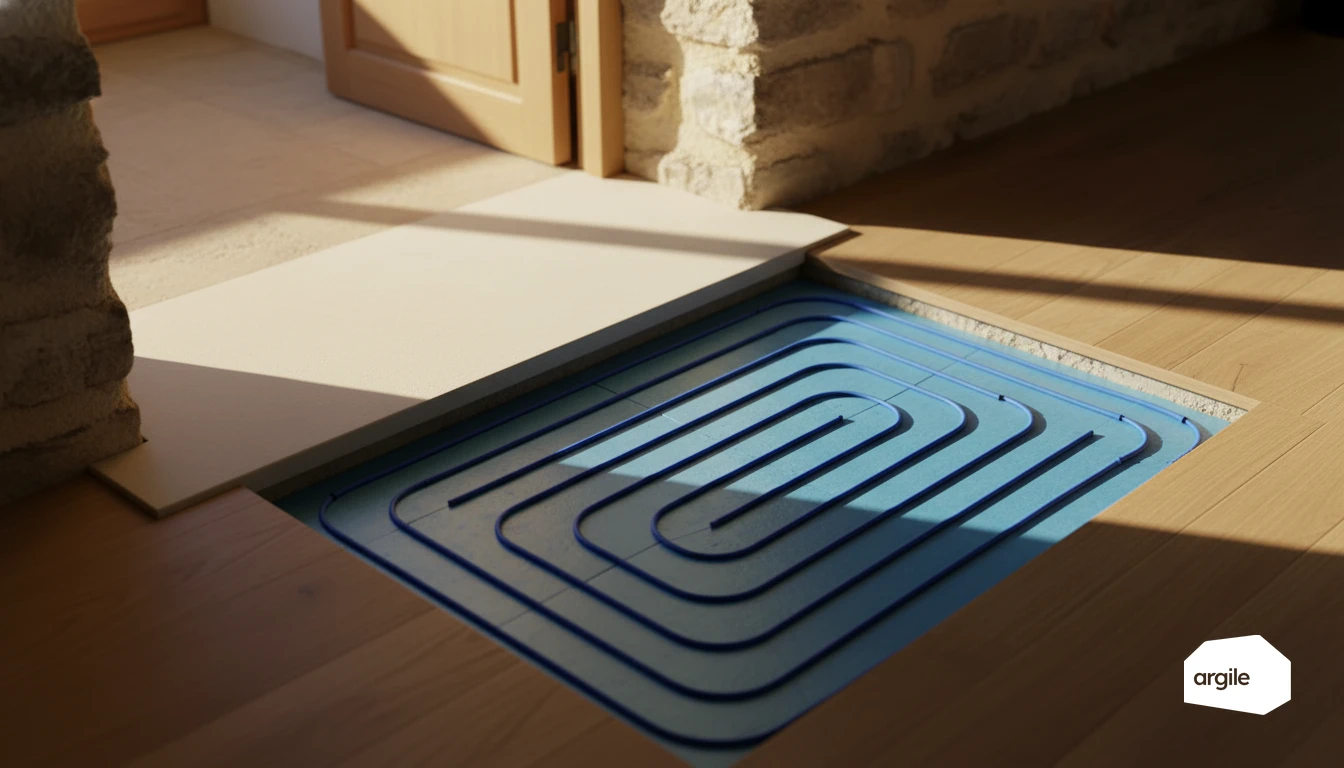
In a geothermal system, the loop is the circuit that captures heat from the ground or from water. A fluid circulates through it, recovers heat via the collector (buried horizontal collector or vertical boreholes), then transfers it to the heat pump through the exchanger. The more stable the source temperature, the more consistent the seasonal efficiency, especially in winter.
Open loop and closed loop: simple definitions and key differences
In a closed loop, a fluid circulates through sealed pipes that are buried or drilled into the ground. In an open loop, groundwater is drawn, the heat is exchanged, then the water is reinjected. The open loop depends heavily on flow rate, water quality and permits, but can offer good efficiency if the resource is suitable.
Which criteria guide the choice: surface area, ground type, water access, building needs
- Available surface area. A horizontal collector needs space; vertical boreholes need much less.
- Ground and subsoil. Conductivity, moisture, rock, checked through a study and sizing calculation.
- Water access. Presence of an exploitable aquifer, reinjection constraints and monitoring.
- Building needs. Power demand, low-temperature emitters, insulation level.
Open geothermal loop: siting conditions and points of vigilance
Operating principle: pumping, discharge and impacts on the water resource
An open geothermal loop draws water from an aquifer via a pumping borehole, recovers heat in the heat pump, then returns the water by reinjection or discharge. The challenge is preserving the aquifer: a compatible flow rate, a limited return temperature, and no mixing between aquifers.
Permits and procedures: what to check in 2026 (drilling, abstraction, discharge)
In 2026, check local rules case by case. A doublet (abstraction plus reinjection well) often triggers a procedure under the French water law (declaration or authorisation depending on volumes), plus constraints in water-catchment protection zones. The thresholds are set out in the schedule to article R. 214-1 of the French environment code. Heading 1.1.2.0 covers abstraction from a borehole, a well or underground works: a declaration above 10,000 m³/year, a full authorisation from 200,000 m³/year. Heading 5.1.1.0 covers the reinjection into the same aquifer of water abstracted for geothermal use: a declaration where the total reinjection capacity exceeds 8 m³/h without reaching 80 m³/h. The discharge (reinjection or into the environment) must be approved by the authorities, with conditions on temperature and quality.
Risks and checks: clogging, corrosion, water quality, monitoring and maintenance
The sensitive points are clogging (sand, biofilm), scaling and corrosion. A good water diagnosis, suitable filtration, and monitoring of pressures, flow rates and temperatures secure performance. Plan for regular maintenance and checks of pumps and heat exchangers.
Closed geothermal loop: technical variants and installation requirements
Horizontal collectors vs vertical boreholes: advantages, limits and site footprint
On a closed-loop geothermal system, horizontal collectors are laid in shallow trenches, often between 0.8 and 1.2 m deep. They require a large available surface area, away from trees, foundations and underground services. Vertical boreholes, installed in a drilled hole, take up very little space and offer a more stable temperature. In exchange, the work is more specialised, requiring machine access and the procedures tied to "minor-impact" geothermal projects.
Heat-transfer fluid, sealing and safety: good practices to avoid leaks
The circuit contains water and an antifreeze, often propylene glycol. Favour HDPE pipes and welded joints. Protect the pipe crossings, plan for isolation valves, then carry out a pressure test before backfilling. On vertical systems, grout sealing limits water migration and secures the installation.
Sizing and installation: depth, spacing, testing and handover
Sizing starts with a thermal study, beginning with the building heat loss calculation. It sets the depth, the number of loops and the spacing between trenches or boreholes. On site, locate existing underground services, respect bending radii, then record an as-built plan. At handover, request test reports, settings and the maintenance manual.
Geothermal regulations: what to secure before signing a quote
Declarations, thresholds and zones: checks to anticipate depending on the project
Before a geothermal project, check whether it falls under "minor-impact" geothermal rules. Depending on the borehole depth, the type of collector (closed boreholes or pumping) and the regulatory zone, you'll need to file an online declaration, or apply for an authorisation. Also consider local constraints such as drinking-water catchment protection zones, easements and access to the borehole. A closed loop neither abstracts nor reinjects groundwater, so headings 1.1.2.0 and 5.1.1.0 do not apply to it, and the file turns instead on borehole depth and the regulatory zone.
Certification, insurance and liability: documents to prepare to stay on solid ground
To unlock the funding, the company installing the heat pump must be MCS-certified with the ground source scope, and an open loop needs the Environment Agency abstraction and discharge permissions before anything is drilled. If a drilling contractor is involved, ask for their own qualifications and insurance certificates. Require an up-to-date public liability and professional indemnity cover, with the activities actually covered, and a quote that clearly states who does what.
Traceability and evidence: documents to keep (plans, test reports, technical data sheets)
Keep a simple but complete file: siting and as-built plans, borehole logs, heat-transfer fluid data sheets, leak-test reports, settings and commissioning records. This evidence protects you for after-sales service, warranties, and any scheme audit. A clear file avoids back-and-forth.
Choosing between open and closed loop: decision method and project costing
Decision tree: when to favour open, when to stay closed
For a geothermal installation, start from the ground conditions. If an aquifer is accessible, with a stable flow rate and controlled water quality, an open loop can make sense. If procedures need to be minimised, if the resource is uncertain, or if siting two boreholes (pumping and reinjection) is complicated, stay with a closed loop (vertical boreholes or horizontal collectors).
The table below sets the two setups against each other on the water regime, which is where they part company.
| What you compare | Open loop | Closed loop |
|---|---|---|
| Abstraction from a borehole, heading 1.1.2.0 | declaration above 10,000 m³/year | not applicable, nothing is abstracted |
| Same abstraction, upper threshold | authorisation from 200,000 m³/year | not applicable |
| Reinjection into the same aquifer, heading 5.1.1.0 | declaration above 8 m³/h and below 80 m³/h | not applicable, nothing is reinjected |
Cost items to compare: drilling, hydrogeology, accessories, control, maintenance
Compare line by line. Drilling. Hydrogeological study, pumping tests, administrative files. Water-specific accessories for open loops (submersible pump, filtration, exchanger, metering). Accessories for closed loops (heat-transfer fluid, manifolds, grout sealing). Control (sensors, variable-speed drive, weather compensation) and maintenance contract (checks, venting, parts replacement).
Common mistakes to avoid: undersizing, poor study, forgotten regulations
The classics: undersizing the power or the borehole field. Neglecting the soil or hydrogeological study. Forgetting local obligations (declarations, catchment protections, drilling rules) and commissioning checks. A robust cost estimate also includes a margin for site contingencies.