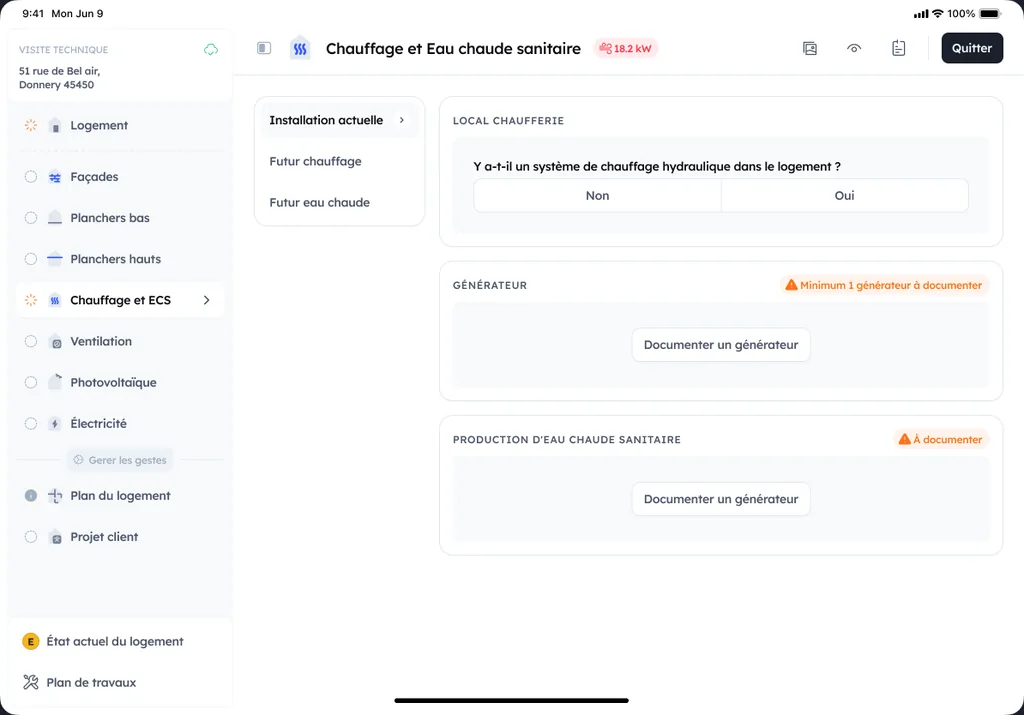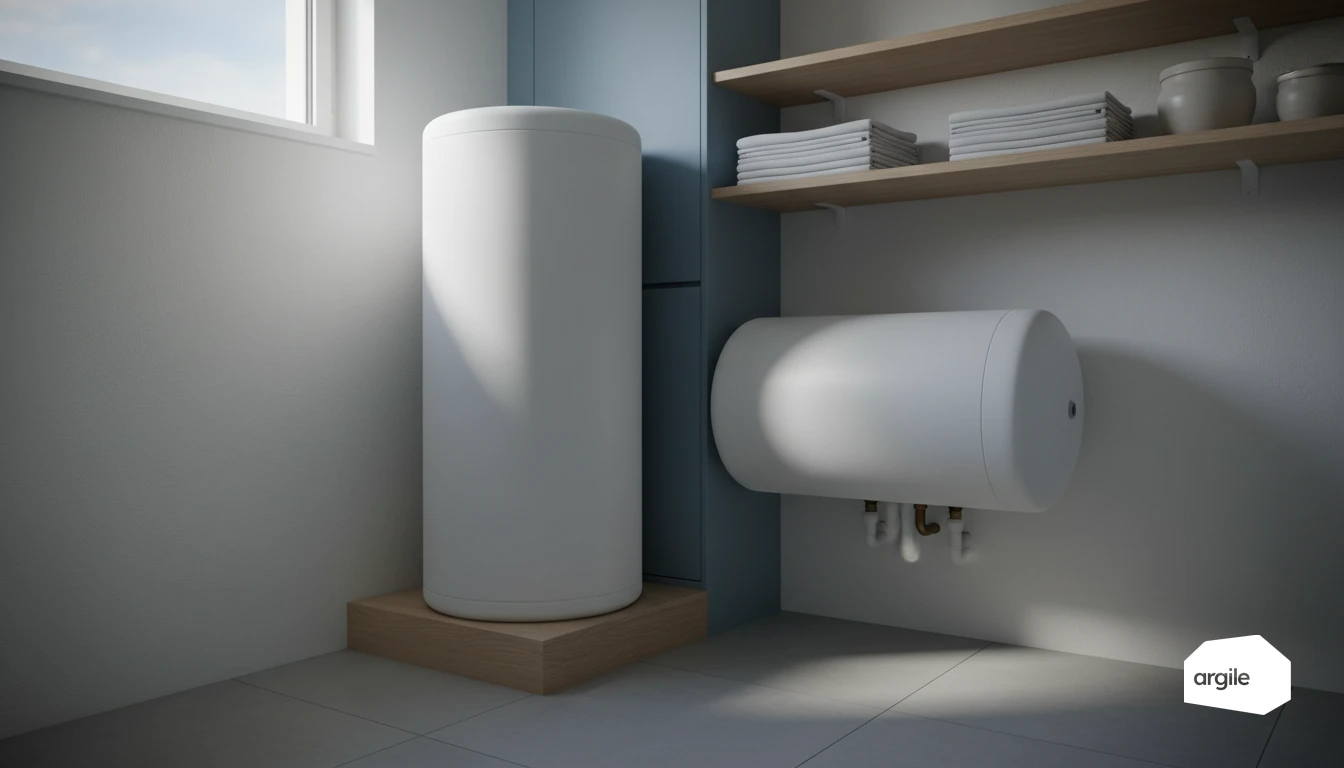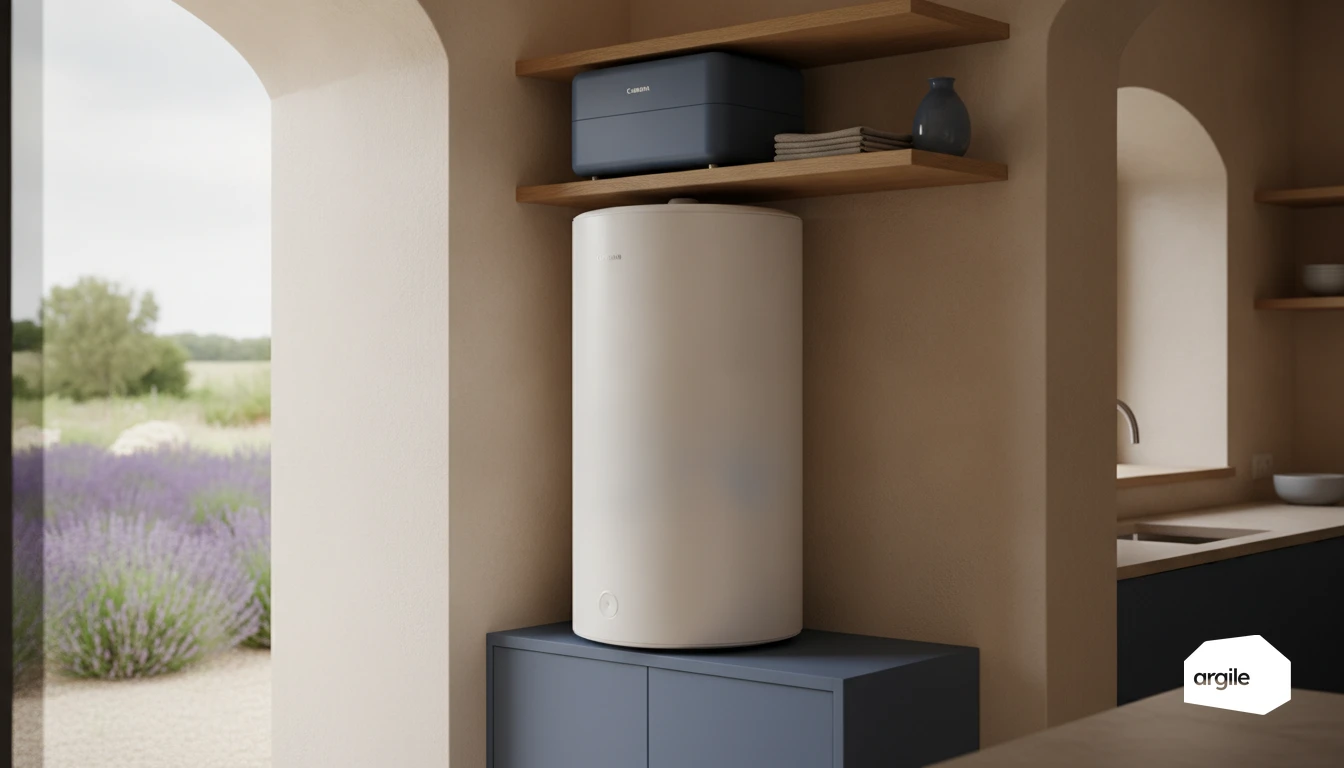
The choice between a vertical and a horizontal electric cylinder is decided by the clear height of the room, measured with the hatch open, not by the catalogue. As long as a vertical unit fits, it fits: the French EPC calculation method gives it a loss coefficient of 0.20 in category C against 0.33 for a horizontal unit in the same volume band, which is 644 against 1,063 kWh of annual losses at 200 litres. Horizontal is the answer to a room constraint, it is justified as such on the estimate, and its running-cost penalty can be quantified. The physics behind that gap is covered separately, in the article on thermal stratification in a cylinder.
The survey that decides the format
Clear height, measured rather than estimated
The dimension that settles it is not the floor-to-ceiling height but the clear height above the position, with the hatch or cupboard door open, allowing for the clearance needed above the cylinder to withdraw the anode or the element. A vertical unit that fits to the millimetre but can no longer be serviced is a deferred callback, not a successful installation.
Access and handling
Door widths, stair turns, loft hatch, distance from where the van can unload. A 200-litre cylinder is a two-person lift when empty, a 300-litre one often calls for lifting equipment or direct access. Handling constraints sometimes rule out a format before the room constraint even comes into play.
Load-bearing capacity and fixings
It is the weight when full that sizes the fixings, not the empty weight. A wall-hung vertical unit transfers a concentrated load onto two high points, a horizontal one spreads it over longer brackets but with a greater lever arm. Check the nature of the wall or floor and allow for altering the fixings when the new cylinder's centres do not match the old ones, which is the usual case on a replacement.
What the format costs when it is forced
The gap quantified by the assessment method
Annual storage losses from the French EPC calculation method, rounded to the nearest kWh.
| Volume | Horizontal | Vertical category C | Annual gap |
|---|---|---|---|
| 100 L | 628 | 403 | 225 |
| 150 L | 797 | 483 | 314 |
| 200 L | 1,063 | 644 | 419 |
| 250 L | 1,208 | 725 | 483 |
| 300 L | 1,450 | 870 | 580 |
These figures depend on neither the brand nor the insulation: the horizontal row of the regulatory table is a single row with no sub-category. The full set of rows and the formula are covered in the article on the assessment storage-loss table.
When altering the room pays
Dropping a suspended ceiling, moving a cupboard partition or shifting the cylinder into an adjacent utility room costs half a day to a day of work. Against 419 kWh a year at 200 litres, that trade-off deserves serious consideration as soon as the alteration stays light. Present both options priced rather than only one: that is what separates a technical estimate from a like-for-like replacement.
What goes into the justification
The clear height recorded, the format chosen, and the annual loss gap that goes with the forced format, three items the site survey carries into the file as the engineer documents the space and where the equipment goes. That single line protects both sides. It explains why the format was chosen if the energy assessment is revisited later, and it documents that the alternative was studied.
The electrical and hydraulic items on a replacement
The safety group and its drain
The safety group goes on the cold water inlet and must remain operable and visible after installation. Its drain connects to an accessible trap with an air break. On a horizontal unit, the available side clearance often dictates where the group can actually sit, which needs checking before ordering rather than at connection time.
The electrical supply
The cylinder connects to a dedicated, protected and earthed circuit with an accessible means of isolation, in line with the national wiring rules that also set the permitted zones in a bathroom. On a replacement, the point to watch is the condition of the existing circuit rather than the cylinder itself, particularly where an old off-peak contactor is being retained.
Reworking the connections
A change of dimensions almost always shifts the connections. Allow for extensions, for reinstating the insulation on the first few metres, and for refitting a thermostatic mixing valve on the outlet, which is required as soon as the store runs hotter than what is allowed at the tap. On that point, see also saving hot water with a thermostatic mixing valve.
Choosing the volume without reopening the format debate
The bounds ecodesign sets
Regulation (EU) No 814/2013 caps the storage volume of the small load profiles: 7 litres at most in profile 3XS, 15 litres in XXS and XS, 36 litres in S. Beyond that the declared profile changes, and the performance scale with it. Those bounds matter for isolated draw-off points, not for a dwelling's main cylinder.
Volume from the demand, not the catalogue
The volume follows from the simultaneous draws recorded during the survey and from the conventional demand of the assessment method, not from a rule per occupant. The full approach is covered in the article on DHW storage volume, which gives the formula and the regulatory bounds.
Format does not rescue a wrong volume
A correctly sized horizontal unit serves better than an undersized vertical one. The order of decisions matters: volume first, from the demand, then format, from the room, then the cylinder category, from the budget. Reversing that order produces the "not enough hot water" callbacks that nobody recovers from after installation.
Securing the installation and the handover
The survey checklist
- Clear height with the hatch open, passage widths and handling access.
- Load-bearing capacity of the support and centres of the existing fixings.
- Position and drain of the safety group, and access after installation.
- Condition of the dedicated circuit, the earth and the means of isolation.
Refilling
Isolate, drain, remove, fit the new unit, then refill with a full purge before energising. Energising before the cylinder is completely full remains the leading cause of destroying a brand-new element on a replacement. Pressure-test for leaks before closing the room back up.
What you leave with the client
Exact reference, volume, format, cylinder category and the setpoint as adjusted. That set of information is what will allow a future assessment to be completed properly and avoid a penalising default entry. The criteria that trigger the next replacement are covered in the article on water heater service life.