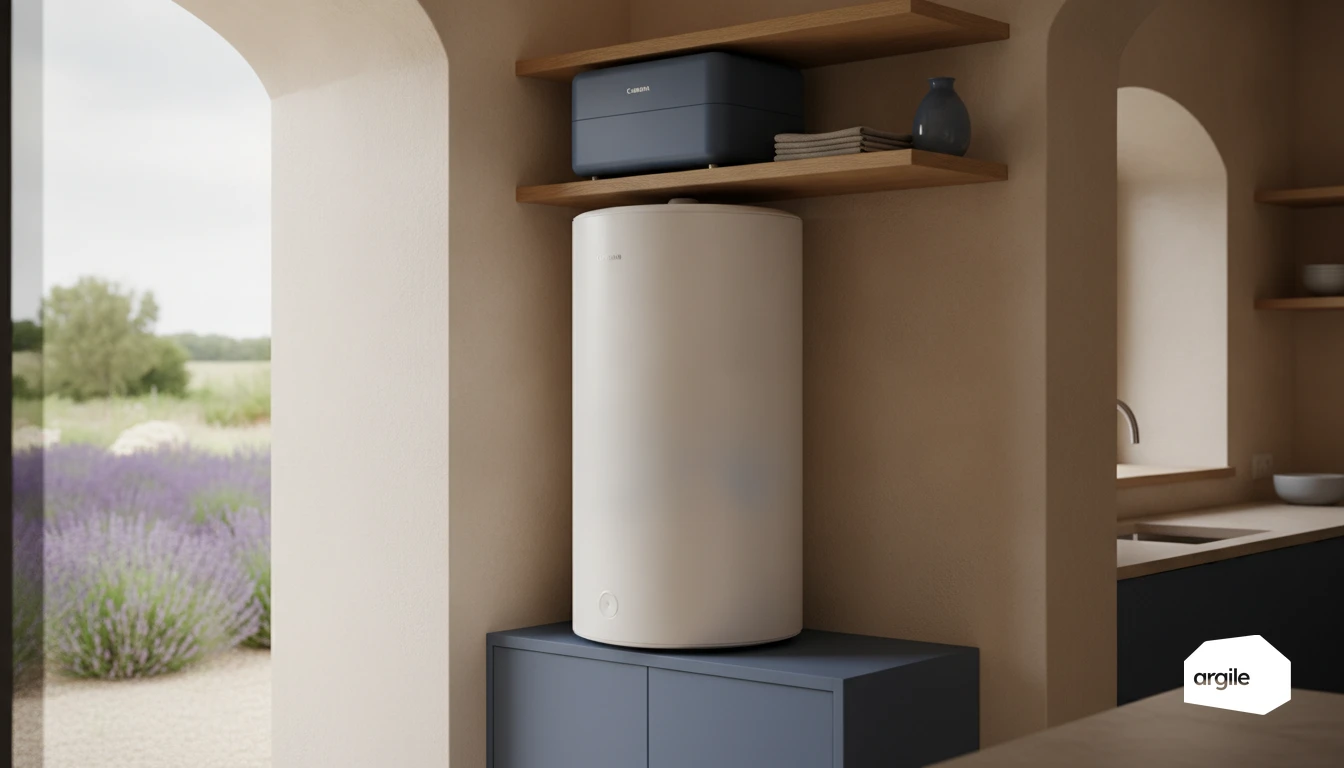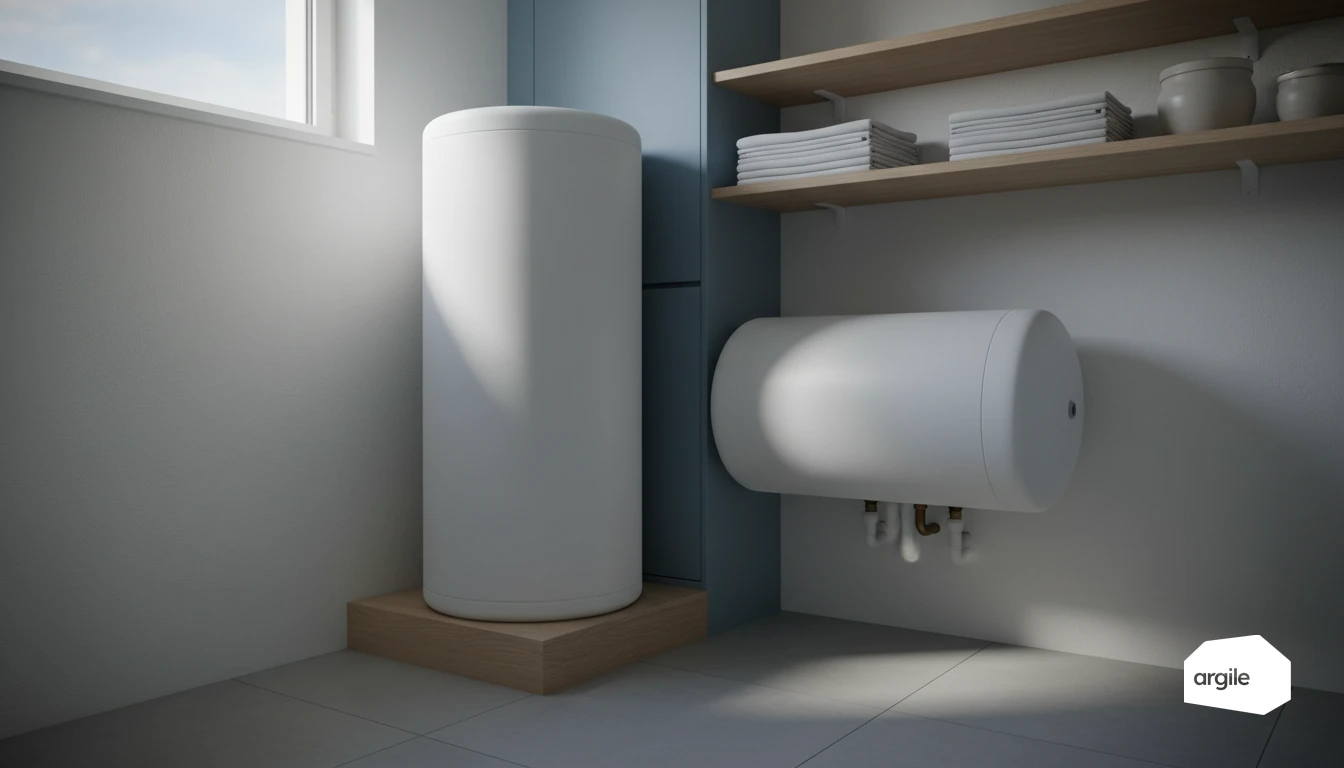
In a cylinder, hot water occupies the top and cold water the bottom. That separation into layers is what sets the temperature the generator sees at its heat exchanger inlet, and therefore its instantaneous efficiency. The French EPC calculation method translates cylinder geometry into a loss coefficient, 0.33 for a horizontal unit of 100 to 200 litres against 0.20 for a class C vertical, which works out at 1,063 against 644 kWh of annual losses at 200 litres. The 419 kWh gap comes solely from the position of the cylinder, at identical volume and identical use.
What stratification changes for the generator
The figure that matters is the temperature the source sees, not the tap
A stratified cylinder holds water close to mains temperature at its base. That is the water the heat source picks up, and the colder it is, the wider the gap to the setpoint. When the layers mix, the base warms up, the generator works against a reduced gap and its instantaneous efficiency falls away, without anything showing at the tap for as long as the top of the cylinder holds.
On a heat pump, the bottom of the cylinder drives efficiency
A heat pump or heat pump water heater performs better the lower the condensing temperature stays. A stirred cylinder forces the whole volume up to setpoint instead of recharging from the bottom, which lengthens cycles and raises the average condensing temperature. On an electric element the mechanism differs but the effect is real: power is fixed, so mixing is paid for in heating time and in the number of restarts.
What the assessment method keeps of all this
The method does not model the layers. It records the outcome and encodes it in a tabulated loss coefficient, with two geometries and nothing in between. It is a simplification, but it is the one that counts in the assessment, and it feeds straight into the calculated hot water consumption.
What the assessment puts a number on
Two geometries, two coefficients
Extract from the storage-loss table of the French method, in Wh per litre, per degree and per day.
| Loss coefficient | ≤ 100 L | 100 to 200 L | 200 to 300 L | > 300 L |
|---|---|---|---|---|
| Horizontal water heater | 0.39 | 0.33 | 0.30 | 0.30 |
| Vertical, category C or 3 stars | 0.25 | 0.20 | 0.18 | 0.16 |
The horizontal row is a single row. Unlike the vertical ones, it has no sub-category, which amounts to saying that the method treats geometry as dominant over insulation quality. The two intermediate vertical rows appear in the full storage-loss table.
The gap in kilowatt-hours
Annual losses calculated with the method's own formula, rounded to the nearest kWh.
| Volume | Horizontal | Vertical category C | Gap |
|---|---|---|---|
| 100 L | 628 | 403 | 225 |
| 150 L | 797 | 483 | 314 |
| 200 L | 1,063 | 644 | 419 |
| 250 L | 1,208 | 725 | 483 |
| 300 L | 1,450 | 870 | 580 |
The gap widens with volume, which reverses a common intuition: the larger the demand, the more the geometry weighs, whereas the instinct is to accept that a room constraint justifies everything once the litreage goes up.
What the table does not say
It says nothing about the quality of the connections, the presence of a diffuser on the cold water inlet, the charging flow rate or the position of the control sensor. Two identical vertical cylinders badly connected will behave like horizontal ones without the calculation ever seeing it. The table frames the subject, it does not replace it.
Measure stratification rather than assume it
The top, middle, bottom survey
After at least two hours without draw-off, take contact temperatures at three points up the height of the shell, on the barrel rather than on the connections. A clear decreasing profile means established layers. A flat profile means mixing, and the cause is almost always hydraulic rather than thermal.
The draw-off test
Open one outlet at a constant flow rate and measure the volume delivered before the outlet temperature drops below the target useful temperature. That is the volume genuinely available, to be compared against the cylinder's nominal volume. The gap between the two is the direct measure of what stratification is giving you.
The recirculation return
On a recirculated installation, measure the return temperature. An abnormally hot return signals that the loop is feeding energy back into the cylinder instead of offsetting pipework losses, and that it stirs the tank on every circulation. The subject is covered in detail in the article on the DHW recirculation loop.
The settings that break the layers
The charging flow rate
Too high a charging flow rate injects energy faster than the cylinder can stack it, and the incoming jet cuts through the layers instead of feeding them from the bottom. On a coil cylinder, the first thing to check is the primary circulator speed, before suspecting the vessel itself.
Sensor position and setpoint
A sensor placed too low forces the generator to bring the whole volume up to setpoint, which mechanically eliminates stratification. A sensor in the upper zone allows recharging in stages. The setpoint itself follows the real demand and the national safety limits on outlet temperature, with a thermostatic mixing valve as soon as the store runs hotter than what is allowed at the tap.
Where the recirculation returns
A recirculation return connected too close to the hot water outlet reheats the very zone that should stay hottest and destabilises the top of the cylinder. Returning it on a mid-height connection with a non-return valve, running the pump only during use periods and insulating the loop continuously are enough to remove most of the parasitic mixing.
What geometry does not solve
Volume remains the first parameter
Perfect stratification on an undersized cylinder still gives lukewarm water at the second draw-off. Geometry optimises the use of the volume, it does not create it. Sizing is settled upstream, from the simultaneous draws recorded during the survey, as covered in the article on DHW storage volume.
When the room forces a horizontal unit
The choice is not always open. Loft space, suspended ceiling, sloping roof, low cupboard: available height settles it before anything else, and it is recorded during the site survey, where the engineer documents the space and where the equipment goes. In that case the subject is no longer performance but the installation trade-off, the footprint and the fixing arrangement, covered in the article on choosing between a vertical and a horizontal cylinder. The running-cost penalty is then quantified with the table above and written into the estimate.
What to confirm before fixing the choice
- Real clear height, measured with the hatch open rather than off a drawing.
- Position of the control sensor and access to the mid-height connection.
- Charging flow rate available at the generator and circulator speed.
- Chosen setpoint and presence of a thermostatic mixing valve on the outlet.