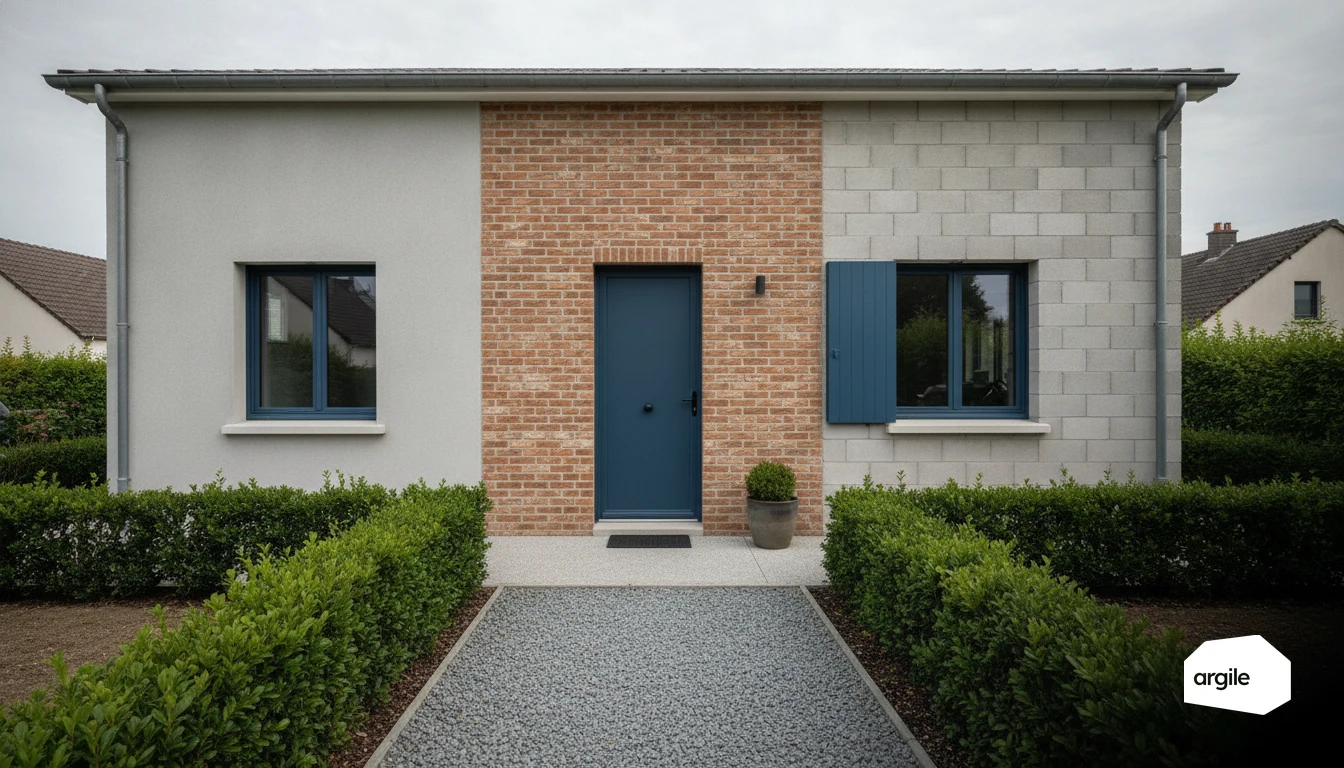
A hollow concrete block has no thermal conductivity you can use in a compliance calculation. The Th-Bat rules send masonry blocks, fired clay blocks and aerated concrete to the "Opaque walls" volume, where what is retained is a thermal resistance R for the whole block, because heat crosses the cavities by convection and radiation as much as by conduction. Lambda only describes the solid material, and the Materials volume tabulates it by dry bulk density: 1.65 to 2.00 W/(m.K) for solid concrete with common aggregates, 0.34 to 1.04 for fired clay, 0.11 to 0.25 for autoclaved aerated concrete laid after 2005. Looking up a "block lambda" therefore compares materials, not walls.
Understanding the thermal conductivity of materials on site
Conductivity, thermal resistance and thermal mass: don't mix them up
Thermal conductivity (lambda) describes how easily a material lets heat pass through it. The lower it is, the more insulating the material. Thermal resistance R, on the other hand, also depends on thickness. The same product can therefore "insulate better" simply because it's thicker. Thermal mass concerns a wall's ability to store and then release heat. That's not the same thing as blocking losses.
What makes results vary: moisture, density, cavities, mortar
On site, gaps show up quickly. Moisture increases the conductivity of many materials. Density matters too, especially for fibrous insulation. Cavities and still air are your allies. As soon as you compress, bond, or fill with mortar, you can create thermal bridges and degrade performance. That's why it pays to look at the whole system, not just the product data sheet.
In 2026, why this figure weighs more heavily in your insulation and wall choices
In renovation work, available thickness is often limited. Good conductivity lets you reach the expected resistance levels without losing too much floor area. The requirements tied to grants and compliance checks also push you toward certified materials with a stable, declared lambda value. On the ground, it's a simple figure that helps you avoid "lukewarm walls" and surprises at the end of the job.
Concrete: what conductivity really tells you in construction
Solid concrete vs aerated concrete: typical conductivity gaps
Thermal conductivity (lambda) measures how easily a material lets heat pass through it. As an order of magnitude, solid concrete is often around 1.5 to 2.1 W/m.K. Aerated concrete, depending on its density, tends to sit around 0.09 to 0.20 W/m.K. At equal thickness, the gap is clear. Lambda doesn't replace the overall calculation. Thickness, moisture and how the materials are assembled matter just as much.
Thermal bridges and insulation continuity: watch points in shell and core work
Shell and core work concentrates thermal bridges at floor/wall junctions, slab edges, balconies, tie beams and window reveals. Aim for continuous insulation. Thermal breaks, insulation returns and a clean panel layout prevent heat loss, cold walls and condensation.
When concrete still makes sense: structure, acoustics, thermal mass and associated solutions
Concrete remains strong on structure, fire resistance, acoustics and summer thermal mass. The right approach is to pair it with high-performance insulation: continuous external wall insulation (ITE), internal lining, blocks with integrated insulation, and careful treatment of junctions. You choose the materials based on the building and your site constraints.
Brick: thermal performance by material and block type
Terracotta brick: hollow brick, monomur, lining brick
In renovation work, terracotta brick performs differently depending on the material and the format. Hollow brick (often used in load-bearing walls) provides thermal mass, but its thermal resistance stays limited at typical thicknesses. Monomur brick relies on its large thickness and cavities to reduce heat loss. It's rarely enough on its own when you're targeting a good insulation level. Lining brick is mainly used as an interior facing or partition wall. It improves comfort and flatness, but it isn't insulation.
The impact of joints and installation on the wall's overall conductivity
At equal performance on paper, the real-world wall depends on the joints. Thick mortar joints, missing thermal breaks, or poorly cut pieces create fast paths for heat. Rectified bricks laid with thin joints limit these bridges. Continuity at tie beams, lintels and abutments matters just as much as the block itself.
Common cases in renovation: internal lining, ITE, treatment of window reveals
On site, the most common approach is insulated internal lining, or external wall insulation (ITE) when the facade allows it. The point that makes the difference is often the thermal bridges around the windows. Think about insulation returns in the reveals, the sills, and airtightness. A good brick wall means a continuous envelope, with no gaps of light.
Concrete block: comparing materials beyond the price per m²
Hollow vs solid concrete block: differences in conductivity and use
On paper, concrete block doesn't "insulate" much. Between hollow and solid blocks, conductivity varies with density and the void ratio. The hollow block limits heat exchange a little and remains the common choice for single-family homes. The solid block is heavier and more robust. It's mainly used for foundations, heavily loaded load-bearing walls, or areas exposed to impact.
Real-world wall performance: renders, linings, thermal breaks and installation defects
What makes the difference isn't the block alone, but the assembly. A concrete block wall becomes high-performing with continuous exterior render, a well-jointed insulated lining, and thermal breaks handling the thermal bridges. Installation defects (hollow joints, poor flatness, unfilled penetrations) quickly bring the result down.
Concrete block and energy retrofit: how to avoid bad surprises
Before starting work, check the moisture level and the condition of the render. Choose internal (ITI) or external (ITE) wall insulation based on constraints and your goals. And compare materials using the same indicator. The final thermal resistance of the whole assembly, not the price per m², is what guides a renovation that actually keeps the building warm, without pitfalls.
Choosing your materials in 2026: a simple method to decide and cost it out
Comparing for equivalent performance: conductivity, available thickness, site constraints
A wall is not compared on the lambda of its block but on the resistance of the finished build-up. On survey, record the three things that drive the price: the nature and thickness of the substrate, the clear thickness available on the inside once windows and services are accounted for, and whether external insulation is feasible given roof overhangs and planning constraints. The rest is arithmetic. Where no declared value is available from the manufacturer, the Th-Bat rules require the default value matching the bulk density, and where that density is unknown, the highest conductivity given for the material family. It is a precautionary rule that works against you if you do not document the substrate. Argile's survey flow guides those readings step by step, so that no costing input is missing.
Useful orders of magnitude: conductivity ranges by material family
To refine your comparisons, keep in mind that thermal conductivity is the basic parameter for estimating the impact of an insulation material at a given thickness, before translating that into thermal resistance R. The values below are the default design thermal values from the Materials volume of the Th-Bat rules, the ones a compliance calculation falls back on when no declared value exists.
| Material | Dry bulk density ρ (kg/m³) | Design λ (W/(m.K)) |
|---|---|---|
| Solid concrete, common aggregates | 2 000 < ρ ≤ 2 300 | 1.65 |
| Solid concrete, common aggregates | 2 300 < ρ ≤ 2 600 | 2.00 |
| Reinforced solid concrete, 1 to 2 % steel | 2 300 < ρ ≤ 2 400 | 2.30 |
| No-fines concrete | 1 600 ≤ ρ ≤ 1 800 | 1.15 |
| Fired clay, nominal bulk density 1 400 | 1 300 < ρ ≤ 1 400 | 0.50 |
| Fired clay, nominal bulk density 1 800 | 1 700 < ρ ≤ 1 800 | 0.69 |
| Fired clay, nominal bulk density 2 200 | 2 100 < ρ ≤ 2 200 | 0.92 |
| Autoclaved aerated concrete, NBD 400, after 2005 | 375 < ρ ≤ 425 | 0.125 |
| Autoclaved aerated concrete, NBD 600, after 2005 | 575 < ρ ≤ 625 | 0.20 |
| Autoclaved aerated concrete, NBD 800, after 2005 | 775 < ρ ≤ 825 | 0.25 |
Two readings stand out. Solid fired clay sits roughly three times below solid concrete, which explains its place in load-bearing walls without making it an insulant. And aerated concrete plays in another league, an order of magnitude lower, because the porosity does the work. None of these rows applies to a hollow block: for a hollow concrete block or a cellular clay block, it is the thermal resistance of the block, measured in the laboratory under EN 1745 and carried into the "Opaque walls" volume, that enters the wall calculation.
Grants and requirements in 2026: how to connect material choice, R, and the renovation project
The substrate does not decide the grant, the installed system does. The BAR-EN-102 measure requires a thermal resistance R of at least 3.7 m².K/W for wall insulation, with no distinction between external and internal work, and with no credit for existing insulation. In practice, a block wall and a clay wall call for the same insulation performance, and the argument about the block's lambda changes nothing about the threshold to reach. What it does change is the margin: on an already low-conductivity substrate, the same insulation thickness delivers a better finished wall, an argument to carry on the quote rather than in a debate about materials. Write the resistance of the system, its commercial reference and the thickness installed on the quotation, those are the three lines an inspection looks at. Argile flags on the quote the technical characteristics still missing before it goes out.