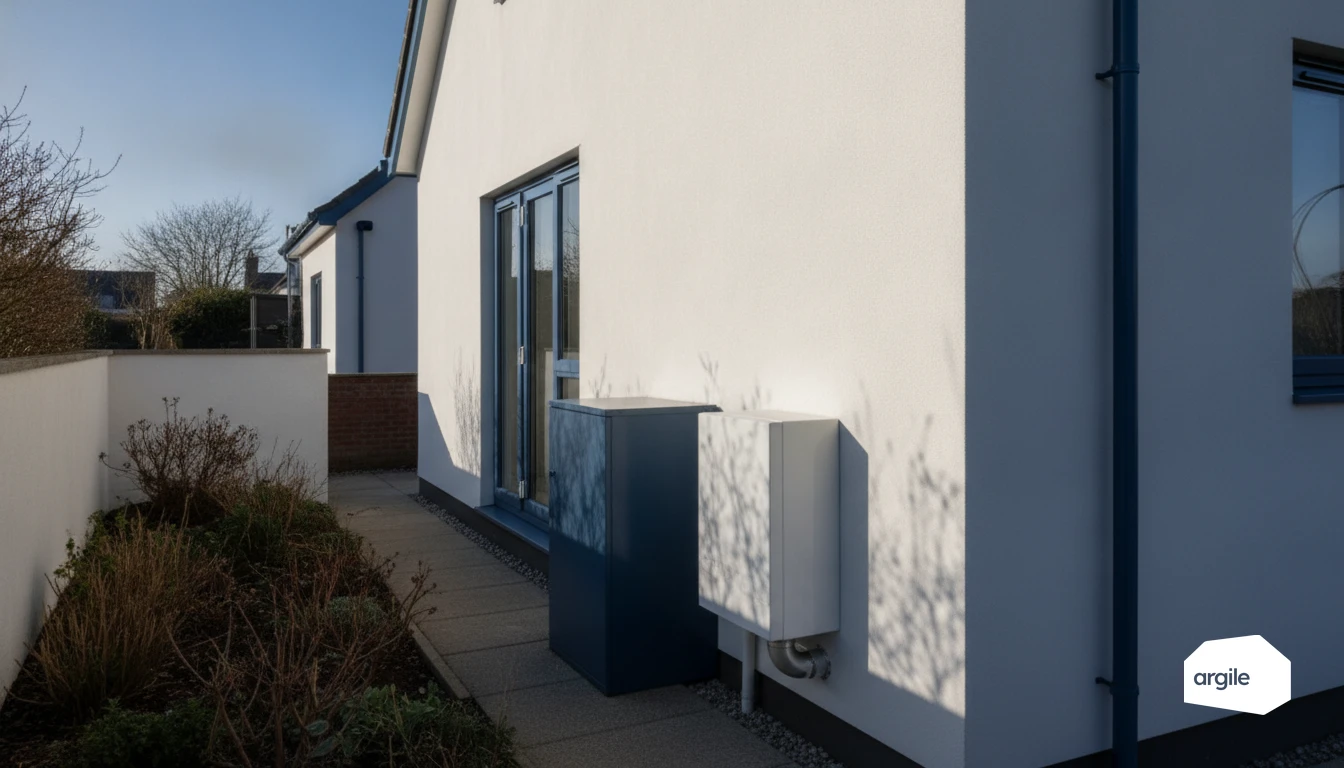
A condensate lifting station falls under BS EN 12050-2, which covers plants for faecal-free effluent, and its design is calculated to BS EN 12056-4. Two decisions carry your liability and nothing else does: the total head, which is not the vertical height, and the high-level contact, which should shut the appliance down rather than merely sound. Everything else, materials and tank access, follows from the acidity of the effluent, at pH 4 to 5.
When lifting is required, and when it is not
The only question to answer on site
Lifting is never a comfort choice. It becomes necessary as soon as you cannot guarantee a continuous gravity fall from the collection point to the wastewater connection: appliance in a basement, discharge point above the appliance outlet, or a run so long that the fall would use up all the available height.
The often-forgotten corollary: if gravity works, prefer it. A pump adds an electrical supply, a moving part, a fouling point and a possible failure in mid-season. The rules for gravity installation, fall, trap and material selection are covered in the article on sizing the condensate drain.
What the station has to cope with
The effluent is acidic, around pH 4 to 5 according to Cegibat, GRDF's technical documentation service, and it arrives lukewarm. These are not extreme conditions, but they are permanent for the whole life of the appliance. So check that the tank, the non-return valve, the float and the seals are stated as compatible with combustion condensate, and that the rated temperature covers your appliance's outlet temperature.
The standards worth citing
| Subject | Reference | What it covers |
|---|---|---|
| The station itself | BS EN 12050-2 | Construction and testing principles for lifting plants handling faecal-free effluent |
| The installation design | BS EN 12056-4 | Layout and calculation of wastewater lifting plants in buildings |
| The downstream drainage | BS EN 12056-1 | Required resistance to effluent below pH 6.5 |
Citing these on a quotation is not decoration: it is what lets you refuse the generic cellar pump the customer found on the grounds that it "does the same job".
Sizing: head, not height
The calculation, line by line
The classic mistake is to measure the vertical height between the station and the discharge point, then pick a pump rated for that height. The real duty point is somewhere else.
| Term | What you measure | Trap |
|---|---|---|
| Geometric lift | Vertical difference between tank level and discharge point | Measured at the real discharge point, not at the ceiling |
| Friction losses | Developed length of the rising main and internal bore | An undersized bore costs more head than a metre of height |
| Fitting losses | Number and angle of bends, non-return valve, connectors | Tight bends at the tank outlet are the most expensive |
| Ageing margin | Fouling of the impeller and the valve | Without margin the pump is adequate on the day and short two winters later |
The sum of the first three lines is the total head to cover, and that is the point to read on the manufacturer's curve, not the maximum printed on the box. A pump run at its maximum point delivers nothing at all.
Flow rate, and why it is rarely the issue
The volume a domestic appliance produces is modest against what any station on the market will shift. On a communal or commercial plant room, by contrast, flow becomes the governing figure and must be taken from the condensate rate quoted by the appliance manufacturer, allowing for simultaneous operation. Do not carry a domestic reflex across to a cascade of appliances.
The rising main
The rising main is sized with the pump, not afterwards. Too small a bore is paid for twice: in lost head and in fouling rate. Provide a high point above the discharge level to prevent siphoning, an accessible non-return valve, and a route that can be dismantled without breaking finishes.
Making it safe: what separates a professional installation
The high-level contact must shut the boiler down
This is the most important paragraph in the article. On a condensing boiler, condensate production does not stop because the pump has failed: as long as the appliance runs, the tank keeps filling. A station fitted with a simple audible alarm therefore turns a pump failure into water damage, unless someone is present to hear it.
The arrangement to aim for is this: the station's high-level contact wired into the appliance's external fault or safety input, so the appliance stops before the tank overflows. Test it at commissioning by filling the tank by hand, and record the test on the commissioning sheet. Without that written test, your installation is indistinguishable from one with no safety at all.
What has to stay accessible
A lifting station is opened up several times in its life. The following must be reachable without dismantling the appliance or removing finishes.
- The tank, for draining and a full rinse.
- The float or level sensor, to check it moves freely.
- The non-return valve on the rising main.
- The socket and its residual current protection.
The mistakes that come back as callbacks
Back-fall on the inlet or the rising main, undersized rising main, non-return valve fitted the wrong way round, station installed with no high point and therefore permanently siphoned, power taken from a circuit that switches off with the lights. Each is visible in thirty seconds at commissioning and costs a full visit six months later.
Maintenance and diagnosis
Routine servicing
Isolate the supply before any work. Empty and rinse the tank, remove the sludge, check that the float moves freely and inspect the valve. Refill and test by pouring clean water in: the pump should start decisively and stop without an abnormal delay. Then check the rising main, the upstream trap and the clips.
Frequency depends on how dirty the site actually is. On a clean installation with a recent appliance, one annual visit inside the service contract is enough. In an old plant room or a dusty space, tighten it up.
Reading a fault without stripping everything
A pump that will not start points to the supply, a jammed float or the capacitor. A pump that runs without delivering points to a seized valve, a crushed pipe or an exceeded head. Very short repeated cycles mean a leaking valve letting the column drop back. A smell means a fouled tank or an unprimed upstream trap. An overflow with a working pump means a blocked rising main.
What you leave with the customer
A sketch of the rising main route, the exact station references, the head selected and how it was calculated, proof of the appliance shutdown test, and what to do if the alarm sounds. That page is worth more than the invoice on the day a water damage claim is investigated, because it establishes that the safety existed and had been verified. That document stays within the customer's reach when the job documents are gathered in a dedicated client space.