Understanding low-income households' needs on the ground
Identifying the obstacles: budget, out-of-pocket costs and fear of paperwork
On site, low-income households talk about budget first. Even with ECO4 and the Great British Insulation Scheme, the out-of-pocket cost and the need to advance funds can be a sticking point. Add to that the fear of "getting it wrong" with the paperwork, the documents required, and the many different contacts involved. Your role is often to bring order to the process and to price things clearly. Pricing clearly means grants and monthly payments sit inside the costing, with the out-of-pocket cost shown before signature.
Spotting the homes most affected: energy sieves and discomfort
The most common cases involve older, poorly insulated homes, often rated F or G on their EPC. The signs are concrete: cold walls, damp, draughts, heating that runs constantly without results, and high bills. This winter discomfort guides the priorities: insulation before the heating system, then ventilation if needed. For more background on the topic, see energy sieves.
Adapting how you talk about it: concrete, educational and reassuring
Talk in steps, not "schemes". A simple action plan works: recommended work, expected savings, timeline, and who does what. Remind clients that free advice exists - the national home energy advice service, Home Energy Scotland or Nest Cymru depending on the nation - and that on a large-scale retrofit a retrofit coordinator keeps the process on track. A clear, itemised quote reassures more than a long explanation.
Setting up social and technical support throughout the job
Doing a simple diagnosis: usage, ventilation, damp, heating
Start with a site diagnosis. Ask a few questions about usage (temperatures, which rooms are heated, schedules), check the ventilation (air inlets, vents, mechanical ventilation), look for signs of damp, and note the type of heating. For low-income households, this time spent listening avoids misunderstandings and puts health and comfort first.
Building a phased work plan: prioritise insulation, then systems
Build a logical sequence. Deal with insulation and airtightness first, usually starting with the loft, then the walls and floors. Then add suitable ventilation. Once heat loss has come down, size the heating and hot water systems, a heat pump, for example, based on real data.
Securing the relationship: clear quotes, a clear schedule, regular check-ins
Create contractual clarity. Produce clear quotes, broken down lot by lot, with options and funding assumptions. To make sure you're covering everything required, base yours on clear quotes and the information that must appear on them. Share a simple schedule with key dates, access to the home, and protective measures. Plan regular check-ins, even short ones, to confirm progress, manage any deviations, and keep the job running smoothly.
2026 funding: guiding low-income households without getting lost in the schemes
Explaining ECO4 and the Great British Insulation Scheme with common real-world examples
For low-income households, ECO4 funds a package of measures according to how the household qualifies and what the property needs. The Great British Insulation Scheme sits alongside it for single insulation measures. Both are delivered by an "obligated party", an energy supplier meeting its statutory obligation, rather than paid to the household. A simple example: insulating an unheated loft plus replacing an old boiler with a heat pump. The measures are assessed together, and the funding follows the package.
Anticipating the documents needed: income, home, quotes and compliance
Prepare proof of the qualifying benefits the household receives, or the local authority's flexible eligibility declaration, proof related to the home (address, tenure), the current EPC, and detailed quotes. Also think about proof of compliance: product references, insulated surface areas, output and performance figures. The declarations are signed at the end of the job, along with the invoice.
Avoiding the mistakes that hold up applications: TrustMark, dates, invoices, scope changes
Hold-ups often come from TrustMark registration that has lapsed at the wrong moment, a measure signed off after the work started, or an invoice that doesn't match the quote. If the scope of work changes, sign an amendment before carrying it out. And keep clean dates: assessment, sign-off, signature, start of work, completion. For more on the points to watch, see why funding applications get refused.
Working with the local ecosystem to strengthen the social impact
Relying on local partners: CCAS, ADIL, charities, approved operators
To reach low-income households, work with local partners already known on the ground. The council's housing team spots urgent situations, Citizens Advice gives reliable information on rights and bills, and charities guide and reassure people. Also make use of the local authority's own retrofit schemes and their approved installers when extra support is needed.
Organising a support pathway: first contact, visit, application, job
A simple pathway prevents drop-outs: first contact and an eligibility check; a visit to scope the work and ventilation; putting together the funding application, then scheduling the job. In 2026, support from an advisor may be required depending on the project and level of funding.
Preventing sensitive situations: fuel poverty, health, overcrowding
On site, watch for warning signs: unpaid bills, a damp home, vulnerable occupants, overcrowding. Document them, alert the right partner, and offer gradual solutions. The goal is to improve comfort without putting the household at risk. A well-managed out-of-pocket cost often makes the difference. To better understand the scale and the profiles affected, see fuel poverty.
Delivering lasting results for low-income households
Ensuring quality: checking the key points (airtightness, thermal bridges, ventilation)
For low-income households, a mistake is costly for a long time. Check airtightness with a blower-door test where possible, treat thermal bridges at junctions, and confirm the ventilation is suitable (flow rates, air inlets, vents). Document with photos, product data sheets, and on-site checkpoints to secure PAS 2030 compliance and the funding.
Following up after the work: settings, good habits, maintenance and after-sales support
Performance also depends on what happens after handover. Plan a commissioning visit, some simple adjustments (temperatures, programming, balancing), and a "good habits" reminder sheet on heating and ventilation. Schedule a follow-up visit at 1 or 2 months to fix any issues, then make maintenance easy (filters, cleaning, service contracts) and ensure after-sales support is reachable.
Measuring the improvement: comfort, consumption, safety and occupant satisfaction
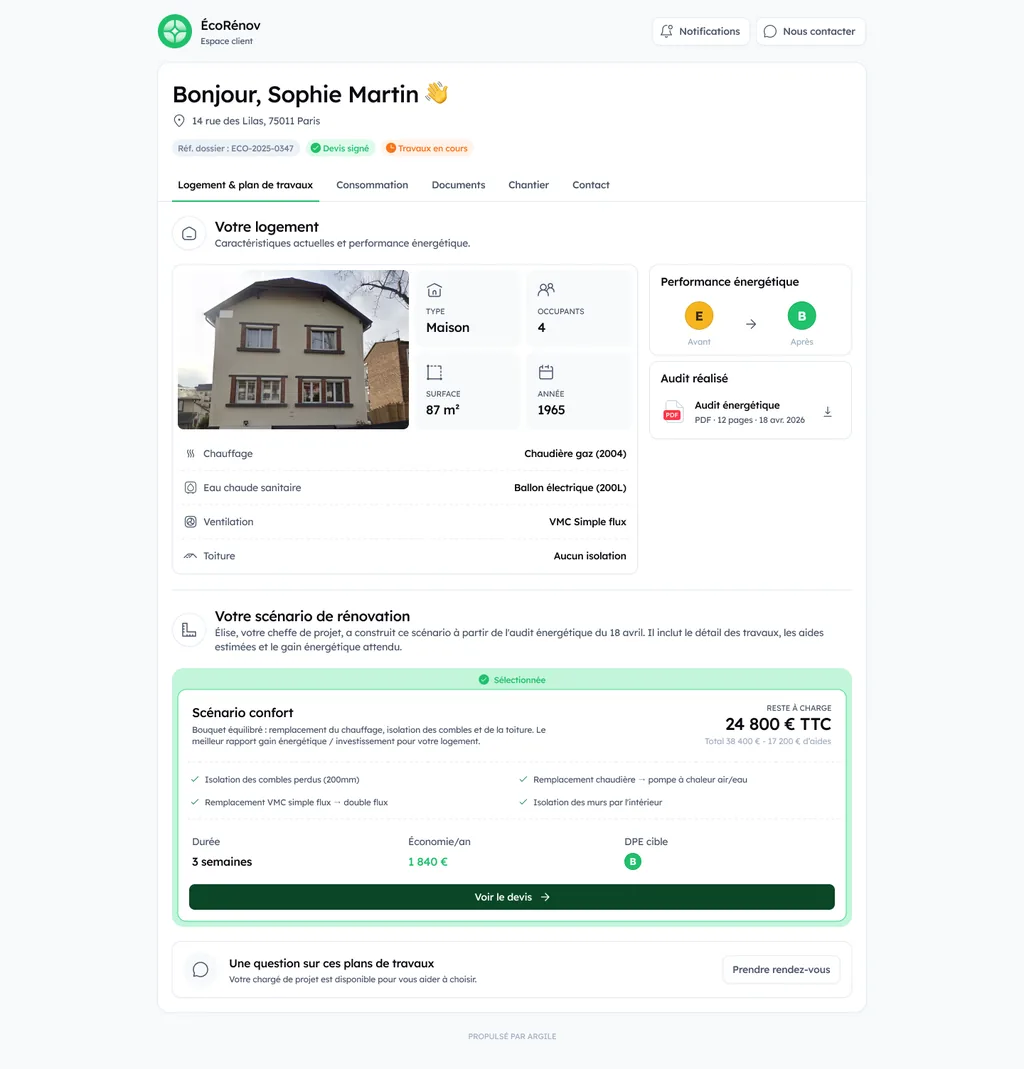
Track concrete indicators. Compare consumption before and after, adjusted for weather, and gather feedback on perceived comfort, damp, noise, and safety (CO, draught, overheating). A short occupant questionnaire and a meter reading provide useful proof and help you make adjustments if needed. That follow-up can live on the client's side, in a space where they find their documents and watch their consumption change.